Compile the law
Brazil's Forced Decisions, Ranked and Built by Agents
October 2026
Brazil writes law faster than its small firms can read it, and over the next nine months the law forces decisions with dates on them: two rest days a week, a new consumption tax, new IT rules for notaries. On Sunday 11 and Monday 12 October I ran AI agents through a search for software that a one-person firm could sell into that gap. They wrote 93 research reports, about a million words, and scored 331 product ideas on nine criteria, and by Monday noon the ten best buildable ones existed as tested software. This book sets out the ranking that came out, the method that made it, an atlas of what the search found and what it is worth to Brazil, what the products are and what their markets are worth, and the machine that searched and built, read against Cursor's account of a self-driving codebase. Every table behind it is published with it. One pattern survived all of it. Where the state forces a decision and ships no tool for it, and checking an answer costs far less than finding one, the product that sells is the law compiled into code that checks.
How to read this page. The book is cut into numbered verses: 7:12 is chapter 7, verse 12, and #7:12 after this page's address links straight to it. Beside each verse, the margin lists what the verse points to (→), the verses that point to it (←) and the chains it lies on. A chain follows one theme through the book; ‹ and › step to its previous and next verse. On a narrow screen, the + after a verse number opens its margin.
Hover over a reference to read what it points to without losing your place, or tap it once on a touch screen. Click it to go there; the back button returns you. A dotted underline marks the first use in each chapter of a word the book defines. Figures marked interactive respond to the controls under them. The appendices at the end collect the forecasts, an index of definitions, propositions and equations, a concordance of the defined words, the chains and the sources.
Part I. The ranking
0 The argument
0.1 The vote on Wednesday
0:1 On 14 October the Brazilian Senate votes the first round of PEC 221/2019, the constitutional amendment that ends the six-day working week. The Câmara passed it 461 to 19 in May. If 49 of the 81 senators approve the same text in two rounds, it goes straight to promulgation. Two months later every employer with formal staff must give two rest days a week and cap the week at 42 hours, and twelve months after that the cap falls to 40. Brazil last shortened the legal week in 1988, from 48 hours to 44.
0:2 The Labor Ministry counts 14.8 million formal workers on six-day schedules, and 37.2 million on 44-hour weeks, out of 50.2 million. Each of their rosters has to be rebuilt against rules most managers have never read: 11 hours between shifts, a weekly rest of 35 hours, in commerce a Sunday off at least once every three weeks, and a night hour that counts as 52 and a half minutes. The state will publish the amendment. It won't publish a single roster.
0:3 That asymmetry runs through the whole book. The Brazilian Institute of Planning and Taxation (IBPT) counted 8,222,427 norms issued between the 1988 Constitution and September 2025, or 609 a day. Of those, 541,680 were tax norms, about 40 a day, and 37,686 are still in force. Now the consumption-tax system is being replaced as well: CBS takes over from PIS and Cofins in January 2027, and IBS phases in until 2033.
0.2 What the search found
0:4 The agents wrote 93 research reports, 1,020,164 words in all, and filled a card for every product idea they found: buyer, price, delivery, a revenue estimate with its method shown, and nine scores. The 331 scored variants merged into 220 product families. Five findings carry the rest of the book:
- Four families reached TOP: a roster builder for the end of the six-day week (4.00), a writer for the descriptive reports preschool teachers owe each child (3.85), numerology and astrology charts (3.80), and dated planner pages for stationery shops (3.80). Forty-four more reached GOOD.
- Money and a dated reason to buy separated the winners from the losers. Bureaucracy barely did, because the briefs threw out heavy ideas before anyone scored them.
- The money sits in a long tail. No family's base case reaches R$3 million over 24 months; the 220 together add up to R$66 million, and more than three-quarters of it lies in families worth less than R$1 million each.
- The products that score well are checkers. They take a proposed answer, such as a roster, a bid price or a quoted article, and return the rules it breaks, each with the source that says so.
- Building is now cheap and selling is not. At base benchmarks the main ad channels at best break even on a R$97 product, so distribution becomes a search of its own, with a stopping rule.
0.3 Ten products by Monday noon
0:5 The ranking was done at 03:05 on Monday and the ten products to build were chosen at 03:12. By 11:57 twelve build branches had produced a shared storefront and ten products: six local-first web apps and four with a small cloud service of their own. They carry 1,041 tests, 856 for the products and 185 for the storefront, and all of them pass. None is on sale yet. The storefront is deployed without public routes, and the products wait in preview or waitlist mode. Their code is free under the MIT licence (Appendix D). Chapter 11 describes each one, and §3.4 says what they would be worth if each found buyers at a price that pays for its ads.
0:6 The machine that did this had the shape Wilson Lin describes in "Towards self-driving codebases", Cursor's account of a harness that ran thousands of coding agents on one project for a week. A planner owns the goal and writes no code. Workers own one task each, in their own copy of the work, and never talk to each other; each sends one handoff back to the planner that assigned the task. His system peaked at about 1,000 commits an hour. Mine was small enough to show where such a system waits. In the 17.3 hours of research, some agent was running for 4.4 of them. For the other 12.9 nothing ran, mostly on Sunday, until I had written the next brief. Chapter 14 reads the two harnesses side by side.
0:7 The thesis, in Ashby's language, is that the small firm lacks requisite variety and the product is an amplifier (Proposition 9.1). AI makes the amplifier cheap to build. The part that sells isn't the language model. It is the law, compiled into code that checks, with a model in front to propose and explain.
1 The ranking
1.1 The top fifteen
1:1 The ranking scores product families. A family is one product sold to one buyer, with its offline, hybrid and cloud variants merged, and it takes its best variant's score (Definition 2.3). The scores come from the rubric of §2.3: nine criteria from 1 to 5, weighted toward money, salesability and bureaucracy, with TOP from 3.8 and GOOD from 3.3. The money column is the base case, the card's central estimate of gross revenue over the first 24 months (Definition 3.1).
| # | Family | What it does | Score | Base, 24 months |
|---|---|---|---|---|
| 1 | Escala Certa | builds and checks staff rosters for the end of the six-day week | 4.00 TOP | R$2.86M |
| 2 | Kit Professora | writes the descriptive report each preschool child gets | 3.85 TOP | R$1.85M |
| 3 | Estúdio de Mapas | numerology and astrology charts for practitioners and their clients | 3.80 TOP | R$0.84M |
| 4 | Agenda Pronta | dated planner pages that stationery shops print and sell | 3.80 TOP | R$0.47M |
| 5 | Ficha & Termo | client forms and consent terms for beauty clinics | 3.75 | R$1.20M |
| 6 | Preço de Licitação 2027 | public-bid prices with CBS and IBS for each year to 2033 | 3.75 | R$1.00M |
| 7 | Reajuste da Reforma | accountants' fee repricing, letters and contract addenda | 3.75 | R$0.79M |
| 8 | Família Lote | badges, certificates and check-in for events, in bulk | 3.75 | R$0.61M |
| 9 | Dossiê 213 | IT-compliance evidence for notary offices | 3.70 | R$2.28M |
| 10 | Consultor da Reforma | reform answers that cite the article, or refuse | 3.70 | R$1.17M |
| 11 | Corretor de Discursivas | grades bar-exam and civil-service answers against the official rubric | 3.70 | R$0.86M |
| 12 | OS Nuvem | repair-shop service orders with a status page for each customer | 3.70 | R$0.46M |
| 13 | Tabela Fiscal Viva | tax-classification tables for the new invoices, kept current | 3.70 | R$0.40M |
| 14 | Raio-X da Carteira | the reform's effect on every client of an accounting firm | 3.65 | R$1.29M |
| 15 | Minha Obra | budget and spending for a home building project | 3.65 | R$0.66M |
1:3 Two of the four TOP families answer a dated obligation. The roster builder exists because of PEC 221. The report writer exists because Brazilian law requires preschools to issue documentation of each child's development and learning (LDB, art. 31), which teachers write as a descriptive report on each child, with the heaviest season in November and December. The other two won on money, salesability and season. Numerology practitioners pay for charts all year, and stationery shops buy dated planner pages from October to January. The thesis explains the GOOD tier better than the very top (16:2).
1:4 Ranks 5 to 15 split the same way. Six of the eleven are forced by the tax reform or a regulator: bid prices, fee repricing, the notary rules, cited reform answers, classification tables and the portfolio diagnosis. The other five sell a routine chore done faster: beauty-clinic forms, event badges, exam grading, repair-shop orders and building budgets.
1.2 The whole distribution
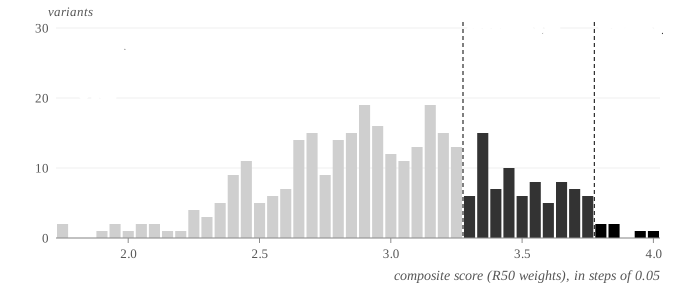
1:6 Of the 331 variants, 247 scored NO, 78 GOOD and 6 TOP. Grouped into families, 4 reached TOP and 44 GOOD, so 48 of the 220 families are worth building on the scores alone; ranks 49 and 50 are the best of the NO. The full top 50 is in Appendix A.
1:8 Every best variant in the top 50 was written in the last two waves of the search: thirty-one in the fourth, which covered the tax reform, the non-tax regulatory calendar and products with a light cloud part, and nineteen in the third, which went deep into niches. Fifteen of the fifty exist only because of the consumption-tax or income-tax reform. Four need a domain of their own before they can be advertised, and two more might (§13.5).
1.3 From fifteen to ten
1:9 Two rules turned the top fifteen into the ten to build. The first skips any family that can't live on the main domain without putting every other product's advertising at risk. Meta classifies whole domains for health and religion, and an esoteric or health product would get the domain classified (§13.5), so the astrology charts and the beauty-clinic forms wait for domains of their own. The second caps the products sold to accountants at two, because they compete for one buyer's budget. It kept fee repricing and the reform consultant and dropped the classification tables.
1:10 The same domain rule trimmed two of the ten. The report writer ships without its module for special-needs plans, whose pages would name autism and ADHD, and the event kit ships without its church editions. Next in line are the classification tables, the portfolio diagnosis, the building budget, kitchen date labels for a state food-safety rule that starts on 1 February 2027, and an anti-money-laundering kit for the declaration accountants file every January.
1.4 The graves
1:11 Most ideas died, and they fell into a few graves. Anything that competed with a free official tool died. When Receita Federal began issuing alphanumeric CNPJs in July, it published the check-digit rules, and free validators followed. Reform courses died the same way, after a free course from Receita and the accounting council enrolled more than 50,000 people. Ideas that needed a customer's government login died, and so did time-clock software, which needs its own registration and attestation. Anything that put health or children's data in my cloud died. Psychosocial-risk surveys under the NR-1 rule died twice: the Supreme Court suspended the fines until about 23 December, and at least five SaaS tools already sell the surveys.
Part II. The method
2 The search
2:1 The ranking is the output of a search in four waves of agents, with one card per idea, one rubric and one merge rule. Each piece can be checked, and most of the method is in the checks.
2.1 Four waves
2:2 Each wave answered a brief, and each brief set a different objective. The times are local, on Sunday 11 and Monday 12 October.
| Wave | Ran | Reports | Words | What the brief asked |
|---|---|---|---|---|
| 1 | Sun 09:33–10:34 | 30 | 344,730 | map the market for software a small firm buys online and runs on its own machine, Mercado Livre first |
| 2 | Sun 23:20–Mon 00:51 | 27 | 223,214 | validate about 18 finalist families, design each product and forecast its sales |
| 3 | Mon 01:00–02:34 | 19 | 264,650 | zero-maintenance software sold with paid traffic: niches, ads, checkout, sales pages, marketplaces |
| 4 | Mon 01:45–02:48 | 17 | 187,570 | products with a light cloud part, the tax-reform gap, and a top 50 under one rubric |
| Re-score | Mon 02:00–02:53 | 10 | the third wave's niches scored again under the fourth wave's rubric |
2:4 The first brief assumed what the sellers on Mercado Livre sold: installed programs, paid once, with the data on the buyer's machine. Its 30 reports produced 208 cards, and the second wave turned the best of them into finalists. The third brief replaced the operating model outright: downloads only, no maintenance, almost no support, growth bought with ads. The fourth, written at 01:37 after I allowed products with a small cloud part, asked for the most money with the least bureaucracy and introduced the rubric the ranking uses. Waves three and four overlapped, and the re-scoring pass ran beside them, so that the third wave's cards and the fourth's shared one scale.
2:5 The agents worked only from public evidence: Mercado Livre listings and their archived review counts, search-engine autosuggest, Hotmart and Kiwify catalogues, app-store reviews, company counts by activity code (CNAE), regulators' pages and the official gazette, and archived copies of competitors' pages. One tally of search suggestions alone reached 37,796. Every scripted fetch went through one shared, rate-limited fetcher, at most 150 scripted queries per agent, and the rules forbade bypassing a login, a paywall or a captcha.
2.2 The card
Definition 2.1 (Card). A card describes one product idea in a fixed template: the buyer and the size of the pool of buyers, with its source; the job, and the trigger or deadline that makes it urgent; dated demand evidence; competitors and the free alternative, with prices; a minimal product and its stack; the bureaucracy it touches; what must be updated, by whom and how often; a sales plan with an acquisition cost and its method; a money estimate with low, base and high cases; and nine scores.
2:7 The template made 331 cards from 22 different agents comparable. Observed data carried a date and a source and estimates carried a method, so a card's weakest number is visible on the card.
2:8 The bureaucracy score counts nine kinds of exposure, each rated by severity:
- fiscal documents issued inside the product, which need the customer's digital certificate and state or municipal credentials;
- a sector regulator's approval: ANVISA, the Central Bank, CVM, SUSEP, ANATEL, INMETRO, or the Labor Ministry for time clocks;
- a professional council's rules, for medicine, psychology, law, accounting, real estate, engineering or nutrition;
- sensitive personal data in my cloud: health, minors, biometrics, finances;
- dependence on government systems, logins, certificates or data licences;
- moving or holding customers' money;
- platform approvals, such as WhatsApp's business API, the app stores or restricted ad categories;
- liability for professional outputs, such as a tax, legal or engineering conclusion;
- partners, resellers or public procurement needed to make a sale.
2:9 Some ideas never needed a score. Illegal or grey categories, software that ANVISA would treat as a medical device, betting, holding customers' money without a regulated partner, WhatsApp automation that breaks Meta's terms and anything near piracy were NO whatever their numbers. Hard exclusions worked better than advice, the same lesson Cursor drew for its agents (14:18).
2.3 The rubric
Definition 2.2 (Composite score). A card scores nine criteria from 1 to 5, where 5 is best for the seller. Its composite is their weighted mean, with weights that sum to 100: money 20; salesability and bureaucracy 15 each; operations, recurrence, speed and asymmetry 10 each; durability and risk 5 each ((2.1)). A composite of 3.8 or more is TOP, 3.3 to 3.79 is GOOD, and anything lower, or any hard exclusion, is NO.
| Criterion | Weight | 5 means | 1 means |
|---|---|---|---|
| money | 20 | base case of R$3M or more over 24 months | under R$150k |
| salesability | 15 | strangers buy online without talking to anyone, and acquisition costs at most 30% of first-year revenue | needs sales calls or procurement |
| bureaucracy | 15 | none of the nine exposures | several severe ones |
| operations | 10 | no human support and no rule updates by hand | continuous compliance tracking and support for each customer |
| recurrence | 10 | most revenue recurs with low churn | a single purchase |
| speed | 10 | first sales within two weeks | more than four months |
| asymmetry | 10 | a concrete reason to win now: a deadline, a reform gap, incumbents' pricing | none |
| durability | 5 | demand lasts five years or more and clones can't erase margins quickly | under a year |
| risk | 5 | low legal, liability, platform and ad-policy risk | high |
2:13 Money is scored in bands of the base case: 4 from R$1 million, 3 from R$400,000 and 2 from R$150,000 over 24 months. No family reached 5, so for every family a fifth of the composite tops out at 4. Every composite in the scoreboard recomputes exactly from its nine scores, the cheapest check in the whole method.
2.4 What separated the winners
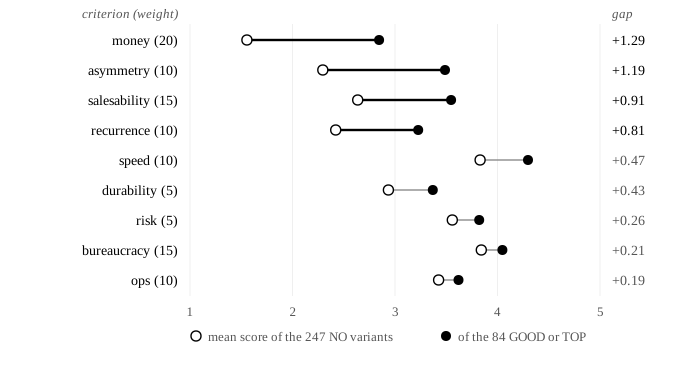
2:15 What separated winners from losers matters more than the winners. Money had the largest gap, 2.85 against 1.55. Then came asymmetry (3.49 against 2.30), salesability (3.55 against 2.64) and recurrence (3.23 against 2.42). Of the 41 families scoring 4 or 5 on asymmetry, 27 made the top 50. A reason to buy now was worth more than any feature.
2:16 Bureaucracy barely separated them, at 4.05 against 3.84, and the reason is the method, not the world. The briefs had already thrown out most ideas that needed a regulator's approval or held customers' money, so the ideas that reached a score were all light. A criterion the search filters on before scoring stops predicting anything after it, which is Berkson's paradox inside a rubric.
2.5 Families
Definition 2.3 (Product family). A family is one product sold to one buyer: all its variants, offline, hybrid and cloud-light, and any duplicate cards that other agents wrote for it. Its score is its best variant's composite and its money is its largest variant's base case, never a sum. Families rank by score, with ties broken by money.
2:18 The 331 variants merged into 220 families, plus one module and one distribution channel that are not ranked. Two scores were cut by hand, both for free alternatives the scoring agent had missed: a bank-statement converter lost 0.30 and an AI photo-culling tool 0.55.
2:19 Duplicate cards are a free cross-check. Two agents working on different topics wrote the roster builder independently, one as Escala Certa and one as Escala Nova 40h, and both ranked it first. The duplicate also explains the largest number in the top fifteen: the family's R$2.86 million belongs to Escala Nova's card, while Escala Certa's own card has a base of R$1.59 million. Four of the ten build families take their money from a variant other than their best-scoring one, so the ten sum to R$12.35 million at family level and R$10.33 million at the variants that set their scores.
2.6 Shaking the weights
2:20 The weights are a judgment, so the ranking should survive other judgments.
Experiment 2.1 (Shaking the weights).
Setup: the 220 families re-ranked by their best variant under 1,000 random weightings, with ties broken by money, as in Definition 2.3.
Parameters: near the rubric, a Dirichlet distribution centred on the rubric's weights with concentration 50, so that a weight typically moves by a third of its value; anywhere, weightings drawn uniformly from all weightings that sum to 100; one fixed seed.
Result: near the rubric, Escala Certa ranks first in 88% of draws and in the top three in 97%; the four TOP families stay in the top ten in 95 to 100% of draws; ranks five to eight stay in it in 67 to 71%; Dossiê 213 and Consultor da Reforma in 41 to 44%, though both stay in the top twenty in 92%. Under any weights, Escala Certa is first in 35% of draws and in the top ten in 87%, Agenda Pronta stays in the top ten in 90%, and Consultor da Reforma makes it in 8%.
Shows: the top of the ranking is a fact about the products, and the bottom of the build list is partly a fact about the weights.
3 Market size
3:1 Every base case in the ranking is a Fermi estimate: a pool of buyers, the share that pays, and what each payer is worth over 24 months. One at a time the estimates are small, and together they come to R$66 million across 220 families, most of it in a long tail of products that no company would staff.
3.1 The Fermi chain
Definition 3.1 (Base case). The base case of a card is its central estimate of gross revenue over the first 24 months, written as a chain of factors with a source or a method for each ((3.1)). It comes with a low case, a high case and the probability the card's author put on the base, which most cards set at 30 to 35%.
3:4 Here is the pool of possible buyers, counted from a public source; is the share of the pool that pays within 24 months, the reach of the channel times its conversion; and is the revenue per paying buyer over the period, which folds in renewals, add-ons and churn. Five of the ten build cards, as their authors wrote them:
| Card | Pool | Payers in 24 months | Share | Revenue per payer | Base (low to high) |
|---|---|---|---|---|---|
| Escala Certa | 1.0 to 1.5 million establishments on six-day or 12x36 rotations | 2,830 | 0.23% | R$563 | R$1.59M (0.50 to 3.93M) |
| Kit Professora | about 800,000 teachers who write descriptive reports | 9,500 annual plans | 1.2% | R$194 | R$1.85M (0.68 to 4.24M) |
| Dossiê 213 | 13,567 notary and registry offices | 714 | 5.3% | R$3,199 | R$2.28M (0.55 to 4.77M) |
| Consultor da Reforma | 101,880 accounting firms | 1,420 subscribers at month 24 | 1.4% | R$823 | R$1.17M (0.42 to 3.17M) |
| Preço de Licitação | about 150,000 bidding firms | 2,250 first-year licences | 1.5% | R$311 | R$0.70M (0.18 to 1.80M) |
3:7 The chains differ most in the share. A notary office is a buyer with a deadline, a regulator and a budget, so its card assumes one office in twenty buys; a teacher has a season and a small budget, and her card assumes about one in 85; the roster card assumes one establishment in 440. The pool is the easiest number to source and the share the hardest, and a factor of two in the share is a factor of two in money, which is why the low and high cases sit a factor of three to ten apart.
3.2 Calibration
3:8 The shares were anchored to sales that can be observed. Mercado Livre shows reviews, not sales, so the search calibrated one against the other: about one review for every 8 to 20 sales on listings that accumulated reviews in 2023 to 2025, one for every 34 to 42 on older review stocks, and as few as 2 to 5 sales a review on small niche listings. The best software listing on record, SMB Store's point-of-sale system built on Microsoft Access, went from 2,321 to 11,478 units between August 2019 and December 2022 at R$58.90 to R$68.95, about 200 to 250 units a month. That is the ceiling one listing has reached, and it caps any card that assumes a marketplace alone.
3:9 Marketplace demand is winner-take-most: the top three listings on a results page hold a median 60% of its reviews, and a median 60% of listings have none. Search suggestions say what buyers type, which is rarely what sellers write. They search "sistema para", "programa para" and "app para" a trade, often with "grátis". "Sem mensalidade", the seller's favourite phrase, appeared once in 7,501 suggestions and "vitalício" never. Free alternatives are the competition, not pirates: 4 of 37,796 suggestions looked for a crack, and 11.6% asked for something free.
3.3 The long tail
3:10 Across the 220 families the base cases sum to R$66.1 million over 24 months. Only ten families reach R$1 million, and 77% of the total lies in families below it. The median family is worth R$212,000 and the median top-50 family R$602,000. It takes 38 families to cover half the total, and the top 50 hold R$36.0 million, 54% of it.
3:11 The score and the money are correlated, 0.61 between the composite and the logarithm of the base case, partly by construction, since money is a fifth of the score. The rest of the correlation is the finding of §2.4: the ideas with a dated reason to buy are also the ones with buyers.
3:12 No single product here is a company. The numbers describe a portfolio of small products, each sized by a forced decision or a season, sold through one storefront under one stopping rule. A market made of tails needs two costs near zero, building and upkeep. A self-driving codebase supplies the first, and §14.8 argues it can supply the second.
3.4 The ten as a portfolio
3:13 The ten build families add up to R$10.33 million at the variants that set their scores, about R$430,000 a month over two years. That is a sum of central estimates, each of which its card gave roughly a one-in-three chance, and it leans on two products: Dossiê 213 and the roster builder are 38% of it. If the Senate shelves the amendment, the roster card falls to about R$0.74 million on ordinary CLT scheduling demand.
3:14 What the ten are worth depends on one number per product that nobody knows yet, the true cost of acquiring a buyer. Every card assumes its channel works at the acquisition cost it states. The stopping rule finds out for about three break-even acquisition costs of ad spend per product (Experiment 13.1): about R$250 at R$97, R$382 at R$147 and R$792 at R$297. Testing all ten once costs on the order of R$5,000 of ads, against 60 agent-hours to rank them.
3.5 When code is free
3:15 Cursor's harness measures supply: about 1,000 commits an hour from thousands of agents. In a market of 220 tails, supply stopped binding the moment one agent could write the app. Inference costs R$0.003 to R$0.17 a use in these products, at most about 7% of the price; cloud speech recognition costs about R$0.16 an hour of audio; hosting runs R$0.14 to R$0.53 a customer a month at a thousand customers. The marginal cost of the product is close to zero, and so is the cost of the next competitor's.
3:16 The search saw that competitor arriving. All 20 AI niches it checked already had Brazilian entrants or a free official equivalent: at least ten reform question-answering tools, nine bid-notice analyzers and six tools for contesting traffic fines. Hotmart banned AI-generated downloadable programs in September, and new software listings there still tripled, to about 15 a day. Clone factories had already failed on Mercado Livre before the agents arrived: one seller ran 77 listings that gathered 103 reviews in total.
3:17 So when code is free the size of each market is set by the pool and the share, and the share is set by things that don't clone. A date: being in the auction the week the decision is forced. A check the buyer can see: citations, tests, a free simulator. Distribution assets: a domain with an ad history, a list of past buyers, reviews. And freshness, a rule set kept current while the law moves. Entry competes the rest of the surplus into the ad auction, which is why the auction, and not the code, is where Chapter 13 spends its attention.
Part III. The atlas
4 The asymmetries
4:1 The 93 reports end in summaries, and the 1,008 numbered points of those summaries are the search's evidence. Each one was classified by the kind of asymmetry it reports, out of fourteen kinds. Dated obligations, prices that don't fit small buyers and costs that collapsed open markets; platform rules, risk and the price of a customer close them. Within each wave, the families that came from reports with a forced decision in them reached the top fifty more often than the rest.
4.1 Fourteen kinds
Definition 4.1 (Asymmetry). An asymmetry is a gap between what a change in law, prices or costs makes necessary or possible and what the state and the market have built for it. A report has found one when it can say who faces the change, how many they are, what they can use today and when the gap will close.
4:3 Each numbered point of a report's summary became a finding, with the references it cites resolved to their URLs. A language-model pass read the 1,008 findings under one written specification and gave each a primary kind and at most one secondary kind from the fourteen, a polarity (opening, wall or context), the personas it concerns, the date it forces when it names one, the main kind of evidence behind it, and a strength from 1 to 3, where 3 means quantified, sourced and directly actionable. The specification is published with the data (Appendix C), so another model can redo the labels and the two can be compared.
| Kind | What a finding of this kind reports | An example from the reports |
|---|---|---|
| forced-decision | a law, regulator or deadline forces a decision on a counted population | software sold under licence needs a service invoice with CBS and IBS fields from 1 December 2026, and Mercado Livre's free invoicer issues only goods invoices (F0013) |
| missing-tool | no adequate tool exists for a forced job, or a free one has set the price at zero | a supplier's choice of the hybrid regime is visible only to the supplier, so its buyers must ask each one (F0827) |
| price-gap | incumbents' prices or packages don't fit small buyers | professional design and CAD licences cost 6 to 64 times gray copies, against a revealed budget of R$80 to R$600 paid once (F0077) |
| demand-signal | measured demand: searches, marketplace sales, downloads, paying buyers | the leading commerce-software listings on Mercado Livre sell an estimated 10,000 to 35,000 licences a year (F0019) |
| supply-gap | supply is absent, outdated, badly rated or not in Portuguese | software for drink shops, auto parts, pharmacies, greengrocers and stationers has no reviewed leader on Mercado Livre (F0027) |
| localization | a product proven in one country has no equivalent in another | Mexico's point-of-sale software on Mercado Livre has half Brazil's review volume at 1.8 times the dollar price (F0407) |
| channel | a distribution route is cheap, underused or decisive | 82% of small business owners sell through WhatsApp, and CADE has kept third-party AI chatbots allowed on its API (F0048) |
| platform-rule | a platform's rule or fee opens or closes an option | Mercado Livre gives third-party sellers no digital delivery and one post-sale message of 350 characters (F0004) |
| cost-collapse | building, running or serving got cheap | permissive open-source libraries now read CorelDRAW, embroidery and DXF files, and only DWG still needs a paid membership, from US$3,000 (F0083) |
| verification | checking an answer is cheaper than producing it | code that models write for fiscal documents most often gets the signature algorithm, one-cent totals and the 2026 rules wrong, mistakes a test suite catches (F0388) |
| data-access | open data or a public API can become a product | the national judicial gazette's public API lets a desktop app collect a lawyer's publications free, the core of tools that charge R$57 to R$1,249 a month (F0319) |
| unit-economics | acquisition, conversion, refund, churn or fee facts that decide viability | a R$68.90 sale on Mercado Livre nets R$48 to R$54 before ads, and an ad-driven sale costs R$20 to R$33 (F0028) |
| risk | legal, platform, fraud, piracy or support risk that blocks an idea | WhatsApp won all 11 suits it brought in state business courts against vendors of mass-messaging tools, with damages of R$30,000 to R$150,000 (F0046) |
| population | the size or structure of a buyer population | 40% of the MEIs active today opened in 2025 or 2026, so most buyers are buying their first system (F0160) |
4.2 Openings and walls
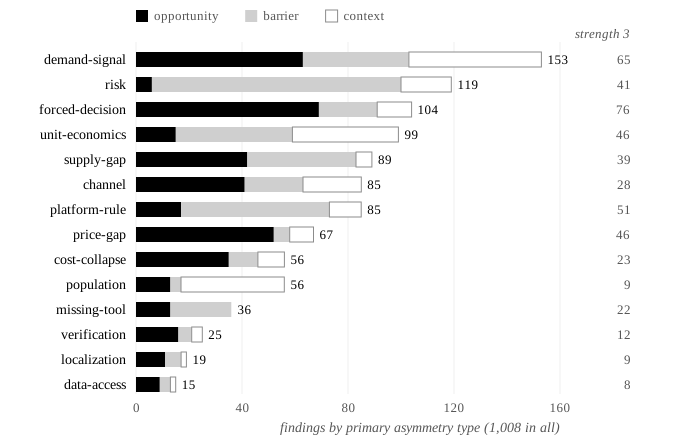
4:6 Polarity splits the kinds in two. Of the 1,008 findings, 402 point to an opening, 378 to a wall and 228 are context. Forced decisions (69 of 104), price gaps (52 of 67) and collapsed costs (35 of 56) are mostly openings. Risk (94 of 119), platform rules (56 of 85) and unit economics (44 of 99, with 40 more as context) are mostly walls. The walls say little about what buyers need. They say what a seller can reach: a marketplace that won't deliver a file, a lawsuit waiting for a mass sender, an auction where a click costs more than the margin.
4:7 Missing tools fall on both sides, 13 openings against 23 walls, because a gap closes when someone ships the tool. In most of the 23 a free official or free market tool already does the job: the government's invoice emitters for MEIs, Receita's reform calculators and its validator for the alphanumeric CNPJ, free tax tools for retail investors, Meu INSS for retirement planning. These are the attenuators of 9:10, found one at a time, and they dug the first of the graves in 1:11.
4:8 The evidence is uneven, and the labels say how. Laws and official data back 194 findings, marketplaces and searches 221, platform policies 104 and prices 91. Another 161 rest mainly on a model, a report's own arithmetic from other numbers, 167 on a mix, and the last 70 on costs, complaints, tests and foreign cases. Almost half, 475, are rated 3. Forced decisions are the best-supported kind, with 76 of 104 rated 3. Population is the least, at 9 of 56, because a head count alone is background: it says how many could buy, not that anyone will.
4.3 The sources
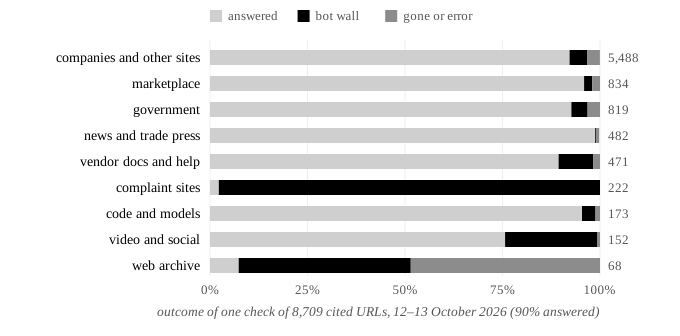
4:9 The findings cite 8,709 distinct URLs, and on 12 and 13 October each was requested once. Of these, 7,806 answered (90%), 630 met a bot wall, 271 were gone or failed and 2 were cut by the privacy filter. The walls stand where a seller's evidence is richest: complaint sites refused almost every automated request, and video and social platforms about a quarter. Of the 575 findings that carry URLs, 558 have at least one that answered. The other 433 carry none. Most restate evidence that the body of their report cites, and 44 cite reference numbers their reports never resolved; those are the findings to check against the report's text first.
4.4 Where forced decisions led
4:11 A forced decision in a report predicted a better idea from it. Fifty-eight of the 93 reports contain at least one finding of that kind. In the two waves that wrote ranked cards, the families that came from those reports reached the top fifty more often: 19 of 83 against 6 of 43 in wave 3, and 42 of 111 against 2 of 8 in wave 4, counting a family once for each report it came from. The briefs of the later waves aimed at the reform, so part of this is the method grading its own aim. The rest agrees with the scores, where asymmetry separated winners from losers second only to money (2:15).
4.5 Gaps close
4:12 Every asymmetry has a closing date, written or not. The state closes the gaps it can answer from data it already holds (16:14), and rivals close the rest once the demand is visible (16:17). The reports caught both in motion: free tools for repair shops, technical trades and retail investors appeared during 2026, and the hybrid-regime choice was served by free simulators before any product could launch (F0768, F0783, F0820). A finding is true on its date, and this atlas is a picture of 12 October 2026.
4:13 One open gap makes a clean test. A Simples supplier's choice of the hybrid regime decides how much CBS and IBS credit its buyers get, and only the supplier can see it; the accountants' council asked for a national lookup in September (F0827). If the state publishes one, Mapa de Crédito at rank 28 loses its main job. The data sits with Receita, the side where the state builds tools (16:14), and its Consulta Optantes page already shows any company's Simples status, so I put a public lookup by mid-2027 a little above even, at 55%. The reform's crowded agenda keeps it from higher.
Forecast 4.1 (A public lookup of the hybrid choice). By 30 June 2027 Receita Federal or the Simples Nacional committee offers a free public lookup that shows, for any CNPJ, whether a Simples company pays CBS and IBS under the regular regime.
- Horizon
- 2027-06-30
- Probability
- 55%
- Check
- On 30 June 2027 read Receita Federal's Simples Nacional portal, including the Consulta Optantes page, and the committee's resolutions since October 2026. The forecast holds if a free page or API returns, for a CNPJ entered by anyone, whether that company chose the regular IBS and CBS regime; it fails otherwise.
5 Who is forced
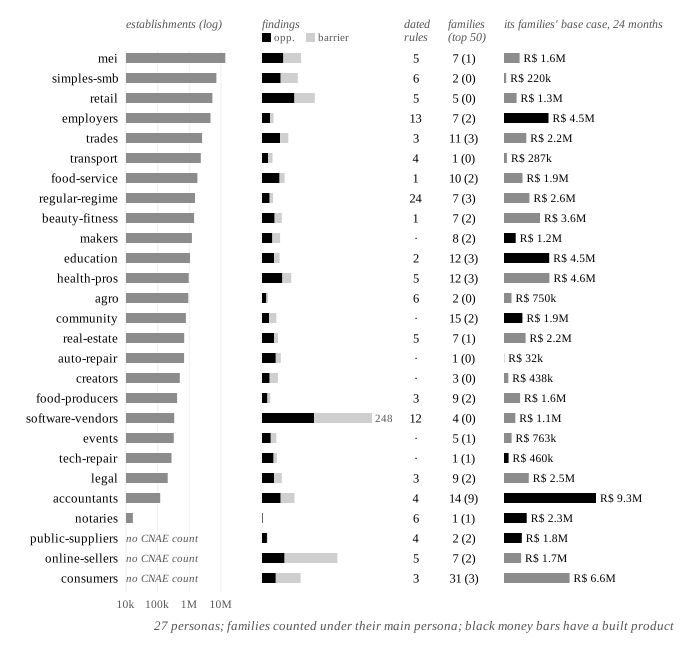
5:1 The findings, ideas, families and obligations were all tagged with 28 personas, and 25 of the personas have a population counted from public data. Laid side by side, they show where the search spent its attention. Accountants, 120,434 establishments, are buyers for thirteen of the top fifty families. Shops, 5,387,626 establishments, are the main buyer of none, and transport, 2,312,313 establishments with more than half opened since 2024, appears in none of the fifty at all.
5.1 Counting them
Definition 5.1 (Persona). A persona is a group of buyers who face the same jobs under the same rules, such as shops, employers, accountants, MEIs or consumers. Every finding, idea, family and obligation lists the personas it concerns, main persona first.
5:3 The populations come from Receita Federal's open CNPJ data of August and September 2026: active establishments in each of the 1,337 CNAE subclasses, with their size, tax regime, kind of e-mail address and year of opening. Each subclass counts under one persona by an ordered list of rules in which the first match wins, so narrow personas such as notary offices (CNAE 6912) and auto repair (4520 and 4543) are carved out before broad ones. Shops come to 79 subclasses, led by clothing with 1,015,646 establishments; accountants to two. MEIs, Simples firms and small businesses in general are counted across all subclasses, employers from the employer registry, and firms in the regular regime from Receita's count of presumed-profit companies. Three personas have no count of their own: online sellers, public suppliers and consumers. The full mapping is in the data, so a reader who disagrees with an assignment can move a subclass and count again.
5.2 Where the attention went
5:5 The search looked hardest at its own trade. Software vendors, the persona the seller belongs to, collect 351 findings, more than a third of the total, and their most common kinds are risk, platform rules and unit economics: the walls a seller meets, more than the needs of a buyer. Online sellers come next with 176, most of them walls too. A search for something to sell has to learn its own constraints first, and these are published so that the next search can start past them.
5:6 The ranking looked hardest at accountants. Thirteen of the top fifty list them as buyers and nine as the main one, and the fourteen families whose main buyer they are add up to R$9.3 million of base case, the most of any persona. They face the reform first, they already buy software, a council's registry counts them, and they carry the reform to 7.2 million Simples firms. The same reasons draw the incumbents: searches for reform tools already end at Sebrae, Receita, Domínio and Omie (F0826).
5.3 The blank rows
5:7 Shops are the largest trade in the atlas. They have 126 findings, more than any other trade, and 87 idea records, more than any persona, yet no top-fifty family has them as its main buyer; they appear only beside makers in Agenda Pronta and beside online sellers in Catálogo Zap. Their findings say why. Their asymmetries are demand, supply and price, not dates: niches with many listings and no reviewed leader (F0027), point-of-sale software that a local one-time product undercuts by 55 to 95% over three years (F0194), and a store-credit ledger market led by an Indian app with 1.92 million installs (F0253). Their next dated rule, CBS and IBS fields on invoices in January, lands on fiscal software they already rent (F0200). The best family for them, Carnê Pix, instalment booklets with a Pix code on each slip, ranks 71st.
5:8 Transport is the newest population: 2,312,313 establishments, 79% of them MEIs and 56% opened since 2024, mostly road freight, couriers and drivers. One family in 220 serves it, an app for the driving instructors whom the reform of the driving licence allowed to work on their own, at rank 70. That reform is one of the best-sourced forcing findings in the data, with 14 of its 15 links answering: 172,200 instructors are on the national list, and the apps for them have at most a thousand installs (F0307). Freight is closed for another reason. The CIOT, mandatory on every paid road-freight operation since May with a fine of R$10,500, has to be generated through a licensed payment institution, which a small seller can't be (F0343).
5:9 A blank row is a hypothesis, not a verdict on the market. It says that this search found nothing a one-person firm could sell to that persona, online and without support, at a price that pays for its ads, under the rubric of §2.3. A seller with other assets, a payments company for the store-credit ledger or a freight platform with a payment licence for the CIOT, faces a different rubric and may find these rows the fullest.
5.4 Reach
5:10 Two columns of the CNPJ data say how a persona can be reached. The share of establishments opened since 2024 runs from a third of shops to more than half of transport, and 40% of active MEIs opened in 2025 or 2026 (F0160). Most buyers are new firms buying their first system, not incumbents switching, which favours the places where a new owner searches over lists of established firms. The share with no e-mail address on record runs from 3% of creators to 32% of notary offices and 39% of churches, associations and clubs. Those personas are reached through their councils, registries and suppliers, not their inboxes.
5.5 The dates
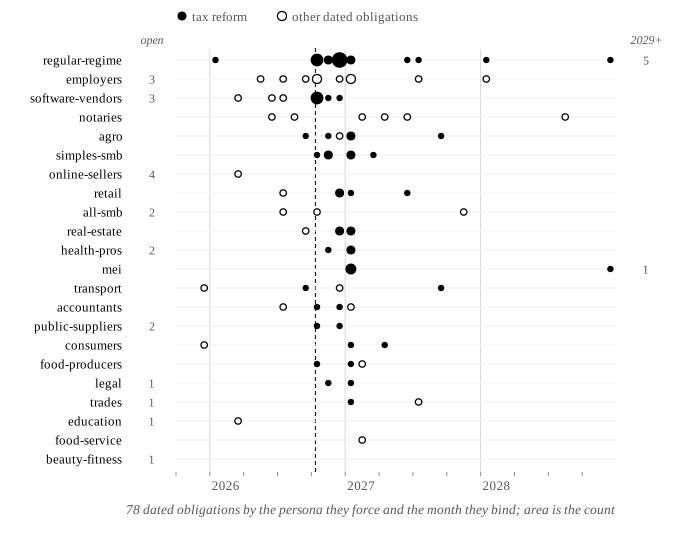
5:11 The two calendars hold 78 dated obligations, 42 from the consumption-tax reform and 36 from other forced demand. Forty-eight bind between October 2026 and December 2027, 18 are already in force, 9 come in 2028 or later and 3 have no date. They fall unevenly: firms in the regular regime are named by 24, employers by 13 and software vendors by 12. The reform puts its dates on firms that accountants and fiscal software already serve, which is why its products sell to accountants. The other rules put theirs on employers, teachers and notary offices, which is where the roster builder, the report writer and Dossiê 213 sell.
6 Every idea
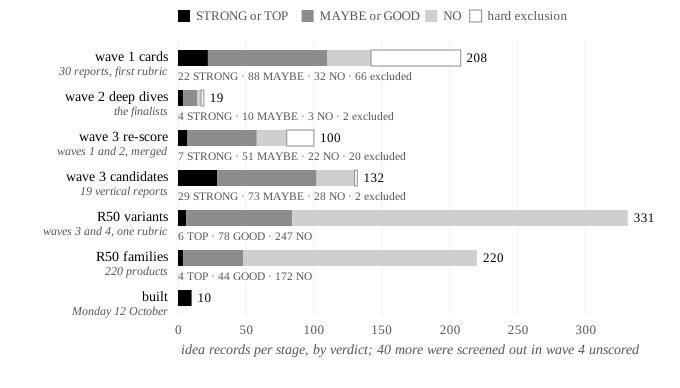
6:1 The search wrote 698 idea records in four waves, and the data keeps all of them: every card, deep dive, re-score, variant and screen-out, with its verdict, its report and the links between stages that were written down. The ranking of Chapter 1 is the end of this funnel. Most of what died was killed by a free tool, a platform's rules or the price of a customer, or because it needed something this seller had ruled out, and the last kind is where a different seller should look first.
6.1 The funnel
6:2 Wave 1's thirty reports wrote 208 cards, and wave 2 took 19 finalists into deep dives. In wave 3 one report re-scored all of those as 100 merged ideas under the third brief's rules, while the 19 vertical reports wrote 132 new candidates. The re-scoring pass then put the third wave's niches on the fourth wave's rubric beside the fourth wave's own cards: 331 variants in all, 199 from the third wave's reports and 132 from the fourth's, which merged into the 220 families and two pieces of shared infrastructure. Forty more ideas were screened out in wave 4 before they got a card, each with its reason. Ten families were built.
6.2 Lineage
6:4 Each record carries the links that were written down. Wave-1 cards and wave-2 deep dives point to the merged idea of the wave-3 re-score that absorbed them, the 132 wave-3 candidates carry their first score into the final ranking, and every variant on the final rubric points to its family and the family's rank. One link was never written: the final cards came from the third and fourth waves' reports, not from the re-scored list, so an early idea that returned to the ranking did so under a new name. The driving instructors' app is one. It began as a wave-1 card, was excluded in wave 3 because it needed an app-store phone app, and came back at rank 70 in wave 4 as a web app.
6.3 The jobs
6:5 A tagging pass gave each family one job, the thing the buyer gets from it, and marked it forced when a legal or regulatory date makes the purchase urgent. Documents and calculations are almost half of the 220 families and 26 of the top fifty. Checks, calculations and documents are mostly forced; selling, content and personal tools almost never are. Operating software, the point-of-sale, service-order and stock systems that incumbents already sell, is 33 families and only 4 of the fifty, because the rubric's weight on operations and support counts against it.
| Job | Families | In the top 50 | Forced | Base, 24 months |
|---|---|---|---|---|
| document | 54 | 16 | 32 | R$21.0M |
| calculate | 42 | 10 | 28 | R$11.8M |
| operate | 33 | 4 | 7 | R$5.9M |
| data | 19 | 2 | 11 | R$4.0M |
| sell | 17 | 4 | 2 | R$4.0M |
| content | 16 | 4 | 1 | R$3.3M |
| learn | 11 | 3 | 6 | R$4.0M |
| check | 10 | 3 | 9 | R$4.9M |
| personal | 10 | 1 | 0 | R$2.4M |
| schedule | 8 | 3 | 3 | R$5.0M |
6:7 The job says what the buyer gets, not how the product works. The roster builder is tagged schedule and Dossiê 213 document, and both are checkers inside (Definition 10.1). Ninety-nine of the 220 families are forced, 45%, and 28 of the top fifty, 56%.
6.4 The exclusions
6:8 The hard exclusions list what this seller couldn't do, not what the market doesn't need. Of the 100 merged ideas the wave-3 re-score judged, 20 were excluded outright, and their reasons name the seller's limits: issuing fiscal documents, which needs constant maintenance; depending on a government login or a third party's API; running a server that holds customers' data; selling hardware, a service or a phone app; gambling and piracy, which the ad platforms refuse; and procurement for public bodies, with its service levels. When the fourth brief allowed a small cloud part, several came back in a new form, the instructors' app among them, and the invoice products at ranks 47 and 50.
6:9 So the 88 records that ended in a hard exclusion, 66 of them wave-1 cards, are the cheapest place for a differently built seller to start. Each has a card, evidence and a reason for its death that may not apply to that seller.
7 Value to Brazil
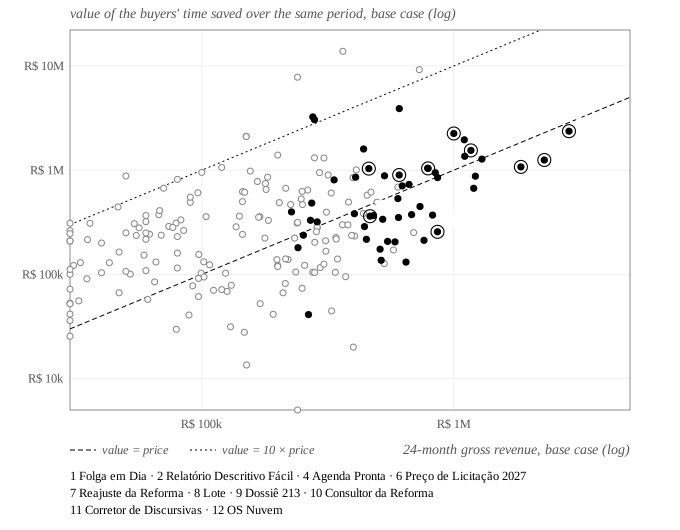
7:1 A product for a forced decision is worth more to the economy than its revenue, and much less than the decision it serves. At base, the 211 families with a price would gross R$65.0 million in 24 months and save their buyers 4.68 million hours, worth R$126.5 million at what those buyers earn an hour, about two reais of time for each real paid. Nearly half of the revenue goes to buy ads. And one hour of the 24 forced decisions that bind in the next twelve months is worth R$3.02 billion of their deciders' time, forty-six times what the whole portfolio grosses in two years.
7.1 Three tiers
7:2 The model counts value at three tiers. The first is what the products capture, the base cases of Chapter 3. The second is the time they save their buyers, priced at what those buyers earn an hour. The third ignores products and prices the decisions: how many people must make each forced decision, and what one hour of their time is worth. The first is what a seller can bank, the second what buyers get for their money, and the third the size of the problem the products nibble at.
Definition 7.1 (Time value). The time value of a family is the hours of their own work it saves its buyers inside the 24-month window, priced at what those buyers earn an hour. Fines avoided, extra sales, money saved and use after the window are left out, so the time value is a floor.
7:5 Here is the family's base case ((3.1)) and is what one buyer pays inside the window, so counts the buyers. For a subscription , the entry price plus the monthly price times paid months, and the years of use are . A one-time buyer pays and, buying on average halfway through, uses the product for year inside the window. is the hours saved per buyer per year, and the hourly earnings of the buyer's tier. At the monthly churn of 6.1% that ChartMogul reports for subscriptions under US$25 a month, and .
Derivation: Paid months
A buyer with months left in the window pays at the start of each month while still subscribed, so pays for months. Buyers arrive evenly, so is uniform on . With , so that , averaging over gives , the of (7.1).
7.2 The wages
7:6 The hourly values come from IBGE's PNAD Contínua for the second quarter of 2026: average habitual monthly income from all jobs, divided by 173.3 working hours. An employer's hour is worth R$52.79, an own-account worker's R$17.94 and the average working person's R$21.57, with low and high cases from the same survey. Each persona takes one tier. Shops, restaurants, trades, accountants, notary offices and firms in either tax regime take the employer's; MEIs, beauty and health professionals, teachers, lawyers, makers and online sellers the own-account worker's; consumers the average person's. The own-account base is deliberately the average over all own-account workers, so a lawyer's or a dentist's hour is undervalued and the model leans low.
7.3 The buyers' side
7:7 At base, the 211 families with a price would sell to about 359,000 buyers in 24 months and save them 4.68 million hours, worth R$126.5 million against R$65.0 million paid: R$1.95 of time for each real. The nine families that earn from ads, leads or fees, R$1.2 million of the R$66 million in 3:10, have no buyers to count and stay out. The low case gives R$0.62 a real and the high R$6.01. Much of that range is the hours, which a language-model pass estimated for each top-fifty family from its card, 30 of them at low confidence and none at high. Families outside the top fifty borrow the median hours of the top-fifty families with the same job, which probably flatters them: the top fifty alone return R$1.21 for each real, and the ten built products R$0.98.
7:8 For 28 of the top fifty the time saved is worth less than the price, and their case rests on what the model leaves out. The estimating pass named it for each family: a penalty avoided for 14, money saved or earned for 14, extra sales for 10 and nothing for 12. The roster builder returns R$0.83 of time for each real and is bought to avoid overtime claims and labour fines; Dossiê 213 returns R$0.55 and is bought to avoid the inspecting judge's sanctions. The products that return the most time are cheap tools that take a repeated chore off a small firm: Cardápio Zap, a menu that takes orders by WhatsApp, at R$11.77 a real, Certifica NR, training certificates in batches, at R$10.88, and Etiqueta de Validade, kitchen date labels, at R$6.41. The least are those whose buyers' hour is cheap or whose payoff is money, race timing at R$0.16 and holding-company planning at R$0.20.
7.4 Where the money goes
7:10 Of each real the products earn, the base case sends 9.1% to the state as Simples tax, 7.5% to checkout and payment companies and 46% to buy ads, which leaves 37.4% for the seller before any cost of building or support. The tax share is a software seller's all-in Simples rate in Annex III, counting the owner's pro-labore; the payment share is the median fee on a R$97 sale across 21 checkouts; and the ad share is the median ratio of acquisition cost to first-year revenue across the 63 product archetypes of the salesability report. On R$65.0 million that is R$5.9 million to the state, R$4.9 million to payment companies, R$29.9 million to the ad platforms and R$24.3 million to the seller.
7:11 The ad share is the largest and the only one that grows with competition, because every clone bids for the same buyers (16:17). It buys attention mostly from Meta and Google. A channel the seller doesn't rent, such as a council's newsletter, an accountant who resells, a marketplace's organic search or a free portal of the seller's own, keeps that share with the buyer or the seller. For the economy, the cheapest improvement to the whole portfolio isn't a better product but a cheaper way to be found.
7.5 An hour of the deadlines
Definition 7.2 (Hour value). The hour value of a forced decision is the number of people who must make it times the hourly earnings of their tier: what one hour of the decision costs all of them together.
7:13 Twenty-four of the 78 obligations bind between 12 October 2026 and 12 October 2027 and name a population. Their deciders add up to 70.0 million, counting a Simples firm once for each of the six decisions it faces, and their hour values to R$3.02 billion at base, between R$1.83 billion and R$3.52 billion across the cases. These are the ten largest.
| Binds | Decision | Deciders | Hour value |
|---|---|---|---|
| 30 Oct 2026 | Simples firms choose whether to pay CBS and IBS outside the DAS in 2027 | 8.3M firms | R$440M |
| 1 Nov 2026 | Simples service firms move to the national service invoice | up to 8.3M firms | R$438M |
| March 2027 | Simples firms choose the hybrid regime for the second half of 2027 | 8.3M firms | R$438M |
| 1 Jan 2027 | MEIs issue an invoice for every sale and service | 17.5M MEIs | R$314M |
| two months after promulgation | the six-day week ends: two rest days and 42 hours | 4.7M employers | R$248M |
| 23 Dec 2026 | the Supreme Court's suspension of the NR-1 psychosocial-risk penalties ends unless extended | 4.7M employers | R$248M |
| 1 Jan 2027 | Simples and MEI invoices carry CBS and IBS item codes | 4.0M firms | R$211M |
| 31 Dec 2026 | capital goods bought by year-end resell free of CBS up to their net value | up to 1.75M firms | R$92M |
| 1 Jan 2027 | CBS replaces PIS and Cofins at the full rate | 1.75M firms | R$92M |
| 15 Oct 2026 | last day for small firms outside the Simples to opt in for 2027 | 1.51M firms | R$80M |
7:15 Against these numbers the products are small. The whole portfolio's two-year base case equals 1.3 minutes of the 24 decisions, and its buyers' time value 2.5 minutes. Saving one hour on the hybrid choice for a tenth of the Simples firms would be worth R$44 million, two-thirds of everything the 220 families gross in two years. The World Bank's last measure put a medium-sized Brazilian firm's tax compliance at 1,501 hours a year, the most of any country; these 24 decisions are the part of that burden with a date on it.
7:16 So the largest value at stake goes to whoever makes the decisions cheaper, whether or not anyone is paid for it. A free official tool that answers from the state's own data is worth more to Brazil than any product here, and that is where 16:14 says the state will act. The seller's room is the rest: decisions that need the firm's own schedules, buyers, costs and evidence, delivered in the weeks before the date. A product that takes ten minutes off one of those decisions for a few thousand buyers is a small business. The same ten minutes taken off all 24 decisions for everyone who faces them would be worth half a billion reais.
8 The protocol
8:1 Everything in this book can be done again by an agent that has never read it, starting from the data. The protocol below is the method cut to seven steps, from the calendar of forced decisions to the stopping rule, and each step names the tables that hold its inputs. It is written for the next search and for the agents that will run it.
8.1 Seven steps
- Start from the calendar. Take the obligations that bind in the next nine months, name a counted population and carry a penalty, and drop those for which the state already ships a tool rated 4 or 5 (obligations.csv). A dated reason to buy outranks any feature (2:15).
- Count the deciders from public data: the CNAE subclasses of the open CNPJ data for firms, the councils' registries for professions, and Receita's counts for the Simples and the MEI (persona-cnae.csv, cnae-counts.csv). A count without a source is a guess.
- Read the persona's findings, strongest first (findings.csv). Look for the four kinds that open markets, a forced decision, a missing tool, a price gap and a collapsed cost, and test each opening against the three that close them: platform rules, risk and unit economics.
- Write a card for each idea and score it on the rubric, with a Fermi chain in which every number has a source (Definition 2.1, (3.1)). Keep the dead cards with their reasons (ideas.csv).
- Build the checker before the product. Encode the rules from the primary text, tag each as law, proposal, precedent or uncertain, and publish what the checker covers (Definition 10.1, 10:9).
- Sell before polishing. Run the stopping rule on a few break-even acquisition costs of ads, and log the spend, the sales and the decision, whatever it is (Experiment 13.1, §17.4).
- Re-read the sources every month and run the calendar again. A finding is true on its date, and a gap closes when the state ships a tool or rivals bid up the ads (4:12).
8.2 Asking the data
8:3 The tables join on a few ids: a finding's (F0827), a report's (W4-02), an obligation's (C04 in the reform calendar, CAL-09 in the other), a family's (F-ESCALA) and a persona's code (retail). The questions an agent will ask map onto them directly:
- Which decisions are forced in the next six months, on how many people, with what free tool? obligations.csv, by date, population_n, penalty and free_tool_quality_1to5.
- What do the reports say about one persona, openings first? findings.csv, filtered on personas and polarity and sorted by strength, each row with its URLs and how many of them answered.
- Which ideas were tried and killed, and why? ideas.csv, by stage, verdict and end_verdict, with wave3-rescore.csv for the kill reasons.
- What is a family worth, and to whom? families.csv for its scores and base case, economic-value.csv for its buyers, hours and time value.
- Where did a number come from? reports.csv for each report, research/ for its text, and sources.csv for every URL it cites.
import pandas as pd

base = "https://future-seems-so-good.com/blog/assets/compile-the-law/data/tables/"
# The site turns away Python's default urllib client, which pandas uses; any User-Agent of your own passes
opts = {"User-Agent": "compile-the-law-reader"}
obligations = pd.read_csv(base + "obligations.csv", storage_options=opts)
findings = pd.read_csv(base + "findings.csv", storage_options=opts)

# Decisions with a counted population and no good free tool
open_gaps = obligations[obligations.population_n.notna()
                        & ~obligations.free_tool_quality_1to5.isin([4, 5])]

# The strongest openings the reports found for shops
shops = findings[findings.personas.str.contains("retail", na=False)
                 & (findings.polarity == "opportunity")
                 & (findings.strength == 3)]
8.3 What not to trust
8:5 Five cautions go with the data:
- The labels are a model's. The kinds, polarities, personas, job codes and hours saved come from language-model passes under the specifications in methods/, and no second model has redone them. Spot-check any label before leaning on it.
- The money is estimated. Base cases are agents' central estimates, and the hours saved, 30 of the fifty at low confidence, are guesses with stated ranges. Both are priors for sales to replace (1:12).
- The links were checked once. An answering URL means a page came back on 12 or 13 October, not that it still says what the report quoted.
- The counts overlap. Personas share findings and families, an obligation can name several personas, and the 70.0 million deciders count decisions, not people.
- The dates move. The PEC, the CBS rate and the NR-1 suspension can each change before they bind (§16.3), and everything here was true on 12 October 2026.
8:6 The book is written to be read by machines as well as people. Its markdown copy, the site's llms.txt and agents pages, and the schema.org Dataset markup on this page all point to the same package, and every column of every table is described in datapackage.json. An agent that cites a finding, an obligation or a family by its id lets the next reader join it to everything else. One practical note: the site's firewall turns away Python's built-in urllib client, which pandas uses by default, so a script should send a User-Agent of its own, as the example above does; curl, requests and the AI labs' crawlers pass as they are.
Part IV. The thesis
9 Requisite variety
9:1 A small firm meets more legal situations than it can tell apart, and W. Ross Ashby's law of requisite variety puts a floor under how steady its outcomes can be: no regulator does better than the variety it brings. The state adds variety with every norm and, for most of the decisions it forces, supplies none. The products that ranked well amplify the firm's variety, and the good-regulator theorem says what an amplifier must contain to work: a model of what it regulates, which for compliance is the law, compiled.
9.1 The regulator in a small firm
9:2 Ashby described regulation as a game. A disturbance arrives, a regulator answers with a response , and the pair fixes an outcome (Ashby, An Introduction to Cybernetics, 1956, ch. 11). For a small firm the disturbances are the situations the law creates for it: a roster that leaves someone without a second rest day, an invoice without its CBS group, a bid price that still carries PIS and Cofins in 2027. The responses are what the firm can do about them, and the outcome is whether it ends the month legal and solvent.
Definition 9.1 (Variety). The variety of a set is the base-2 logarithm of the number of states an observer can tell apart, in bits; when the states have probabilities, it is their Shannon entropy . A regulator maps each disturbance to a response, and , the mutual information of the two, measures how much of its variety tracks the disturbance.
Proposition 9.1 (Requisite variety). If, for every fixed response, distinct disturbances lead to distinct outcomes, then however the regulator chooses, , and in entropies the outcome obeys (9.1).
Proof
Group the disturbances by the response they get. Within a group the response is fixed, so its disturbances reach distinct outcomes, and the largest group, with at least members, reaches that many on its own. For entropies, the outcome and the response together determine the disturbance, so . Mutual information is at most , and responses carry at most bits.
9:6 Only variety in the response can absorb variety in the disturbance, and only the part that tracks the disturbance counts. A firm whose responses don't depend on what the law did to it this month, with the same roster every month and the same price in every bid, has , and every bit the law adds reaches its outcomes as fines, labour claims and lost bids.
9:7 The disturbance is large and growing. The three main texts of the consumption-tax reform hold about 13,000 provisions between them: 4,232 in LC 214, 4,322 in the CBS decree and 4,411 in the IBS regulation, as the Consultor da Reforma's corpus counts them (10:10). A roster for six people over three weeks is one of grids, and the PEC changes which of them are legal. A shop manager tells legal rosters from illegal ones only as finely as she knows the rules.
9:8 Today most small firms buy their variety from an accountant, one of the 101,880 accounting firms in the Consultor's card, who regulates dozens or hundreds of clients at once. The reform adds variety to every client without adding hours to the accountant, so the accountant's fee becomes the price of variety, and two products in the ten sell to accountants for that reason: one prices the extra work, the other answers the questions with the article attached.
9.2 Amplifiers and attenuators
Definition 9.2 (Amplifier). A variety amplifier raises the number of distinct responses a regulator can give, and the share of them that track the disturbance, at a cost that grows more slowly than the variety it adds. An attenuator works from the other side: it shrinks the variety of the disturbance the regulator has to face. The pair of terms is Stafford Beer's (Viable system model).
9:10 A free official tool is an attenuator. When Receita Federal published the check-digit rules for the alphanumeric CNPJ, each new number had one right answer that anyone could compute, and the disturbance collapsed. The free national service-invoice emitter did the same for a whole class of invoices. Products that tried to sell those answers died (1:11). A product survives where the state attenuates nothing: it publishes the rule and leaves each firm to compute its own answer, because the answer depends on the firm's own data.
9.3 Forced decisions
Definition 9.3 (Forced decision). A forced decision is a choice that a law or a regulator requires of a firm by a date, with a fine, a lost right or a lost sale for getting it wrong or late, and whose right answer depends on the firm's own data, so that no single published answer serves every firm.
9:12 The hybrid Simples is the cleanest case. Between 1 September and 30 October every Simples company other than a MEI may choose to pay CBS and IBS outside the Simples from January, under the regular regime, and 854,670 had asked by 8 October. The right answer depends on whether the firm's buyers are businesses that can take credit for the tax, and on a CBS rate the Senate is due to set by 15 December, after the window has closed. A window to cancel runs to 20 December. A date, money at stake, and an answer that only the firm's own numbers can give: that is the shape of every product in the GOOD tier.
9:13 The scores agree. Asymmetry, the criterion that scored a dated reason to buy, separated winners from losers second only to money (2:15). Of the 41 families that scored 4 or 5 on it, 27 made the top 50, and fifteen of the top fifty exist only because of a tax reform.
9:15 The clock explains the timing of the whole search. The free tools all arrived before October, and ten of the fifteen forced decisions fall between mid-October 2026 and February 2027. A product finished in March would sell into the second hybrid window and the notary offices' second deadline. Finished in October, it sells into the first of everything.
9.4 The good regulator
Proposition 9.2 (Good regulator). Among the regulators that minimize the entropy of the outcome there is always one whose response is a fixed function of the disturbance, . Such a regulator is a model of what it regulates: it maps each state of the system to the response that state calls for. Conant and Ashby proved the stronger statement that the simplest optimal regulator has this form (Conant and Ashby 1970).
Proof
A regulator is a policy . The distribution of outcomes is linear in the policy and entropy is concave in the distribution, so is a concave function of the policy. The policies form a product of simplices, one for each disturbance, and a concave function on such a set reaches its minimum at a vertex. The vertices are the deterministic policies, which choose one response for each disturbance.
9:17 For compliance, the system being regulated is the law as it applies to the firm's own data, so the good regulator is a function from the firm's situation to a legal response: the law compiled into code. A language model alone is a random policy. Asked the same question twice it may answer differently, and asked about a provision that doesn't exist it may cite one anyway. Its randomness given the question, , is variety that tracks nothing, and since it raises the floor of (9.1).
9:18 The design the ten products share follows from the theorem: deterministic code for the parts of the law that are deterministic, which in these products is nearly all of it, and a model only where the input or the output is language. The book's title is the theorem applied. Every good regulator of a firm's compliance must be a model of the law it complies with, so the product that sells is the law, compiled.
10 Checking is cheaper than finding
10:1 Most forced decisions are hard to answer and easy to check. A roster that satisfies twenty rules is a search through some grids, and checking one grid takes a single pass over it. A product built as a proposer and a checker gets its error from the checker and its cost from the proposer, so the checker has to be right and the proposer only has to be cheap. Language models make good proposers, and the law, compiled, makes the checker.
10.1 The roster
10:2 A roster for six people over three weeks, each day off, a morning shift or a late one, is one of grids. Personnel scheduling is NP-hard in most of its forms (Brucker, Qu and Burke 2011), and nurse rostering, its best-studied case, has a literature of heuristics because exact search doesn't scale (Burke and others 2004). Checking a grid is linear in its size: walk each person's shifts, measure the gaps, count the rest days and the Sundays.
10:4 The sample roster breaks nothing under today's 44 hours with one rest day. Under the PEC it breaks two rules in every person-week, 18 missing second rest days and 18 weeks of overtime at 8 h 24 a shift, and the search finds a roster that breaks nothing after 2,729 proposals, each checked in full. The search proposes and the checker decides, and a proposal the checker hasn't passed never reaches the screen.
10:5 The product does the same at shop scale. Folga em Dia lays out thirty people over a month in a tenth of a second or so, and its free simulator reports the headcount of a rotation that passes the checker, not the headcount from the usual formula. The formula is only a lower bound: in four of the simulator's eight sample businesses, the rotation that actually passes needs up to four more people than the formula says. A store that hired by the formula would find out in the first month.
10.2 The checker
Definition 10.1 (Checker). A checker is a program that takes a proposed answer and returns the rules the answer breaks, each with the source that states the rule, and returns nothing only when no rule it encodes is broken. It decides and never searches. Its coverage is the share of the rules binding the buyer that it encodes.
Proposition 10.1 (The checker sets the error, the proposer the cost). Let each proposal satisfy every encoded rule with probability , independently, and let the checker pass exactly the proposals that do. The loop that proposes until the checker passes stops after proposals on average and never returns a proposal that breaks an encoded rule, whatever is. All remaining error lies in the rules the checker doesn't encode.
Proof
The number of proposals up to the first pass is geometric with success probability , so its mean is . The loop returns only a passing proposal, and the checker passes only proposals that satisfy every encoded rule.
10:8 The proposition splits a product's quality into two numbers that improve in different ways. A better model raises , which lowers cost and latency and leaves the error alone. A longer and fresher rule list lowers the error and does nothing for cost. Anyone can rent the same model by the token. A rule list can be written cheaply once, since agents wrote these, but keeping it read against its sources as the law moves is a running cost, and the buyer sees its date on every alert.
10:9 Folga em Dia's twenty rules were each read at the primary source on 12 October 2026: the Constitution, the CLT, the Superior Labour Court's precedents and the PEC's final text in the Câmara. Each is tagged as law, proposal, precedent or uncertain, and the uncertain ones became settings the user chooses, with the uncertainty written beside them. Hard rules are ones the generator never breaks and the screen marks in red; soft rules are warnings, such as overtime. Every alert says "possible conflict", links the norm and adds that it is not legal advice and the collective agreement should be checked. That sentence is the coverage statement: agreements differ by union and region, and the checker encodes none of them by default.
10.3 Citations
10:10 The same split governs answers written in language. The Consultor da Reforma answers questions about the consumption-tax reform from 15 official texts: the constitutional amendment, LC 214 and LC 227, the CBS decree and the IBS regulation, the technical note and its classification table, and Receita's question-and-answer pages. They are split into 3,958 chunks holding 15,712 provisions, with a SHA-256 hash of each source as fetched. A model writes the answer with numbered references to the passages it was shown. A deterministic validator then checks every reference: each number must point to a passage the model saw, and each provision the answer writes out must exist in the indexed text, or it is marked "not found" in red. An answer that cites nothing is marked unsupported. No model judges another model.
10:11 The validator is what made the choice of model possible. On 29 questions, ten models on Cloudflare's Workers AI answered from the same passages, and nine of them invented at least one citation, between one and eight each. The one chosen, Qwen3-30B, scored 0.943, invented none, had 88.5% of its citations verified, refused all three questions outside the corpus, and cost US$0.0004 a question at a median of 5.6 seconds. The larger GPT-OSS-120B invented two. Without a checker the ten would have looked alike on a demo. With one, the cheapest good proposer is a measurement.
10.4 Rubrics
10:12 Some answers have no rule to check against, only a rubric. The Corretor de Discursivas grades bar-exam and civil-service answers item by item against the examining board's official answer grid, and it can award only the marks the grid allows. A grade is noisier than a citation, so for full legal briefs it grades three times and takes the median of each criterion. That buys down the randomness of 9:17 at three times the inference cost, and the product's usage quotas are set from the measured cost of each kind of answer.
10:13 The products sit on a ladder of checks. At the bottom are exact checks: a roster's gaps, a bid's BDI band from the federal audit court, a citation's existence. Above them are graded checks, a rubric applied by a model and steadied by the median. At the top is the check no product can run on itself, whether a stranger pays. The search used the same ladder on itself (§14.7), and most of the ten built have an exact check at their core.
Part V. The products
11 Ten products
11:1 The ten products built on Monday share one shape. A free check shows the buyer the problem, a paid tool fixes it, and under both sits an engine of rules, each with its source and its tests. Six run entirely in the buyer's browser and four add a small serverless service of their own. They carry 856 tests of their own and 185 for the storefront they share, and none is on sale yet.
11.1 The shape
| Product | Family | What its engine checks or computes | Price | Runs | Tests |
|---|---|---|---|---|---|
| Folga em Dia | Escala Certa | 20 labour rules, today's and the PEC's | R$297 a year | browser | 129 |
| Relatório Descritivo Fácil | Kit Professora | the five BNCC fields and 93 objectives, phrasing without labels | R$97 for the 2026 and 2027 school years | browser | 94 |
| Agenda Pronta | Agenda Pronta | holidays by law, Easter by two algorithms, moon phases | R$147 a year | browser, encrypted backup | 72 |
| Reajuste da Reforma | Reajuste da Reforma | cost per hour, the reform's new services, the contract items the accounting council requires | R$67, 2027 edition | browser | 114 |
| Preço de Licitação 2027 | Preço de Licitação 2027 | BDI by the audit court's formula, with CBS and IBS for each year to 2033 | R$247 with a year of rate updates | browser, encrypted backup | 91 |
| Lote | Família Lote | badges, certificates with a signed QR code, check-in | R$97 once | browser | 161 |
| Dossiê 213 | Dossiê 213 | the notary IT controls for the office's class, with hashed evidence | R$990 a year, smallest class | browser and a Worker | 54 |
| Consultor da Reforma | Consultor da Reforma | every citation against 15,712 provisions | R$47 once | browser and a Worker | 55 |
| Corretor de Discursivas | Corretor de Discursivas | the examining board's grid, three gradings for full briefs | R$29.90 for 30 days | browser and a Worker | 41 |
| OS Nuvem | OS Nuvem | quotes valid for 10 days and 90-day warranties under the consumer code | R$19.90 for 30 days | browser and a Worker | 45 |
11:3 The free part is the advertisement. Folga em Dia is free for up to five people and its simulator of the end of the six-day week is free for everyone, Lote's demo handles twenty participants, and every local app opens in a demo mode with watermarked output. The paid part is a licence: annual where the law changes every year, a single payment where it doesn't, thirty days where use comes in bursts, and no automatic renewal anywhere.
11.2 The roster builder
11:4 Escala Certa became Folga em Dia because two Brazilian scheduling services already use the name. It builds the month's roster for six-day, five-day and 12x36 rotations, with commerce's Sunday rotation, the fortnightly Sunday off that the CLT gives women (art. 386), and national and city holidays. It prints a wall chart, a sheet for each person, a spreadsheet and a calendar file per employee. The engine is the checker of §10.2, and the free simulator answers the question every employer will ask the week the Senate votes: how many people the same store needs at 42 hours and at 40. Pro costs R$297 for twelve months, paid once.
11:5 The card's money depends on the vote. With the amendment, the family's base case is R$2.86 million on Escala Nova's card and R$1.59 million on Escala Certa's (2:19); without it, about R$0.74 million of ordinary CLT scheduling (3:13). The product is useful either way, since the rest rules it checks are already law.
11.3 The report writer
11:6 Relatório Descritivo Fácil writes the descriptive report a preschool owes each child. The teacher marks observations on a grid of the five fields of experience of the national curriculum (BNCC) and its 93 objectives, and the app writes each report from 13,247 phrase variants that agree in gender and never label a child. It exports Word, PDF and a version for the family, plus a summary for the coordinator. There is no AI, sync or cloud backup in this version: children's data stays on the device behind a passphrase vault (AES-GCM, with the key stretched by 600,000 rounds of PBKDF2) until a lawyer has reviewed the consent wording that the data-protection law requires for children (LGPD, art. 14). The launch price of R$97 covers the 2026 and 2027 school years, and the season is November and December.
11.4 Planner pages
11:7 Stationery shops sell personalized planners, and Agenda Pronta makes the dated pages inside them, in four sizes and six layouts. Every national holiday carries its law, the client's city holidays are added by hand, and the moon phases fall within a minute of NASA's tables for 2026 to 2030. Easter, which sets Carnival and Corpus Christi, is computed by two independent algorithms, Meeus's and Gauss's, and a date-check report compares them, a checker in miniature. A 580-page planner renders in half a second. There is no pack of state holidays, because not all 27 state laws could be sourced; users add their own. It costs R$147 a year and sells from October to January.
11.5 Fees and bids
11:8 Reajuste da Reforma prices the reform for accountants. It computes the firm's cost per hour, lists the new services the reform creates for 2027, estimates the cost of serving each client, and suggests a fee that the accountant approves. Then it writes the fee letter, the contract addendum with the items the Federal Accounting Council requires (CFC Resolution 1.590/2020) and proposals for new clients, in bulk as Word and PDF, with the text ready for e-mail and WhatsApp. The 2027 edition costs R$67, and its deadline is the January fee round after the Senate sets the CBS rate.
11:9 Preço de Licitação 2027 opens with the sentence its buyers need to hear: a BDI built in 2025 is wrong for 2027, because PIS and Cofins end. A BDI is the markup that public bids add to direct costs, and the federal audit court fixed its formula and its reference ranges (TCU, Acórdão 2622/2013). The product computes the BDI and the cost sheet of the federal procurement rule (IN 5/2017) for each year of a contract from 2026 to 2033, as CBS and IBS replace the old taxes, checks the result against the court's ranges, and writes a spreadsheet with live formulas and a memo that cites every rate. When the Senate sets the official rate, a signed update reaches the app. It costs R$247 once, with a year of updates.
11.6 Event kits
11:10 Lote turns a spreadsheet into badges with photos, cut-marked A4 sheets, certificates in bulk and an offline check-in desk that takes a camera, a USB scanner or a typed name, and turns attendance into certificates. Each certificate carries a QR code with an Ed25519 signature that a phone verifies without a server. Three hundred people with photos take 4.3 seconds for badges and 3.9 for certificates. It costs R$97 once and keeps no cloud backup, because photos, CPF numbers and minors stay on the device. The address of the validator is permanent, since printed certificates point to it for years, a promise that outlives any redesign.
11.7 Notary compliance
11:11 The CNJ's Provimento 213, as rewritten by Provimento 243, makes each notary and registry office complete the first two stages of its Annex IV within 180, 240 or 300 days of 22 August 2026, by class: the largest offices by 18 February 2027, the middle class by 19 April and the smallest by 18 June. Every requirement needs evidence kept for five years, and the two larger classes need a signed list of hashes. Dossiê 213 works out the class and the dates, maps the self-assessment onto Annex IV, versions the policies, keeps evidence in a vault with a SHA-256 hash for each file, and writes the hash manifest and the evidence file as PDF. It also records the restore test that Annex V requires, the seven clauses each supplier contract needs, each employee's acknowledgement and a chained audit log. Its page puts the division of labour in one line: the product organizes, and the office declares. It costs R$990 a year for the smallest class.
11:12 The card counts 13,567 offices and assumes one in twenty buys, at R$3,199 each over two years, for a base case of R$2.28 million, the largest on the build list after the roster builder. It is also the least certain rank on the list: the weights experiment keeps it in the top ten in only 41 to 44% of draws (Experiment 2.1). Its buyer has a deadline, a regulator and a budget, which is what the money score rewards and the other criteria discount.
11.8 Cited answers
11:13 The Consultor da Reforma costs R$47 once. Its engine is the validator of 10:10, and two pieces around it keep it honest at the edges. Before any model sees a question, the app strips CPF and CNPJ numbers, including the new alphanumeric CNPJ, e-mail addresses, phone numbers and invoice access keys, and the Worker strips them again. Once a day it reads the official pages of its sources and lists each new amending act, or flags a compiled text whose hash changed with no new act, so that the corpus can be rebuilt and the questions re-run.
11:14 It sells into the most crowded corner of the ranking. Receita has offered a free AI chatbot for reform questions since February, and the search counted at least ten Brazilian reform question-answering tools (3:16). Its only edge is the validator, which is why the weights experiment drops it from the top ten in nine draws out of ten when the weights are free (Experiment 2.1).
11.9 Exam grading
11:15 The Corretor de Discursivas costs R$29.90 for thirty days. It grades a written answer item by item against the board's official grid, awards only the marks the grid allows, quotes the passage of the answer behind each mark and says what was missing for full marks. It has a mode for the bar exam's legal brief with line counts, a notebook of errors, a helper for appeals, and photo reading of handwritten answers in beta. The grading model runs in Cloudflare's cloud, which may be outside Brazil, and the page says so. The bar exam's second phase falls around March, and civil-service exams run all year.
11.10 Repair shops
11:16 OS Nuvem keeps the repair shop's service order on paper and adds a QR label that opens a status page for the customer. The shop moves each order across a board, from received through quote and approval to delivered. The customer approves the quote on that page, with name, date and time recorded and a validity of ten days by default, as the consumer code sets (CDC, art. 40), and at delivery the page shows the end of the warranty, at least the 90 days of art. 26. "Notify the customer" opens WhatsApp with the message written and a person presses send, since automating WhatsApp outside Meta's terms is one of the hard exclusions; a Pix payment goes straight to the shop, since holding customers' money is another. It costs R$19.90 for thirty days, for up to three people.
11.11 What is left
11:17 None of the ten is on sale. The storefront is deployed without public routes and every product sits in waitlist mode, unlisted. What blocks the launch isn't code. Brazil's data-protection law requires a privacy notice that names the controller before any personal data is collected (LGPD, art. 9), so no public page collects anything until the seller's legal name and contact are set. After that come a lawyer's review of the children's-data wording and of the liability cap in the terms, which the consumer code allows only for business buyers (CDC, art. 51, I); domains of their own for the health, esoteric and religious lines; a trademark search for Folga em Dia; the production key that signs Preço de Licitação's rate updates; and the Consultor's sales copy, still a placeholder.
11:18 Every item on that list is on the rubric's bureaucracy list or is a decision only the owner can make, and none of them is code. The code has a backlog of its own, one of integration: the first storefront was built on the integration branch itself, five of the other eleven branches are fully merged into it, and the four products with a cloud part were never merged at all (14:16).
11:19 The code needn't wait for either. All ten are free under the MIT licence, in one tree with the four cloud products merged in, and the six local ones come built, in editions that sell nothing and send nothing anywhere (Appendix D).
12 Ship the regulator to the device
12:1 Six of the ten products run entirely in the buyer's browser: the rules, the data and the licence check all live on the device. Local-first removes most of the bureaucracy the rubric counts, since there is no personal data in my cloud, no server to keep up and no government login, and the product keeps working whatever happens to the seller. The four with a cloud part keep it small, one serverless Worker per product that holds only what the job needs.
12.1 Where the code runs
12:2 A local product is an installable web app. After the first visit it works offline, keeps its data in the browser's own storage, saves files to the device and needs no code-signing certificate, so no operating system warns the buyer off; a Windows installer would have needed a certificate bought by a company. The licence is a token signed with Ed25519 that the app checks on the device, with no server call. It carries an edition or a permanent right, and then never expires, or a term of 365 days.
12:3 Each product with a cloud part has its own Worker on Cloudflare, with its own database and storage, and accepts the buyer's licence as its credential: the same signature check, plus a shared revocation list for refunds and a usage quota per licence. One Worker per product was chosen so that the builders could work in parallel without touching shared code, the isolation Cursor's harness gives its workers (14:3). The Workers keep little. The Consultor strips identifiers before any model call. Dossiê 213 keeps the class, the dates, the self-assessment, the policies and the contracts on the device, and sends to the cloud only what the team must share or prove: vault files with their hashes, published policy versions, acknowledgements and the audit log.
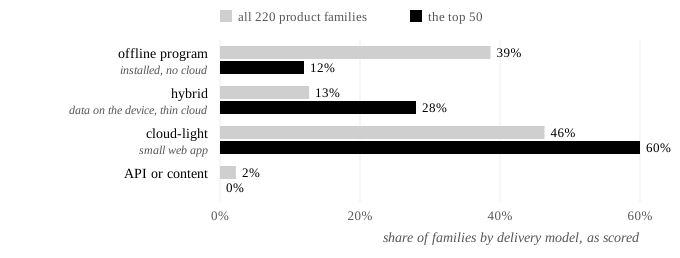
12.2 Why the device
12:5 The scores leaned the other way. In the top 50, sixty percent of best variants were cloud-light and only twelve percent offline, because recurrence earns points and a cloud part makes a subscription natural. The build moved five products whose best-scoring variants were cloud-light or hybrid into the browser, and replaced their monthly plans with annual or single payments. Each move answers an item on the bureaucracy list. Children's data, photos, CPF numbers and minors stay off my servers. Nothing runs that someone must keep running. And with no recurring charge, there is nothing for Meta's September rule on deceptive subscriptions to catch (Meta, Prohibited Commercial Practices).
12:6 In Ashby's terms the move ships the regulator to where the disturbance is. The firm's data, which is the disturbance, never leaves the firm, and the rules travel to it as code. That is also what makes the product cheap to sell to a stranger: the buyer doesn't have to trust me with anything but the price.
12.3 The edition
12:7 The law versions itself, so the products sell editions. Relatório Descritivo's key for edition N covers every school year up to N, so a buyer in December 2026 also finishes the 2026 reports. Reajuste da Reforma sells the 2027 edition and switches to 2028 on 1 October 2027. Preço de Licitação accepts rate updates published within 365 days of the licence. Recurrence then comes from the law's own clock, with no subscription to cancel and no charge the buyer didn't make.
12.4 What the device costs
12:8 The device has a regulator of its own. Safari and every browser on iOS delete a site's storage after seven days of use without a visit to it, unless the app was added to the home screen (WebKit, 2020), and asking the browser to persist the storage doesn't stop it. A local app that ignored the rule would lose a teacher's reports in the week she didn't open it. The shared kit detects Safari outside an installed app and shows the steps to install before any real data goes in, reminds the user to download a backup after each session, and offers an encrypted cloud copy, locked by a key only the buyer holds, for the products whose data isn't sensitive.
12:9 Local-first moves the risk of loss from the seller to the buyer, and the product has to manage that risk as one more rule. Refunds work the same way in reverse: a revoked licence stops working wherever the app checks the revocation list, and an app that never goes online keeps the key it has.
13 Selling
13:1 Building is now cheap and selling is not. At the prices these products charge, the main ad channels at base benchmarks barely break even, so what each market is worth hangs on one unknown per product, the true cost of acquiring a buyer, and the way to learn it is to buy ads under a stopping rule. A self-driving codebase changes selling in one place: it raises the number of products the rule gets to test.
13.1 Break-even
Definition 13.1 (Break-even acquisition cost). The break-even acquisition cost of a product is the most a seller can pay in ads for one first order without losing money on it: the price plus the expected order bump and upsell, less the checkout fee, refunds and tax, with the ad platform's own tax on the cost side.
13:3 For a R$97 product sold through a checkout that charges 8.99% plus R$2.49, with refunds at 6%, tax at 9.08%, an order bump taken by one buyer in five and an upsell by about one in seventeen, the break-even acquisition cost is R$81.56. It is R$36.88 at R$47 and R$171.08 at R$197. Since January, Meta adds Brazilian taxes to its ad bills: R$100 of spend costs R$113.83, which these numbers already include.
13.2 The channels
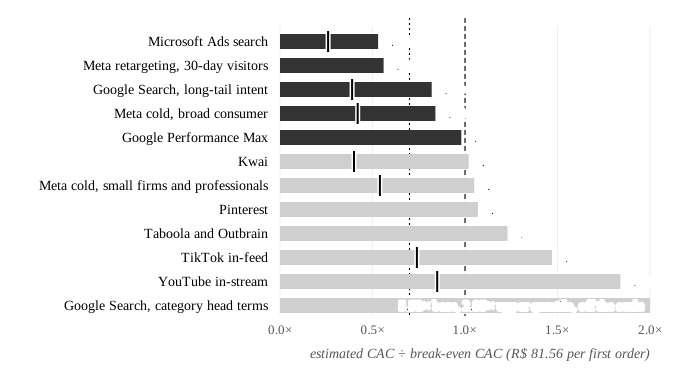
13:5 At base benchmarks, cold Meta traffic to small firms and professionals costs 1.05 times break-even, and long-tail Google searches 0.82 at R$97, falling to 0.68 at R$147. Microsoft's search ads and retargeting of past visitors pay well, at 0.53 and 0.56, but carry little volume. TikTok, YouTube, Pinterest and the native-ad networks lose money, and Google's category head terms cost five times what a sale is worth. Profit comes from the upper quartile of product and creative pairs, which the research put at 0.52 to 0.58 times break-even. A test is the only way to learn which quartile a product is in.
13:6 Buyers say what they want before the ad does. They type "sistema para", "programa para" or "app para" and a trade, and one search suggestion in nine asks for something free (3:9). So every product leads with a free check, and the free check is the ad: the simulator, the demo, the BDI that is wrong for 2027.
13.3 The stopping rule
13:7 Treat a product's sales as a Poisson process in ad spend. Measure spend in break-even acquisition costs, and let be the product's sales per break-even of spend, so that its true acquisition cost is under break-even exactly when . The rule starts sceptical, with a prior on , under which the typical product doesn't pay.
Derivation: The posterior
After spend and sales the likelihood is proportional to , so the Gamma prior updates to . For a Gamma variable with whole-number shape and rate , is the chance that a Poisson process of rate has fewer than events by time 1, which gives (13.1) with and .
13:9 The fast rule kills a product when that probability falls under 0.20, but never before two break-evens of spend, and scales it once eight sales arrive while the probability is still at least 0.85, which means an observed cost of at most 0.58 to 0.63 of break-even. At the cap of six break-evens, it scales a product with eight sales and kills anything with fewer. In practice a product with no sale or one sale dies at two break-evens of spend, one with two sales at three, one with three at about four and one with four at about five and a half. At R$97 that is a kill at R$163 for a product nobody wants.
Experiment 13.1 (Fast and patient stopping rules).
Setup: 200 simulated products whose true acquisition cost, as a multiple of break-even, is lognormal with median 1.59 and spread 0.67, so that about one in four pays; each is tested by the fast rule and by a patient one on the same random sales.
Parameters: fast rule, kill under 0.20 from two break-evens, cap at six; patient rule, kill under 0.05, cap at ten; both scale on eight sales at a probability of at least 0.85, or at the cap at 0.60; break-even R$81.56.
Result: of the 51 products that truly pay, the fast rule scales 26 and kills 25, scales 6 that don't pay, and spends 3.0 break-evens a product on average, R$244, finding 5.3 winners per R$10,000 of testing. The patient rule scales 33 winners and 8 losers and spends 5.4 break-evens, R$438, finding 3.8 winners per R$10,000.
Shows: when products cost almost nothing to make, test money is the scarce input, and the rule that finds the most winners per real beats the rule that misses the fewest.
13:12 The research tuned the rule on a grid of 24 policies with a fuller model of profit over a year, and the fast rule beat the patient one there by 23% of twelve-month profit. Both rules accept errors in both directions. The fast one kills half the true winners on their first test, which is why a product with at least one sale gets a second test with new creative before it is retired.
13.4 The pool
13:13 Budget stops binding sooner than intuition says. In the research's simulation of thirty products over a year, R$5,000 a month of ads tests about 26 of them, scales five or six and ends the year about R$9,000 ahead on average, and R$20,000 a month makes about R$50,000 while spending only two-thirds of its budget, because spend follows measured winners and the winners run out. What binds is the number of products worth testing and the size of each niche. Doubling the pool to sixty products turns the R$20,000 scenario's tenth percentile from a loss of R$12,600 to a gain of R$8,000, and the hit rate dominates everything: at 12% of products able to beat break-even the same budget makes R$12,800, at 35% it makes R$98,600.
13:14 This is the second place where a self-driving codebase changes the market. The first was the cost of building any one product, which is now close to zero. The second is the number of independent tries the stopping rule gets: a pool of products, each with its own forced decision, its own niche and its own test, with a known cost for each test and a loss bounded by the rule.
13.5 Domains
13:15 Meta assigns a category to each website that sends it data, by the site's topics, and lists health and wellness and religion among the categories whose data it restricts. A classified site loses the parts of each event's address after the domain, and with them the ability to optimize for purchases. The advertiser can't change a category Meta assigned, only ask for a review, and the unit is the whole site: a folder can't be classified apart, and subdomains are reported to inherit the flag. One beauty-clinic product on the main domain could take the advertising of every other product with it.
13:16 So the health, esoteric and religious lines wait for root domains of their own, with neutral names and their own pixels. A domain costs about R$40 a year, which makes the split the cheapest insurance in the business. The rule also cut two modules from the ten, the special-needs plans of the report writer and the church editions of the event kit (1:10). Meta's September rule on prohibited commercial practices raised the stakes, since its penalties can reach the users, pages and business portfolios associated with an offending account.
13.6 Trust
13:17 A stranger who buys from an ad has to trust a seller they have never heard of. The products earn it with things the buyer can check before paying: the free check that finds a real problem in the buyer's own data, citations that open the article they cite, data that never leaves the device, and a payment that renews only when the buyer decides. The consumer code gives online buyers seven days to change their minds (CDC, art. 49), and the break-even already counts refunds at 6%, so every page can promise the refund the law requires anyway.
13:18 What no clone can copy quickly are the assets that build up around a product that sells: a domain with a clean ad history, a list of past buyers who can be offered the next edition, and reviews. These accrue only to products that pass the stopping rule, which is one more reason to test early, in the week each decision is forced.
Part VI. The machine
14 The harness
14:1 Cursor's harness and mine converged on one shape: a planner that owns the goal and writes no code, workers that each own one task in their own copy of the work, and one handoff back from each worker. Both were limited by whatever had to happen in series. In Cursor's it was locks and then an integrator; in mine it was me between waves, and the merge at the end. When code costs almost nothing, the serial part that remains is intent and the paperwork around it.
14.1 Cursor's harness
14:2 Wilson Lin's account is a sequence of designs, each dropped when its bottleneck showed (Lin, "Towards self-driving codebases"). Agents of equal rank first shared a coordination file with locks, and "20 agents would slow to the throughput of 1-3 with most time spent waiting on locks." A planner, an executor and a judge came next, and that system was "bottlenecked by the slowest worker." A continuous executor that also planned was given too many roles at once, and it would "sleep randomly, stop running agents, do work itself" and "claim premature completion."
14:3 The design that held has three roles. A root planner owns the whole scope, issues targeted tasks and writes no code, and when its scope divides it spawns subplanners that own one slice each, recursively. Workers "work on their own copy of the repo, and when done, they write up a single handoff that the system submits to the planner that requested the task." They never talk to each other. An integrator that checked every merge was removed: "There were hundreds of workers and one gate (i.e. 'red tape') that all work must pass through." The system then "peaked at ~1,000 commits per hour across 10M tool calls over a period of one week," and once started it needed no intervention.
14:4 Three of the post's lessons return below. Requiring "100% correctness before every single commit" caused "major serialization," so the system accepted a small, steady error rate, with a "green" branch where an agent takes snapshots and does a quick fixup pass before release. "Constraints are more effective than instructions," and numbers carry intent: "generate many tasks" produced few, while "Generate 20-100 tasks" produced a different system. And agents "will follow instructions to the end, good or bad," which makes the instructions the part worth a person's time. The project's shape mattered as well. Hundreds of agents compiling one monolith made the disk the bottleneck, and splitting the code into self-contained crates multiplied throughput.
14.2 Mine
14:5 Mine had the same roles at a smaller scale. I was the root planner of the search, working through one planning agent that wrote the briefs from my instructions, read the reports and merged the cards. Each research agent got a brief, a topic, the shared fetcher and a file to write; it never spoke to another agent, and its report was its single handoff. There were 103 runs, 93 reports in four waves and 10 re-scoring runs, at most 30 of them at once, at 09:52 on Sunday. The build ran the same way in twelve lanes, the storefront in two versions and the ten products, each lane one agent on its own branch and its own working copy, handing back a branch and a summary.
14.3 Where the time went
14:7 The search ran from 09:33 on Sunday to 02:53 on Monday, 17.3 hours. Some agent was running for 4.4 of them, and in that time the agents put in 60.2 agent-hours and wrote 1,020,164 words, nearly fourteen agents at once on average. For the other 12.9 hours nothing ran. Almost all of that was Sunday, from the first wave's last report at 10:34 to the second brief at 23:20; the rest was nine minutes between the second wave's last report and the third brief. The build ran without a gap from 02:05 to 11:58, twelve lanes and 47.5 lane-hours, about five lanes open at a time.
Proposition 14.1 (Amdahl's ceiling). If a fraction of a job's time must run in series and the rest divides evenly among workers, the job runs times faster than with one worker, as in (14.1), and never more than times faster however many workers it gets (Amdahl 1967).
Proof
With one worker the job takes time , and with it takes . Their ratio is , which rises with toward .
14:10 In the search the serial part was the planner: reading a wave, deciding what it meant and writing the next brief. Counting wall-clock time, , so no number of agents could have brought the 17.3 hours under 12.9, a speedup of at most 1.34. More agents were worth almost nothing, and a planner that never slept was worth almost everything: had the Sunday gap lasted nine minutes, like the night's other gap, the same search would have finished in under five hours. Cursor's root planner is an agent, which is why its harness could run for a week with no one at the keyboard.
14.4 Contention
14:11 Amdahl's law treats the serial part as fixed. Neil Gunther's universal scalability law adds two costs that grow with the number of workers: contention , the share of work that queues for a shared resource, and coherency , the cost of each pair of workers reconciling what they know (Gunther 2008). Relative throughput with workers is
14:13 With this is Amdahl's law with . With any throughput peaks and then falls: past , each worker added makes the whole slower.
Derivation: The peak
Write with . Then where , that is , so .
14:14 Cursor's coordination file is a measurement of contention. Twenty agents doing the work of one to three gives, with no coherency term, between 0.30 and 1: from 30% to all of each agent's time spent queueing on the lock. The fixes removed shared state instead of tuning it. A worker on its own copy of the repository shares nothing while it works, which takes toward zero, and a handoff that goes only to the planner that asked replaces every pair of workers reconciling with one link up the tree, which takes toward zero. The disk that became the next bottleneck was contention again, and splitting the monolith into crates cut it.
14:15 My search shared one resource on purpose. Every scripted fetch went through one rate-limited fetcher with a cap of 150 queries per agent, so contention was bounded by design, and no agent could crowd out the rest or get the search blocked by the sites it read. The build shared the storefront. When its second version landed, every product already built on the first had to adopt it, and four of the eleven merges into the integration branch were adoption passes. That is the coherency term at work: one change to shared code, one more pass in every lane that depends on it. The cure is Cursor's crates. Each product with a cloud part already has its own Worker (12:3), and a storefront with a stable interface would let a new version land without a pass through every lane.
14.5 The integrator
14:16 The integration branch was my integrator, and it behaved like Cursor's. It took eleven merges between 06:42 and 09:43 on Monday, four of them passes to adopt the second storefront, and then took no more. The four products with a cloud part, whose builders started after 06:30 on the second storefront, were never merged, and two other branches ran on past their last merge. Every lane finished, and the gate didn't. Cursor removed its integrator. For a portfolio of independent products the same answer is cheaper still, since the products share a storefront and nothing else: each can ship from its own branch once its tests pass, and the integration branch can become what Cursor's green branch is, a snapshot that a fixup pass reconciles before release.
14.6 Intent
14:17 Lin's lesson on intent held more strongly in the search than in the build. Each wave answered a brief, and the brief decided what got found more than the agents did (2:4). The first brief assumed installed programs sold on Mercado Livre, and its wave mapped that market thoroughly, which was a failure of the specification of the kind Lin describes when his first browser "converged on an architecture that was unfit to evolve into a full browser." Every best variant in the top 50 came from the last two waves (1:8), after the third brief changed the operating model and the fourth changed the objective. The fourth asked for the most money "with the least complexity, where complexity means bureaucracy, not code," and told the agents to "assume writing and changing code costs nothing." That one instruction moved the search from products that are easy to build to products that are easy to own.
14:18 The briefs gave numbers where Lin says numbers help: a top 50 and a top 15, nine criteria scored 1 to 5 with fixed weights, money bands in reais, 150 scripted queries per agent. And where he found constraints worked better than instructions, the briefs listed hard exclusions instead of advice (2:9). No agent had to be persuaded not to design a betting product or one that holds customers' money. Ideas of either kind were NO whatever their numbers, and the agents spent their time elsewhere.
14:19 Lin also advises instructing a model only in what it doesn't know, such as the procedures of the domain it works in. In this domain what the model doesn't know is the law of this month: the PEC's final text, the CNJ's annex as Provimento 243 rewrote it, a CBS rate that doesn't exist yet. The briefs carried those facts to the agents, and the products carry them to the buyer. A product that compiles the law is that instruction made permanent, with its date on it.
14.7 Checks and slack
14:20 Cursor accepted a small, steady error rate in its commits, with a green branch and a fixup pass before release, because demanding correctness at every commit serialized everything. The search made the same trade. Its cards are estimates, wrong in ways no agent could check from public evidence, and the ranking accepted that error rather than demand a verified number for every card, which no amount of agent time could have produced. What it did demand were the checks that cost nothing: every composite recomputes from its nine scores, duplicate cards were merged instead of counted twice, two scores were cut by hand for free alternatives the scorer had missed, and the third wave's cards were scored again on the fourth wave's scale. The build's green branch is its 1,041 tests.
14:21 The fixup pass for the ranking is the market. The stopping rule spends about three break-evens per product to replace an agent's estimate of the acquisition cost with a measured one (Experiment 13.1), about R$5,000 of ads for all ten, the cheapest verified number the whole operation can buy. A ranking that tried to be right before the test would have cost more agent-hours and still been a prior.
14.8 Upkeep
14:22 A product that compiles the law has one standing task, keeping the law current, and it is the kind of work Cursor's harness does best: a steady stream of small changes, each checked by tests. The fourth brief allowed rule updates "only if an AI pipeline can produce them and they can be verified cheaply," and the products were built for that pipeline. Each of Folga em Dia's twenty rules records its source text, its link, how it is encoded, its status and the date it was read. The Consultor keeps a hash of every source as fetched and reads the official pages daily, listing each new amending act. Preço de Licitação takes its tax rates as signed data, so a new rate is a file and not a release.
14:23 The loop that keeps a product current is short. A watcher reads the official gazette and the pages each product depends on. A worker turns a change into an edit of the rule file, quoting the new text with its date. The tests for that rule, plus a new test for the change, decide whether it lands, and a person approves the diff of the rule text, which reads like law rather than code. Two parts of the loop stay scarce. The approval is a legal judgment. And a rule can change without a new act, as when a court reads an old one differently, which a watcher of acts won't see; the Consultor's daily read flags a compiled text whose hash changed with no new act, which catches some of it.
14:24 Upkeep is what turns the long tail of §3.3 into a business. A product worth R$200,000 over two years can't pay a person to follow its law, but it can pay for a watcher, a worker and perhaps an hour of review a month. That is the second near-zero cost a market of tails needs (3:12), and the one the products were built around.
14.9 The human
14:25 What the planner did that no agent could is the list in §11.11: the seller's legal identity, a lawyer's reviews, the domains, the trademark search, the key that signs official rates, and the decision to spend on ads. Code is nearly free, and so is most of the planning. The serial part that remains is a person's signature on what the law asks a person to sign, which is the bureaucracy the rubric was built to count. Lin's post ends in the same place: "taste, judgement, and direction came from humans." The search assumed that code costs nothing and bureaucracy is the cost, and the build confirmed it from the other side.
15 A viable system
15:1 Stafford Beer's viable system model asks what any system needs to keep a separate existence: units that do the work, coordination between them, control of the present with an audit channel, intelligence about the outside and the future, and a policy that holds the whole together. Cursor's harness, my search and build, and the ten products on sale each have all five at different scales, and the model shows where each is thin. A one-person firm is viable if machines run most of the five and the person keeps the policy and the signature.
15.1 Five functions
Definition 15.1 (Viable system). A viable system is one that can maintain a separate existence in a changing environment. Stafford Beer argued that every viable system contains five functions, and contains them again in each of its viable parts: operations that do the work (System 1), coordination that damps oscillation between the operations (System 2), control of the present, with an audit channel that checks what the operations report (Systems 3 and 3*), intelligence about the outside and the future (System 4), and policy that balances the present against the future and holds the system's identity (System 5) (Beer, Brain of the Firm, 1972).
15:3 I used the model to read five centuries of Brazilian history in an earlier essay. Here it reads three systems built in two days.
15.2 The map
| Function | Cursor's harness | The search and the build | The ten on sale |
|---|---|---|---|
| System 1, operations | workers, each on its own copy of the repository | research agents and build lanes, one brief each | the ten products, each with its own page, campaign and rules |
| System 2, coordination | the handoff format, with no shared state | the card template, the shared fetcher, the storefront | one licence format, one checkout, the domain rules |
| System 3, control | planners and subplanners | the briefs and the integration branch | the ad budget and the stopping rule |
| System 3*, audit | the green branch and its fixup pass | recomputed composites, duplicate cards, 1,041 tests | each rule's source and date, the citation validator, the log of tests |
| System 4, intelligence | the root planner's reading of the goal | the four waves of search | the calendar of forced decisions, the daily read of sources |
| System 5, policy | the instructions and their constraints | the objective and the hard exclusions | what the business won't do |
15:5 Each column is thin somewhere. Cursor's harness is thinnest at the top: its System 5 is a set of instructions that agents "will follow to the end, good or bad," and Lin puts taste and direction with the people. Mine was thin at System 3. Control of the present slept for twelve hours on Sunday, and the integration branch stopped taking merges on Monday morning. The portfolio on sale is thin at System 4, which ends when the search ends unless something keeps reading the law.
15:6 Beer's model is recursive, and each product is a viable system in miniature. Its engine does the work, the shared kit coordinates it with the other products, the licence and the usage quota control it, its tests and citations audit it, and in the Consultor's case a daily read of the sources is its intelligence. Its policy is printed on its page, and Dossiê 213 puts it in one line: the product organizes, and the office declares. A product that compiles the law carries its own audit channel and, at best, its own intelligence, which an ordinary app doesn't need.
15.3 Coordination
15:7 System 2 matters most in a portfolio, because Beer's System 2 exists to damp oscillation between units that share resources. The ten share three: one ad account, one buyer's budget for the products sold to accountants, and one domain. The coordination rules are the rules that cut fifteen families to ten (1:9): at most two products for accountants, and the health, esoteric and religious lines kept off the main domain (13:16). The third rule is the licence format, the same for every product, so that a buyer of one can be offered the next without a new account.
15.4 Control and intelligence
15:8 Beer put the hardest balance between System 3 and System 4, the present against the future. The search was System 4 in one burst. It produced 331 variants, and System 3 could build ten and test them on a few thousand reais a month. The ranking was the attenuator between them (Definition 9.2): it cut the variety of possible futures to the variety the present could act on.
15:9 Once the products are on sale, intelligence has to become a standing function. The calendar of Figure 9.1 is its first output and the watcher of §14.8 its daily one. The calendar after February is already known: a hybrid window every March and September, the notary offices' second and third deadlines, the 40-hour week fourteen months after the PEC. A smaller search every quarter, aimed at the decisions the official gazette has just dated, keeps the pool of §13.4 full.
15.5 Policy
15:10 System 5 is a short list of what the business won't do. It holds no customer's money. It keeps health data and children's data out of its cloud. It issues no certificate of compliance: the products sell organizers, checkers and evidence, and leave the signature to the professional or the office. It uses no dark patterns, renews nothing automatically, and refunds within the seven days the consumer code gives. Most of the list is the search's hard exclusions and the rubric's bureaucracy items turned into identity, which is why it costs little to keep.
15.6 The pain channel
Definition 15.2 (Algedonic signal). An algedonic signal is an alarm, of pain or of pleasure, that skips the levels between the operations and policy, so that a threat or a windfall reaches System 5 before the regular reports would carry it there. The word is Beer's, from the Greek for pain and pleasure.
15:12 The portfolio's pain signals are few and known in advance, and each stops spending at once instead of waiting for a weekly review:
- chargebacks approaching 1.5% of card sales stop every campaign, because there Kiwify can hold a seller's balance for up to 120 days and Visa's monitoring program flags a Latin American merchant as excessive;
- refunds above 10% on one product stop that product's ads;
- a restricted ad account, or a domain classified as health or religion, stops every campaign on that account or domain, since Meta's penalties can reach the pages and portfolios associated with it;
- a change in the law that breaks a test pages the owner, because a checker that is confidently wrong about the CLT is worse than none;
- a complaint from a professional council stops the product it names until a lawyer has read it.
15:13 The pleasure signal is the stopping rule's own. A product that reaches eight sales while the rule still trusts its acquisition cost gets its budget raised the same day, without waiting for the month to close (13:9).
15:14 In Ashby's terms, AI removes no variety from Brazilian law. It makes the variety of the response cheap, for the firm that buys a checker and for the one-person firm that sells it, and the viable system model says how little of the second firm has to be a person: the policy, the signature and the decision to spend.
16 Where the thesis leaks
16:1 The thesis fails in known places: where the top of the ranking sells on habit and season, where the estimates err together, where the law isn't in the code, where a buyer can't see quality, where the state ships a tool, stalls or simplifies, and where competitors and platforms take the surplus. Each leak has a sign that it is happening, and five of them carry forecasts with dates.
16.1 What the thesis doesn't explain
16:2 Half the top of the list sells without the law. Two of the four TOP families are numerology charts and dated planner pages, which won on money, salesability and season with no forced decision behind them (1:3). The planner pages carry a checker in miniature, Easter computed two ways, but nobody buys them for the check. The thesis explains the GOOD tier better than the very top, where products sell on habit and season, as small products always have.
16:3 Every score here is an agent's estimate, and the estimates share their errors. The cards drew on the same acquisition-cost benchmarks, the same conversion assumptions and models trained on the same text, so if one card's market is half its estimate, its neighbours' probably are too. The portfolio's R$10.33 million is then less diversified than a sum of ten independent guesses, each of which its card gave about one chance in three. The sign is the first round of tests: if most measured acquisition costs land above their cards' assumptions, the error is common rather than particular, and the whole ranking moves down together.
16.2 What the code doesn't compile
16:4 The statute isn't the whole rule set. Since 2017, article 611-A of the CLT has let collective agreements prevail over the statute on working hours, hour banks and the meal break, and since July holiday work in commerce requires a collective agreement. The true rules for one shop are the CLT plus its union's agreement, which differ by trade and by city, and Folga em Dia encodes none of them by default (10:9). Agenda Pronta ships without state holidays because not all 27 state laws could be sourced. A model can read an agreement and propose parameters, but a person has to confirm them, so part of the variety the products claim to compile stays outside the checker, where Proposition 10.1 puts all the remaining error.
16:5 Some of the law can't be compiled at all. H. L. A. Hart called it open texture: words such as reasonable, adequate or excessive, whose application to a new case takes judgment. The checker encodes what is settled and flags what is open, which is why its alerts say "possible conflict" and why the report writer leaves the final word on each child to the teacher. The sign of this leak is a product page that promises more than its checker encodes.
16:6 Liability caps the best markets. No reform product reached TOP. Each one produces something a professional would sign, such as a classification, a fee or a bid price, and an error there becomes someone's fine. Hence the design rule: sell organizers, checkers and evidence, never conclusions. The professions are drawing the same line from their side. On 7 October a state section of the bar association sued a legal-AI company to set limits on automating the work reserved to lawyers. The sign is a council's complaint, and it is on the pain channel (§15.6).
16:7 Buyers can't see quality. George Akerlof's market for lemons applies cleanly: a roster checker that misses a rule looks exactly like one that doesn't, until the labour claim. The products answer by making quality visible before the sale, with a citation on every alert, a free check run on the buyer's own data, the date each rule was read and a refund with no questions. It may not be enough when a cheaper product makes the same claims.
16.3 What the state can do
16:8 The law can stall. PEC 221 needs 49 of 81 votes in each of two Senate rounds, and an amendment sends it back to the Câmara. If it stalls, the roster builder's forced decision becomes an ordinary one and its card falls to about R$0.74 million (3:13). The research put promulgation in 2026 at about three in four, from the Câmara's margin, the Senate committee's approval and a scheduled plenary. I put it a little lower, at seven in ten, for the second round's timing in a session that ends in December.
Forecast 16.1 (The six-day week ends). Congress promulgates PEC 221/2019 by 31 December 2026, in a text that keeps two rest days a week and a weekly cap that reaches 40 hours.
- Horizon
- 2026-12-31
- Probability
- 70%
- Check
- Read the Senate's page for PEC 221/2019 and the Diário Oficial da União. The forecast holds if the amendment is promulgated by 31 December 2026 with two weekly rest days and a weekly cap that falls to 40 hours; it fails if it isn't promulgated by then, or if the promulgated text drops either.
16:10 Deadlines move too. The state food-safety rule behind the kitchen labels was postponed to February 2027, the Supreme Court suspended the NR-1 fines, and Provimento 213 was rewritten by Provimento 243 before its first deadline arrived. Dossiê 213 is the second-largest card on the build list and rests on one regulator keeping one date. I put the first deadline holding at six in ten.
Forecast 16.2 (The notary deadline holds). The CNJ keeps the first deadline of Provimento 213: through 18 February 2027 no act postpones the date by which the largest notary and registry offices must complete the first two stages of Annex IV.
- Horizon
- 2027-02-18
- Probability
- 60%
- Check
- Read the provimentos and other normative acts the CNJ publishes between 12 October 2026 and 18 February 2027. The forecast holds if none moves the first deadline past 18 February 2027; it fails if one does.
16:12 The products that price the reform carry the CBS rate as data, a signed update in Preço de Licitação and an edition in Reajuste da Reforma, because the rate doesn't exist yet. The Senate must set it by 15 December, the audit court's calculation applies if the Senate is late, and the only figure in circulation is an unofficial estimate of 9.21% for CBS from the committee that will run the IBS. A rate will exist by Christmas. Whether it lands near the estimate is the open question, and I put that at six in ten.
Forecast 16.3 (The CBS rate lands near the estimate). The 2027 CBS reference rate, fixed by a Senate resolution or, failing that, by the federal audit court's calculation, is published by 22 December 2026 and lies within half a percentage point of the unofficial estimate of 9.21%.
- Horizon
- 2026-12-31
- Probability
- 60%
- Check
- Read the Senate resolution or the TCU decision that fixes the 2027 CBS reference rate. The forecast holds if it is published by 22 December 2026 and lies between 8.71% and 9.71%; it fails otherwise.
16:14 The free floor can arrive any day. Free official tools dug the graves of §1.4, and the calendar shows where such tools come from. The state builds the tool when it already holds the data that answers the question: the invoice, for the national service-invoice emitter; the company registry, for the CNPJ validator; the payroll it receives, for the pay-transparency report. It leaves the decision to the firm when the answer needs the firm's own data, its schedules, its buyers, its costs and its evidence. Nine of the ten products sit on that second side. The exception is the Consultor, which answers from the law alone, and that is where a free official chatbot already is. The sign is an official tool that takes the firm's own data as input. I put a free official tool against one of the ten by mid-2027 at four in ten, most of that weight on a chatbot that learns to cite.
Forecast 16.4 (A free official tool for one of the ten). By 30 June 2027 a government body or regulator offers, free of charge, a tool that does the main job of at least one of the ten products: an assistant that cites the article behind each answer on the consumption-tax reform, a roster checker for the five-day week, a BDI calculator with the 2027 taxes, or an evidence checklist for Provimento 213 that keeps the evidence.
- Horizon
- 2027-06-30
- Probability
- 40%
- Check
- On 30 June 2027 read the sites and apps of the Labor Ministry, Receita Federal, the IBS management committee, the TCU and the CNJ. The forecast holds if any of them offers one of those four tools free of charge, where Receita's existing reform chatbot counts only if it has begun to cite the article behind each answer; it fails otherwise.
16:16 A product whose revenue depends on the law staying complicated has a reason to want it complicated, the old business of the despachantes, who are paid to stand in line at the state's counters. The reform promises fewer taxes by 2033, and products that sell only the transition, such as the credit on opening stock and the hybrid choice, end with it by design. The defensible products cut the cost of complying now and would still matter if the rule got simpler, because they also coordinate something real: a roster has to exist under any law, and so do a teacher's report, a bid price and an event's badges. The rubric gave durability 5% of the weight, about right for a two-year horizon and too little for a company.
16.4 What the market can do
16:17 When code is free, so is the competitor's. The search found Brazilian entrants or a free official equivalent in all twenty AI niches it checked, and clone factories had worked Mercado Livre before any agent arrived (3:16). Entry competes the surplus into the ad auction: each new seller bids for the same buyers, and the acquisition cost of §13.1 rises toward the price. The products' defence is what doesn't clone, a date, a visible check, distribution assets and freshness (3:17). The sign that it is failing is a product whose measured acquisition cost climbs month after month while its conversion holds.
16:18 I expect most of the ten jobs to have several paid rivals in the auction by mid-2027, and put it at six in ten, because two of the jobs, the notary evidence file and fee repricing for accountants, are narrow enough to stay quiet.
Forecast 16.5 (Rivals in the auction). By 30 June 2027, Meta's Ad Library shows at least three advertisers in Brazil, other than this storefront, selling software that does the same job as each of at least seven of the ten products.
- Horizon
- 2027-06-30
- Probability
- 60%
- Check
- On 30 June 2027 search Meta's Ad Library for Brazil, all ads, with two search terms for each product's job, such as "escala 5x2" for the roster builder and "relatório descritivo" for the report writer. The forecast holds if at least seven of the ten jobs show active ads from three or more other advertisers selling software for that job; it fails otherwise.
16:20 The platform is the binding regulator. Meta assigns each site a category the advertiser can't change, and in September it folded its business-practice rules into a standard on prohibited commercial practices whose penalties can reach associated pages and portfolios. Hotmart banned AI-generated downloadable programs the same month, and Kiwify can hold a balance for 120 days. The law the products compile moves by public acts with dates; the platforms' rules move by policy page, and an account can lose its reach overnight. The answers are already in the design, domains of their own for the risky lines, no recurring charges and fast refunds, and the sign is a restriction notice, which is on the pain channel.
17 A pilot
17:1 The ranking is a prior and the ten products are hypotheses. Testing them costs a few thousand reais of ads and a few days of a person's signature, and the test should run in the order the calendar forces, under one stopping rule, with every kill written down next to the estimate it replaces.
17.1 The signature first
17:2 The first step is serial and human. No page may collect a name until its privacy notice names the seller (11:17), so the seller's legal identity comes first. Then come the domains for the lines that need their own, a lawyer's review of the children's-data wording and of the liability cap, the trademark search for Folga em Dia, the production key that signs Preço de Licitação's rates, and the Consultor's sales copy. None of it is code and none of it can go to an agent. It is the serial fraction of Proposition 14.1 for the launch, and the cheapest way to shrink it is to do it in one sitting.
17.2 The order
17:3 After the signature, the calendar sets the order. Each product launches in the weeks before its decision is forced, when its buyers search and before any clone has built distribution.
| Launch | Product | What forces it |
|---|---|---|
| at once | Agenda Pronta | stationery shops buy dated pages from October to January |
| the week the Senate's second round passes | Folga em Dia, with its free simulator | every employer asks how many people the same store needs at 42 hours |
| early November | Relatório Descritivo Fácil | reports are due from November to mid-December |
| November, updated after 15 December | Reajuste da Reforma, Preço de Licitação 2027 | January's fee round and bids priced into 2027, once the CBS rate exists |
| November to February | Dossiê 213 | the largest offices' deadline, 18 February 2027 |
| December to March | Consultor da Reforma | CBS replaces PIS and Cofins on 1 January |
| January to March | Corretor de Discursivas | the bar exam's second phase, around March |
| when ready | Lote, OS Nuvem | routine work with no date |
17:5 The research's own plan for the roster builder was R$5,000 over 21 days, starting the week of the Senate's second-round vote. Under the stopping rule that budget is a ceiling, not a target. At R$297 the rule kills a product with no sales at about R$530 of spend, and one that sells takes the rest.
17:6 The hybrid Simples is the decision with the shortest fuse and no product among the ten. Its first window closes on 30 October, before any of them can launch. The next opens in March, and the number of firms that chose the hybrid regime this time sizes the market for the product that would answer it next time, the portfolio diagnosis at rank 14. The count grew from 840,516 requests on 2 October to 854,670 on 8 October, about 2,400 a day, so reaching a million would need the last three weeks to run at nearly three times that pace. Deadlines bunch filings, which keeps my estimate near two in three rather than higher.
Forecast 17.1 (The hybrid regime stays a minority choice). When the first window closes on 30 October 2026, Receita Federal's count of Simples companies that asked to pay CBS and IBS under the regular regime from January 2027 is under one million, fewer than one in seven of the roughly seven million active Simples companies.
- Horizon
- 2026-11-30
- Probability
- 65%
- Check
- Read Receita Federal's last published count of requests for the regular IBS and CBS regime within the Simples for the window that closed on 30 October 2026. The forecast holds if the count is under 1,000,000 before any cancellation in November and December; it fails otherwise.
17.3 The money
17:8 Testing the ten once costs on the order of R$5,000 of ads (3:14). In the research's simulation of thirty products over a year, R$5,000 a month tests about 26 of them and ends the year ahead (13:13), and the binding input is the number of products worth testing. That is the one input a self-driving codebase supplies almost without limit. Besides the four TOP families, 44 more in the top 50 scored GOOD, and building the next one takes an agent a few hours. So the pilot keeps the pool full: a new product from the ranking for each one the rule kills, built in the order of its forced date.
17:9 Of the ten, the simulation's prior says about two and a half truly pay, and the fast rule scales one or two: about half the true winners, plus the occasional loser (Experiment 13.1). Over the first twenty products tested, the same prior gives about two chances in three of at least three scaled. I shade that below even, because no product has launched yet and because the prior is itself the agents' estimate, which the first sales will test.
Forecast 17.2 (Three products scale). Of the first twenty products tested under the fast stopping rule, at least three reach its scale condition, eight sales within six break-even acquisition costs of ad spend.
- Horizon
- 2027-06-30
- Probability
- 45%
- Check
- Count the products in the pilot's log of tests that reached the scale condition. The forecast holds if at least three of the first twenty products tested did; it fails if fewer did, and counts as failed if no such log exists by the horizon.
17.4 The log
17:11 Every test gets a line: the product, its card's assumed acquisition cost, the spend, the sales, the decision and the reason. The log is the portfolio's System 3* (15:4), and it measures the method. Once twenty products have a measured acquisition cost, the composite either predicts it or it doesn't. If better scores buy cheaper customers, the ranking carried information and the next search can lean on it. If they don't, the rubric was a prior with nothing in it, and the stopping rule is the only ranking that counts.
17.5 Compile the law
17:12 The search began as a question about software a one-person firm could sell in Brazil and ended at a pattern. Where the state forces a decision with a date and ships no tool, and checking an answer costs far less than finding one, the product is the law compiled into code that checks, with a model in front to propose and explain. Self-driving codebases made the code nearly free. What they leave scarce is what the code must contain and when it must arrive: the rule, read at its source and kept current, delivered in the week the decision is forced. This book is a prior too, and its forecasts carry dates, so the reader can score them as they arrive.
Appendices
A The top fifty
A:1 The fifty best of the 220 product families the search scored, ranked by composite with ties broken by money (Definition 2.3). The score is the best variant's. The money is the base case of the family's largest variant over 24 months, never a sum (Definition 3.1). The delivery is the best variant's as its card scored it, before the build moved several products into the browser (12:5).
| # | Family | What it does | Score | Base, 24 months | Delivery |
|---|---|---|---|---|---|
| 1 | Escala Certa, built as Folga em Dia | builds and checks staff rosters for the end of the six-day week | 4.00 TOP | R$2.86M | cloud-light |
| 2 | Kit Professora, built as Relatório Descritivo Fácil | writes the descriptive report each preschool child gets | 3.85 TOP | R$1.85M | hybrid |
| 3 | Estúdio de Mapas | numerology and astrology charts for practitioners and their clients | 3.80 TOP | R$0.84M | hybrid |
| 4 | Agenda Pronta, built | dated planner pages that stationery shops print and sell | 3.80 TOP | R$0.47M | cloud-light |
| 5 | Ficha & Termo | client forms and consent terms for beauty clinics | 3.75 | R$1.20M | hybrid |
| 6 | Preço de Licitação 2027, built | public-bid prices with CBS and IBS for each year to 2033 | 3.75 | R$1.00M | hybrid |
| 7 | Reajuste da Reforma, built | accountants' fee repricing, letters and contract addenda | 3.75 | R$0.79M | cloud-light |
| 8 | Família Lote, built as Lote | badges, certificates and check-in for events, in bulk | 3.75 | R$0.61M | offline |
| 9 | Dossiê 213, built | IT-compliance evidence for notary offices | 3.70 | R$2.28M | cloud-light |
| 10 | Consultor da Reforma, built | reform answers that cite the article, or refuse | 3.70 | R$1.17M | cloud-light |
| 11 | Corretor de Discursivas, built | grades bar-exam and civil-service answers against the official rubric | 3.70 | R$0.86M | cloud-light |
| 12 | OS Nuvem, built | repair-shop service orders with a status page for each customer | 3.70 | R$0.46M | cloud-light |
| 13 | Tabela Fiscal Viva | tax-classification tables for the new invoices, kept current | 3.70 | R$0.40M | hybrid |
| 14 | Raio-X da Carteira | the reform's effect on every client of an accounting firm | 3.65 | R$1.29M | hybrid |
| 15 | Minha Obra | budget and spending for a home building project | 3.65 | R$0.66M | offline |
| 16 | Etiqueta de Validade | date labels for food kitchens under a state rule from February 2027 | 3.65 | R$0.61M | offline |
| 17 | Calculadoras da Reforma | reform calculators that accountants put on their own sites | 3.65 | R$0.58M | cloud-light |
| 18 | PLD em Dia | anti-money-laundering records and the January declaration, for accountants and estate agents | 3.60 | R$1.22M | cloud-light |
| 19 | Orçamento Aceito | quotes accepted by link, with a deposit by Pix | 3.60 | R$0.25M | cloud-light |
| 20 | PTAM Fácil | property valuation reports for estate agents | 3.55 | R$0.86M | hybrid |
| 21 | Posts dentro das Regras | social posts for health professionals within their council's advertising rules | 3.55 | R$0.82M | cloud-light |
| 22 | Planeja Holding Pro | holding-company and succession plans for lawyers and accountants | 3.50 | R$0.65M | cloud-light |
| 23 | Receita Saúde em Lote | health professionals' tax receipts, issued in batches | 3.50 | R$0.60M | cloud-light |
| 24 | PMOC em Dia | air-conditioning maintenance plans, with a QR code on each machine | 3.50 | R$0.41M | hybrid |
| 25 | Encomenda com Sinal | seasonal cake and sweets orders with a deposit by Pix | 3.50 | R$0.27M | cloud-light |
| 26 | Kit Doméstica 40h | the new working week for domestic workers | 3.45 | R$0.76M | cloud-light |
| 27 | Alta Renda 2027 | dividends and the new minimum tax on high incomes, for accountants | 3.45 | R$0.73M | cloud-light |
| 28 | Mapa de Crédito | which suppliers' invoices carry tax credit under the reform | 3.45 | R$0.68M | hybrid |
| 29 | Relatório Fotográfico | photo reports and inspection findings from the field, offline | 3.45 | R$0.44M | hybrid |
| 30 | DegravaZap | a WhatsApp conversation as a PDF, with its voice notes as text | 3.40 | R$0.52M | hybrid |
| 31 | Ata Pronta | meeting minutes from a recording, in the required format | 3.40 | R$0.51M | cloud-light |
| 32 | Lista do Time | names, numbers and sizes for team kits, filled in by the client | 3.40 | R$0.29M | cloud-light |
| 33 | Certifica NR | workplace-safety training certificates in bulk | 3.40 | R$0.28M | offline |
| 34 | Rótulo Artesanal | labels for artisanal food under the labelling rules | 3.40 | R$0.23M | cloud-light |
| 35 | Plano Alimentar | meal plans for nutritionists, with a link for the patient | 3.35 | R$1.10M | hybrid |
| 36 | Estoque 2027 | the presumed CBS credit on stock held on 1 January 2027 | 3.35 | R$0.60M | hybrid |
| 37 | Redutor Certo | the reform's adjustment reducer for landlords and property sellers | 3.35 | R$0.55M | cloud-light |
| 38 | Agenda com Sinal | bookings with a Pix deposit for barbers, nail and lash studios and tattooists | 3.35 | R$0.53M | cloud-light |
| 39 | Mensalidade com Nota | recurring fees with an invoice for each payment | 3.35 | R$0.52M | cloud-light |
| 40 | CNPJ Técnico 2027 | the monthly routine of self-employed people who become CBS and IBS taxpayers in 2027 | 3.35 | R$0.45M | cloud-light |
| 41 | EPI em Dia | protective-equipment records and replacements | 3.35 | R$0.34M | offline |
| 42 | Cardápio Zap | a menu with orders by WhatsApp and Pix, and no commission | 3.35 | R$0.28M | cloud-light |
| 43 | Pregação em Texto | sermons turned into text, summaries and devotionals | 3.35 | R$0.27M | cloud-light |
| 44 | Cronômetro de Prova | race timing with live results | 3.35 | R$0.27M | hybrid |
| 45 | Catálogo Zap | a wholesale catalogue with orders by WhatsApp | 3.35 | R$0.24M | cloud-light |
| 46 | Conferência da Apuração | checks the CBS and IBS computed for hybrid and presumed-profit firms | 3.30 | R$1.10M | cloud-light |
| 47 | Kit MEI 2027 | an invoice for every sale, for micro-entrepreneurs from 2027 | 3.30 | R$0.48M | cloud-light |
| 48 | Preço por Fora 2027 | prices with CBS and IBS charged on top | 3.30 | R$0.44M | offline |
| 49 | Raio-X do Edital | reads a bid notice and lists the qualification documents | 3.25 NO | R$0.79M | cloud-light |
| 50 | Nota Automática | service invoices issued automatically for digital sales | 3.25 NO | R$0.62M | cloud-light |
A:3 Ranks 49 and 50 scored NO and close the table because it runs to fifty. Four families need a root domain of their own before they can be advertised, the charts, the clinic forms, the artisanal labels and the meal plans, and two more might, the council-compliant posts and the health receipts (§13.5).
B The rest of the ranking
B:1 The 170 families ranked below the top fifty, all of them scored NO, and the two pieces of shared infrastructure the ranking left unranked. As in Appendix A, the score is the best variant's and the money is the base case of the family's largest variant over 24 months (Definition 3.1). The main buyer is a persona code from Chapter 5, and the job is one of the ten in 6:5. Together the 170 hold R$30.1 million of the R$66 million in 3:10.
| # | Family | What it does | Main buyer | Job | Score | Base, 24 months |
|---|---|---|---|---|---|---|
| 51 | Simulador do Produtor Rural 2027 | simulates 2027 rural producer choice: taxpayer or non-taxpayer, plus buyers' presumed credit | agro | calculate | 3.25 | R$0.60M |
| 52 | Extrato em OFX | converts PDF bank statements, card bills and card-machine reports to OFX or Excel | accountants | data | 3.25 | R$0.50M |
| 53 | Currículo para Gupy | AI builds an ATS-friendly résumé for Gupy job applications in ten minutes | consumers | document | 3.25 | R$0.36M |
| 54 | Imóvel Decorado IA | AI virtual staging that furnishes property photos for real-estate brokers | real-estate | content | 3.25 | R$0.35M |
| 55 | Auditor NBR 17225 | audits website accessibility against NBR 17225 and reports in Portuguese | all-smb | check | 3.25 | R$0.34M |
| 56 | Aluguel 2027 | landlord report comparing 2027 rent taxation: individual vs holding vs 3.65% rate | real-estate | calculate | 3.25 | R$0.30M |
| 57 | Inscrição Pix | event registrations paid by Pix straight to the organiser's key | community | operate | 3.25 | R$0.24M |
| 58 | APR + PT Pronta | prepares preliminary risk analyses (APR) and work permits (PT); one-time payment | trades | document | 3.25 | R$0.16M |
| 59 | Dossiê ECA Digital | risk assessment and evidence dossier for apps, games and stores under ECA Digital | software-vendors | document | 3.20 | R$0.69M |
| 60 | Placa Inteligente | physical NFC and QR plaque with a link the business can edit anytime | all-smb | sell | 3.20 | R$0.45M |
| 61 | Quadra Paga | sports court bookings paid by Pix straight into the arena's account | beauty-fitness | schedule | 3.20 | R$0.33M |
| 62 | Mural de Depoimentos | collects and displays customer testimonials in video or text | all-smb | sell | 3.20 | R$0.28M |
| 63 | TV do Balcão | counter TV showing order-ready calls and the menu by link, phone as remote | food-service | operate | 3.20 | R$0.14M |
| 64 | QR Vitalício | editable QR code that never expires, paid once | all-smb | sell | 3.20 | R$0.10M |
| 65 | Defesa de Multa com IA | AI finds formal defects in a traffic fine notice and drafts the appeal | consumers | document | 3.15 | R$0.73M |
| 66 | Degravação de Audiência Híbrida | transcribes court hearings with speaker labels, offline privately or in the cloud per hour | legal | data | 3.15 | R$0.53M |
| 67 | Canal Seguro | whistleblowing channel and anti-harassment programme under Lei 14.457 | employers | operate | 3.15 | R$0.40M |
| 68 | TV do Cardápio | turns a TV into a digital menu board and indoor media screen | food-service | sell | 3.15 | R$0.33M |
| 69 | Termo na Recepção | clients sign risk acknowledgement and image-use consent forms at reception via QR | all-smb | document | 3.15 | R$0.29M |
| 70 | Instrutor Autônomo PWA | mobile web app for self-employed instructors to manage students, lessons and payments | transport | operate | 3.15 | R$0.29M |
| 71 | Carnê Pix | prints instalment payment booklets with static Pix codes, local-first | retail | document | 3.15 | R$0.05M |
| 72 | Almoxarifado Fácil | simple local-first storeroom control of materials in and out | all-smb | operate | 3.15 | R$0.02M |
| 73 | Treino no Celular do Aluno | personal trainers build workouts that students open on their phones by link | beauty-fitness | document | 3.10 | R$0.47M |
| 74 | Contratos com Nota | bills B2B service contracts, issuing NFS-e with withholdings and IBS/CBS credit | regular-regime | operate | 3.10 | R$0.40M |
| 75 | Vidraceiro Calc | calculates glass sizes, clearances, tempering and quotes for glaziers; one-time payment | trades | calculate | 3.10 | R$0.20M |
| 76 | Ficha Técnica & CMV sem mensalidade | recipe costing sheets and cost of goods sold, with no monthly fee | food-service | calculate | 3.10 | R$0.08M |
| 77 | Campeonato no PC | desktop tournament manager: standings, brackets, match sheets, top scorers and graphics | community | operate | 3.10 | R$0.06M |
| 78 | Orçamento de Salgados, Doces e Buffet | builds quotes for savoury snacks, sweets and buffet catering | food-producers | calculate | 3.10 | R$0.04M |
| 79 | Plano Sair das Dívidas + Lembretes | debt payoff plan with instalment reminders and a couple's money agreement | consumers | personal | 3.05 | R$0.38M |
| 80 | Relatório Consultivo Mensal | monthly branded advisory report for accountants' clients: income statement plus tax-reform impact | accountants | document | 3.05 | R$0.34M |
| 81 | Médico PJ 2027 | annual 2027 tax planner for doctors' companies: pro-labore, Fator R, Presumido, IRPFM, IBS/CBS | health-pros | calculate | 3.05 | R$0.30M |
| 82 | APR + PT em Campo | crews fill and sign APR risk analyses and work permits on phones, approved remotely | trades | document | 3.05 | R$0.29M |
| 83 | Horário Escolar com Links | school timetables published by class and teacher through shareable links | education | schedule | 3.05 | R$0.19M |
| 84 | Extintor em Dia QR | QR tag per fire extinguisher with monthly phone inspections and alerts | real-estate | check | 3.05 | R$0.11M |
| 85 | Avaliações sem Filtro | requests Google reviews from customers without filtering, within Google's rules | all-smb | sell | 3.05 | R$0.10M |
| 86 | NR-1 Psicossocial Direto | anonymous psychosocial risk survey employers run themselves for NR-1 | employers | check | 3.00 | R$0.41M |
| 87 | Diagnóstico Cesta Básica 2027 | finds supermarket items misclassified under the 2027 zero-rate or 60%-reduced basic food basket | retail | check | 3.00 | R$0.36M |
| 88 | Treino & Avaliação Física PC | desktop app for personal trainers' workout plans and physical assessments | beauty-fitness | document | 3.00 | R$0.29M |
| 89 | Kit Repactuação Tributária de Contratos B2B | kit to renegotiate B2B contract prices and clauses for the tax change | regular-regime | document | 3.00 | R$0.28M |
| 90 | Auditor de XML IBS/CBS em lote | offline batch validator of IBS/CBS in NF-e/NFC-e/NFS-e XMLs, with yearly rule packs | accountants | check | 3.00 | R$0.26M |
| 91 | Kit Vendedor MEI de Marketplace 2027 | setup kit taking Shopee and Mercado Livre sellers from CPF to MEI, invoice-ready | online-sellers | learn | 3.00 | R$0.17M |
| 92 | Dedetiza Certo Online | pest-control service certificates under RDC 622 with QR, client portal and reapplication reminders | trades | document | 3.00 | R$0.06M |
| 93 | Agenda da Reforma | tax reform deadline alerts personalised by tax regime, sector and state | all-smb | schedule | 3.00 | R$0.06M |
| 94 | Degravação de Audiência | offline court hearing transcription with a one-time licence | legal | data | 2.95 | R$0.38M |
| 95 | Plano Sair das Dívidas | local app for a debt payoff plan and family budget | consumers | personal | 2.95 | R$0.32M |
| 96 | Radar da Reforma para Escritórios | weekly tax reform bulletin for accounting firms: what changed and whom it affects | accountants | learn | 2.95 | R$0.28M |
| 97 | Kit Seletivo | classifies and calculates the Imposto Seletivo for breweries, distilleries and regional drink makers | food-producers | calculate | 2.95 | R$0.26M |
| 98 | Rótulo Certo Nuvem | compliant product labels with automatic Mercosur edition, product QR pages and cloud sync | food-producers | document | 2.95 | R$0.25M |
| 99 | Selo Fiel na Wallet | digital loyalty stamp card stored in Apple or Google Wallet | all-smb | sell | 2.95 | R$0.21M |
| 100 | Fechamento Anual do MEI | MEI annual closing: DASN-SIMEI declaration plus tax-exempt profit for the IRPF return | mei | document | 2.95 | R$0.20M |
| 101 | Controle do MEI | tracks MEI revenue against the revenue cap and computes tax-exempt profit | mei | calculate | 2.95 | R$0.14M |
| 102 | Lembrete Oficial | sends reminders through the official WhatsApp API from the provider's verified number | all-smb | operate | 2.95 | R$0.10M |
| 103 | Placar na TV com controle pelo celular | scoreboard on a TV controlled from a phone | community | operate | 2.95 | R$0.03M |
| 104 | Placar na TV | electronic scoreboard shown on a TV or projector | community | operate | 2.95 | R$0.03M |
| 105 | Salão Nota Certa | salon bookings, service tabs, per-service NFS-e and partner-professional payouts | beauty-fitness | operate | 2.90 | R$0.58M |
| 106 | Incorporação 2027 | compares RET 2.08% with the regular tax regime per property development for 2027 | real-estate | calculate | 2.90 | R$0.40M |
| 107 | Vale-Presente da Casa | digital gift vouchers for salons and restaurants | beauty-fitness | sell | 2.90 | R$0.23M |
| 108 | CIPA Fácil Online | runs CIPA safety committee elections by phone: secret ballot, notice, candidacies and minutes | employers | document | 2.90 | R$0.22M |
| 109 | Treinamento Reforma na Prática | practical tax reform training for SMB teams with simulated cases and certificates | all-smb | learn | 2.90 | R$0.20M |
| 110 | Rótulo Certo | local-first nutrition tables under RDC 429, product labels and batch tags | food-producers | document | 2.90 | R$0.17M |
| 111 | Transcritor Nuvem | generic cloud audio transcription paid with credits | consumers | data | 2.90 | R$0.15M |
| 112 | Finanças da Família sem Mensalidade | offline family budget app sold once, with no monthly subscription | consumers | personal | 2.90 | R$0.15M |
| 113 | Corretor de Simulados Escola | grades school mock exams (simulados) and reports student results, offline | education | learn | 2.90 | R$0.13M |
| 114 | Fichas de Festa Multi-caixa | sells community-party tokens from synchronised cash desks, with a per-party pass | community | operate | 2.90 | R$0.10M |
| 115 | Dedetiza Certo | issues RDC 622 pest-control service receipts and water-tank cleaning certificates | trades | document | 2.90 | R$0.08M |
| 116 | Correção monetária e cálculos judiciais + Pro | computes monetary correction and court calculations for lawyers, court experts and accountants | legal | calculate | 2.90 | R$0.07M |
| 117 | Extintor em Dia | tracks fire extinguishers, monthly inspections and labels for building and facility managers | real-estate | check | 2.90 | R$0.07M |
| 118 | Reforço & Cursos | management software for after-school tutoring and small course businesses | education | operate | 2.90 | R$0.05M |
| 119 | CNPJ Alfanumérico Kit | kit to validate and convert data for the new alphanumeric CNPJ format | software-vendors | data | 2.90 | R$0.05M |
| 120 | Pedido Pronto | order-ready number display on a TV, called via USB keypad and voice | food-service | operate | 2.90 | R$0.02M |
| 121 | Cardápio na TV | turns menus into MP4 videos played on TVs from a USB stick | food-service | content | 2.90 | R$0.02M |
| 122 | Balanceamento de Sorvete/Gelato | balances ice cream and gelato recipes for artisanal makers and shops | food-producers | calculate | 2.90 | R$0.02M |
| 123 | Corretor de Redação ENEM | grades ENEM essays on the five official competencies, with a teenager variant | education | learn | 2.85 | R$0.31M |
| 124 | Seleção de fotos com IA | local AI photo culling that auto-selects the best shots for photographers | creators | content | 2.85 | R$0.20M |
| 125 | Rotina Visual em Casa | builds printable pictogram visual routines for use at home | consumers | personal | 2.85 | R$0.14M |
| 126 | Fidelidade na Carteira | digital loyalty stamp cards kept in customers' Google or Apple Wallet | all-smb | sell | 2.85 | R$0.12M |
| 127 | Relatório Híbrido Self-service | self-service 'hybrid' tax-regime report for business owners and PJ professionals | simples-smb | calculate | 2.85 | R$0.12M |
| 128 | Código Anatel em Lote | looks up Anatel certification codes in bulk for sellers' product listings | online-sellers | data | 2.85 | R$0.12M |
| 129 | Corretor 2027 | computes real-estate brokers' net commission, tax regime and co-brokerage under 2027 IBS/CBS | real-estate | calculate | 2.85 | R$0.09M |
| 130 | Locação de Festas Nuvem | public online party-rental catalogue showing free dates and taking reservation requests | events | sell | 2.85 | R$0.08M |
| 131 | Nosso Casamento | offline wedding planner for couples organising their own wedding | consumers | personal | 2.85 | R$0.07M |
| 132 | Locação de Festas | local-first management system for party equipment rental businesses | events | operate | 2.85 | R$0.03M |
| 133 | Cabine 360 BR | windows software running photo booths and 360 video platforms for events | events | content | 2.80 | R$0.37M |
| 134 | Anúncio Pronto ML/Shopee | writes Mercado Livre and Shopee titles, descriptions and spec sheets per marketplace | online-sellers | sell | 2.80 | R$0.34M |
| 135 | Exercícios para Casa PC | desktop tool for physios and Pilates instructors to prescribe home exercise programmes | health-pros | document | 2.80 | R$0.25M |
| 136 | Molde na Medida | drafts base sewing patterns from body measurements for dressmakers | makers | calculate | 2.80 | R$0.23M |
| 137 | Carnê Pix Cobrança | pix/boleto installment booklets via the shop's own account, with automatic payment matching | retail | operate | 2.80 | R$0.18M |
| 138 | Rótulo Certo Pro | multi-client food-label maker with calculation report for nutritionists and consultants | health-pros | document | 2.80 | R$0.11M |
| 139 | Digitação Fácil | offline touch-typing course for individuals | consumers | learn | 2.80 | R$0.07M |
| 140 | CIPA Fácil | sizes the CIPA committee, plans its election calendar and generates its documents | employers | document | 2.80 | R$0.07M |
| 141 | Aluguel de Trajes | local-first management system for suit and costume rental shops | events | operate | 2.80 | R$0.02M |
| 142 | Cardápio PDF/Impresso + QR | designs PDF and printed menus with a QR code for restaurants | food-service | content | 2.80 | R$0.01M |
| 143 | API de classificação e tabelas para ERPs e software houses | tax classification and reference-table API for ERPs and software houses | software-vendors | data | 2.75 | R$0.15M |
| 144 | Marmita Rotulada | prints frozen lunchbox labels with nutrition table, temperature-based shelf life and batch | food-service | document | 2.75 | R$0.10M |
| 145 | Exercícios para Casa + Link do Paciente (adesão) | home exercise programmes with a patient link that tracks adherence | health-pros | document | 2.70 | R$0.39M |
| 146 | Rótulo Nutricional por Foto | turns recipe photos into RDC 429 nutrition tables, front-of-pack warnings and allergen labels | food-producers | document | 2.70 | R$0.31M |
| 147 | Lista Remédio Zero | classifies medicines' IBS/CBS treatment by EAN, tracking 120-day zero-rate lists and CMED | retail | data | 2.70 | R$0.24M |
| 148 | Classificador em massa por NCM | bulk fiscal classification of product SKUs by NCM, paid with per-SKU credits | all-smb | data | 2.70 | R$0.15M |
| 149 | Horário Escolar Sem Mensalidade | generates school class timetables offline, with no monthly subscription | education | schedule | 2.70 | R$0.13M |
| 150 | Simulador de Split Payment e Capital de Giro | simulates split-payment effects on B2B firms' cash flow and working capital | regular-regime | calculate | 2.70 | R$0.09M |
| 151 | Transcritor Offline | generic offline transcription app that turns recordings into text locally | consumers | data | 2.70 | R$0.08M |
| 152 | Foto 3x4 Fácil IA | local AI app that produces 3x4 ID photos ready to print | creators | content | 2.70 | R$0.06M |
| 153 | Precifica Ateliê | calculates prices for craft-studio products by production technique | makers | calculate | 2.70 | R$0.06M |
| 154 | Fichas de Festa | sells and prints party tokens on thermal printers for quermesses and festas juninas | community | operate | 2.70 | R$0.05M |
| 155 | Chamada da EBD | cloud Sunday-school (EBD) attendance roll for churches with several teachers | community | operate | 2.70 | R$0.05M |
| 156 | Minha Aposentadoria | plans an individual's INSS retirement from their CNIS contribution record | consumers | calculate | 2.65 | R$0.25M |
| 157 | Corte Seco | removes silences from videos and exports XML/EDL edit lists or MP4 | creators | content | 2.65 | R$0.18M |
| 158 | Bingo de Festa | party bingo: printable cards and a number drawer, without card sales | consumers | personal | 2.65 | R$0.10M |
| 159 | Kit Prontidão da Reforma para PMEs | tax-reform readiness kit for SMBs: checklist, action plan and client/supplier letters | simples-smb | document | 2.65 | R$0.10M |
| 160 | Campeonato Online | public online pages for amateur league championships: fixtures, results and standings | community | schedule | 2.65 | R$0.10M |
| 161 | Tesouraria Multi-congregação | cloud church treasury consolidating finances across multiple congregations | community | operate | 2.65 | R$0.10M |
| 162 | Tesouraria da Igreja | offline church treasury for tithes, offerings, receipts and financial reports | community | operate | 2.65 | R$0.08M |
| 163 | Radar da Reforma | free tax-reform newsletter and website with calculators for accountants | accountants | learn | 2.65 | R$0.04M |
| 164 | Transcrição de Entrevistas para Pesquisa | offline transcription of research interviews for students and researchers | education | data | 2.65 | R$0.03M |
| 165 | Consultório com Nota | scheduling, billing and NFS-e for psychology, nutrition and physio practices, without patient records | health-pros | operate | 2.60 | R$0.28M |
| 166 | Nota do Balcão MEI | two-tap NFS-e issuing web app for MEIs using their own A1 certificate | mei | document | 2.60 | R$0.23M |
| 167 | Fotos da Família Organizadas | local AI that organises family photos by removing duplicates and grouping faces | consumers | personal | 2.60 | R$0.17M |
| 168 | Carteira de Seguros | offline client and policy portfolio manager for insurance brokers | all-smb | operate | 2.60 | R$0.06M |
| 169 | Preenchedor da planilha de Regras Tributárias do Mercado Livre | fills in Mercado Livre's tax-rules spreadsheet for marketplace sellers | online-sellers | data | 2.60 | R$0.06M |
| 170 | Sócio em Dia | tracks association members' dues paid by static Pix and issues membership cards | community | operate | 2.60 | R$0.04M |
| 171 | Orçamento Odontológico PC | desktop tool for dentists to build treatment quotes for patients | health-pros | sell | 2.55 | R$0.18M |
| 172 | Cálculos de Família com índices automáticos | family-law calculations (alimony, legal interest rate, asset division) with automatic BCB index feeds | legal | calculate | 2.55 | R$0.13M |
| 173 | Mockup em Lote | generates product mockups in batches without needing Photoshop | makers | content | 2.55 | R$0.07M |
| 174 | SPDA 2026 | lightning-protection (SPDA) risk analysis under NBR 5419:2026 with technical report for engineers | trades | calculate | 2.55 | R$0.07M |
| 175 | Simulador de Caixa do Split Payment | offline simulator of split-payment impact on B2B suppliers' cash flow | regular-regime | calculate | 2.55 | R$0.06M |
| 176 | Restaurador de Fotos Antigas | restores old photos offline on the user's own computer | consumers | content | 2.55 | R$0.05M |
| 177 | Assistente MEI 2027 white-label | white-label MEI 2027 assistant widget/API for fintechs, accounting firms and networks | software-vendors | data | 2.50 | R$0.24M |
| 178 | Secretaria Escolar Mini | small school-office system for enrolments, student records and school documents | education | operate | 2.50 | R$0.21M |
| 179 | Kit NR-1 Psicossocial | NR-1 psychosocial risk kit: printed questionnaire, tabulation and risk inventory | employers | document | 2.50 | R$0.18M |
| 180 | Etiqueta de Roupa Inmetro | creates Inmetro clothing labels with fibre composition and care instructions | makers | document | 2.50 | R$0.01M |
| 181 | Tarja LGPD | offline anonymiser that redacts personal data in documents for LGPD compliance | all-smb | data | 2.50 | R$0.01M |
| 182 | Revisor de Contrato de Aluguel | reviews rental contracts for abusive clauses under Tenancy Law 8.245/91 | consumers | check | 2.45 | R$0.24M |
| 183 | Extensão "Nota Rápida" para o Emissor Nacional | browser extension adding templates and issued-invoice reading to the national NFS-e issuer | mei | document | 2.45 | R$0.06M |
| 184 | Documentos Veterinários PC | desktop tool generating veterinary documents like prescriptions, certificates and consent forms | health-pros | document | 2.45 | R$0.05M |
| 185 | IR 2026-2027 | calculates 2026-2027 income tax: R$5k exemption, IRPFM minimum tax and dividends | consumers | calculate | 2.45 | R$0.05M |
| 186 | Topo & Nome Laser | generates cake-topper and name designs as SVG for laser cutters and plotters | makers | content | 2.45 | R$0.04M |
| 187 | NFS-e em 1 Clique | one-click NFS-e add-on for ME/EPP auto repair and tech repair shops | auto-repair | document | 2.45 | R$0.03M |
| 188 | ABNT Sem Dor | formats students' academic papers to ABNT standards, offline | education | document | 2.45 | R$0.03M |
| 189 | Precifica 3D | calculates 3D-print prices directly from G-code files | makers | calculate | 2.45 | R$0.03M |
| 190 | Gerador de Rifa | generates raffle tickets for 'ação entre amigos' fundraisers; idea marked excluded | consumers | personal | 2.40 | R$0.24M |
| 191 | NFS-e em 1 toque para MEI de balcão via API de terceiros + A1 | one-tap NFS-e for MEIs serving walk-in clients (salons, classes, personal trainers) via API | mei | document | 2.40 | R$0.24M |
| 192 | Escriba Clínico | local clinical scribe turning consultation audio into clinical notes, one-time licence | health-pros | document | 2.40 | R$0.22M |
| 193 | Talhão EUDR | maps farm plot geolocation for EU Deforestation Regulation (EUDR) compliance | agro | data | 2.40 | R$0.15M |
| 194 | Proposta Solar | sizes solar systems (kWp), computes payback with Fio B and outputs PDF proposals | trades | sell | 2.40 | R$0.08M |
| 195 | Kids Seguro Multi-sala | synced multi-room child check-in for churches and groups, with parent notifications | community | operate | 2.40 | R$0.06M |
| 196 | Kids Seguro | offline child check-in with printed security labels for churches and community groups | community | operate | 2.40 | R$0.04M |
| 197 | Gráfico de Crochê e Ponto Cruz | creates crochet and cross-stitch pattern charts | consumers | content | 2.40 | R$0.03M |
| 198 | IR da Família 2027 | annual-edition family income-tax helper for preparing 2027 IRPF returns | consumers | calculate | 2.35 | R$0.18M |
| 199 | Calculadoras trabalhistas | labour calculators for employees, employers and domestic workers, plus paid domestic payroll | consumers | calculate | 2.35 | R$0.08M |
| 200 | Kit Imposto Seletivo para pequenos produtores de bebidas | selective Tax (Imposto Seletivo) kit for small beer, cachaça and wine producers | food-producers | calculate | 2.35 | R$0.08M |
| 201 | Leitor de XML NF-e | offline viewer that reads and displays NF-e XML invoice files | all-smb | data | 2.35 | R$0.05M |
| 202 | Honorários do Advogado | offline tool for lawyers to calculate their professional fees | legal | calculate | 2.35 | R$0.04M |
| 203 | Escriba Clínico Nuvem | cloud clinical scribe subscription that turns consultations into clinical notes | health-pros | document | 2.30 | R$0.25M |
| 204 | Prova Pronta Online | online tests students answer via link, with automatic grading for teachers | education | learn | 2.30 | R$0.24M |
| 205 | Arremate Certo | offline calculator helping individuals size a safe winning bid at auctions | consumers | calculate | 2.30 | R$0.06M |
| 206 | PDV Nuvem com NFC-e | cloud web point-of-sale with NFC-e invoicing for small retailers and growing MEIs | retail | operate | 2.25 | R$0.44M |
| 207 | Alerta Domicílio Judicial | alerts companies to court summons arriving in the Electronic Judicial Domicile | all-smb | data | 2.25 | R$0.20M |
| 208 | Débito Alimentar | calculates updated child-support arrears offline, with a paid index-update pack | legal | calculate | 2.25 | R$0.09M |
| 209 | Narrador Offline | offline Brazilian-Portuguese text-to-speech narrator | consumers | content | 2.25 | R$0.04M |
| 210 | Kit Isenção do IR por Doença Grave | kit for individuals claiming the income-tax exemption for serious illness | consumers | document | 2.20 | R$0.14M |
| 211 | Cálculo Trabalhista Anual | yearly-edition offline labour calculator for workers' severance and entitlements | consumers | calculate | 2.15 | R$0.08M |
| 212 | Economia com energia solar + venda de leads | free solar-savings calculator for consumers that sells the resulting leads to integrators | trades | sell | 2.10 | R$0.19M |
| 213 | Calculadora de Cashback do Consumidor (CadÚnico) | estimates the tax-reform consumer cashback for low-income CadÚnico families | consumers | calculate | 2.10 | R$0.02M |
| 214 | IR da Bolsa | annual-edition stock-market income-tax calculator for individual investors | consumers | calculate | 2.05 | R$0.31M |
| 215 | Emissor NFC-e/NF-e MEI para os 7 estados sem NFF via API | NFC-e/NF-e issuer via API for MEIs in the seven states without NFF | mei | document | 2.05 | R$0.21M |
| 216 | Revisional Bancário | offline bank-loan review calculations against market average rates, for lawyers | legal | calculate | 2.00 | R$0.09M |
| 217 | Documentos do Dia a Dia | offline generator of everyday personal and household documents for individuals | consumers | document | 1.95 | R$0.08M |
| 218 | NF-e para vendedores de marketplace | batch NF-e issuing from Mercado Livre and Shopee orders for marketplace sellers | online-sellers | document | 1.90 | R$0.17M |
| 219 | PDV Lanchonete com NFC-e | snack-bar point-of-sale with NFC-e invoicing for counter and delivery orders | food-service | operate | 1.75 | R$0.28M |
| 220 | Fechamentos & Bolão | generates lottery wheeling combinations and manages betting pools (bolões) | consumers | personal | 1.75 | R$0.14M |
B:3 Link do Negócio, an optional online layer that adds public business pages to the desktop programs, scored 3.65, and Portal Conta do Negócio, a free portal of tools for MEIs and small firms meant to bring buyers to the rest, scored 3.15. Neither is sold on its own, so neither is ranked.
C The data
C:1 Everything the search collected and derived is published under the Creative Commons Attribution 4.0 licence. The dataset card says what is where. datapackage.json is a Frictionless Data Package that gives every table's schema, the type and meaning of each column and the file it came from. compile-the-law-data.xlsx holds every table as a sheet, with a catalogue and a field dictionary, and compile-the-law-data.zip holds the whole package, with the research, the models, the method specifications and the code. The 84 tables hold 107,368 rows.
C:2 The tables, grouped by what they describe. The groups ideas, ranking, insights, population, regulation and value are the ones this book reads; evidence and process record how the search ran; demand, supply, channels and economics hold the reports' own data.
| Table | Group | Rows | What it holds |
|---|---|---|---|
| ideas | ideas | 698 | Every idea, at every stage |
| wave1-opportunities | ideas | 208 | Wave 1 opportunity cards |
| wave1-card-families | ideas | 208 | Wave 1 cards grouped into families |
| wave2-deep-dives | ideas | 19 | Wave 2 deep dives |
| wave3-card-map | ideas | 255 | Lineage from wave-1 cards to wave-3 merged ideas |
| wave3-rescore | ideas | 100 | Wave 3 re-score of the earlier ideas |
| wave3-candidates | ideas | 132 | Wave 3 candidates |
| idea-screen-mei | ideas | 28 | MEI 2027 idea screen |
| idea-screen-ai | ideas | 31 | Vertical AI idea screen |
| families | ranking | 222 | Product families, ranked and tagged |
| r50-cards | ranking | 331 | The 331 R50 cards as written |
| r50-families-raw | ranking | 222 | Product families as ranked (raw scoreboard) |
| r50-variants-raw | ranking | 331 | Scored variants (raw R50 file) |
| findings | insights | 1,008 | Every summary finding of the 93 reports, classified |
| asymmetries | insights | 14 | The fourteen asymmetry types |
| personas | population | 28 | Persona atlas |
| persona-cnae | population | 1,337 | CNAE subclasses assigned to personas |
| cnae-counts | population | 1,337 | Active establishments per CNAE subclass |
| cnae-openings-by-year | population | 21,572 | Openings per CNAE subclass and year |
| cnae-closures-by-year | population | 43,793 | Registration status per CNAE and year |
| vertical-tam | population | 24 | Vertical sizes and one-time software TAM |
| cnae-trades | population | 48 | CNAE counts for auto and technical trades |
| ai-companies | population | 90 | Companies declaring AI activity |
| os-share-brazil | population | 57 | Operating-system share in Brazil |
| desktop-os-share-brazil | population | 57 | Desktop operating-system share in Brazil |
| windows-version-share-brazil | population | 57 | Windows version share in Brazil |
| mobile-os-share-brazil | population | 57 | Mobile operating-system share in Brazil |
| platform-share-brazil | population | 57 | Desktop, mobile and tablet share in Brazil |
| desktop-resolution-brazil | population | 21 | Desktop screen resolutions in Brazil |
| obligations | regulation | 78 | Dated obligations that force decisions |
| reform-calendar | regulation | 42 | Tax-reform calendar and gap index |
| forced-demand-calendar | regulation | 36 | Forced-demand calendar |
| regulation-matrix | regulation | 442 | Regulation matrix (archetype x obligation) |
| regulation-archetypes | regulation | 26 | Regulation summary per archetype |
| reform-credit-gap | regulation | 50 | Simples Nacional credit gap under CBS/IBS |
| tax-table-versions | regulation | 46 | Versions of the reform's code tables |
| nfe-technical-notes | regulation | 35 | Cadence of NF-e technical notes |
| value-estimates | value | 50 | Time saved per buyer, top 50 (estimates) |
| economic-value | value | 220 | Value to buyers per family |
| economic-value-summary | value | 9 | Value to Brazil, summed |
| economic-value-split | value | 3 | Where the revenue goes |
| forced-decisions-stake | value | 24 | What an hour of each forced decision is worth |
| value-assumptions | value | 17 | Assumptions of the value model |
| sources | evidence | 8,709 | Every cited URL and whether it answered |
| reports | evidence | 93 | The 93 research reports |
| agent-runs | process | 103 | Research agent runs |
| build-lanes | process | 12 | Build lanes |
| products | build | 10 | The ten products built |
| search-keywords | demand | 13,511 | Search autosuggest keywords |
| search-niche-metrics | demand | 178 | Search demand per niche |
| search-demand-index | demand | 27 | Uniform demand index (wave 2) |
| search-seed-metrics | demand | 144 | Demand metrics per seed (wave 2) |
| search-niches-wave1 | demand | 214 | Autosuggest niches ranked (wave 1) |
| search-autosuggest-docs | demand | 121 | Autosuggest summary: documents, real estate, legal, office |
| search-autosuggest-simples | demand | 102 | Autosuggest summary: Simples Nacional and the reform |
| marketplace-listings | demand | 3,322 | Mercado Livre software listings (deduplicated) |
| marketplace-observations | demand | 4,207 | Mercado Livre listing observations |
| marketplace-niche-demand | demand | 61 | Mercado Livre demand per niche |
| marketplace-price-bands | demand | 32 | Mercado Livre price bands |
| marketplace-seller-leaderboard | demand | 71 | Mercado Livre seller leaderboard |
| marketplace-search-pages | demand | 70 | Archived Mercado Livre search pages |
| marketplace-latam-listings | demand | 102 | Software listings in other Latin American marketplaces |
| marketplace-listings-wave2 | demand | 806 | Mercado Livre listings used by the demand index |
| app-store-apps | demand | 1,380 | Google Play apps for small-business jobs |
| app-store-complaints | demand | 48 | Complaint themes per app (Google Play) |
| app-store-complaint-themes | demand | 23 | Complaint themes across app groups |
| global-analogs | supply | 43 | Proven foreign products and the Brazilian gap |
| sales-pages | channels | 40 | Sales pages of Brazilian software sellers |
| checkout-platforms | channels | 21 | Checkout and infoproduct platforms |
| checkout-fee-per-sale | channels | 21 | Checkout fees per R$97 sale |
| nfse-issuers | channels | 21 | Cost of issuing NFS-e per sale volume |
| selling-stack-costs | channels | 63 | Cost of the selling stack per volume |
| payment-providers | channels | 12 | Payment providers for recurring billing |
| fiscal-api-vendors | channels | 24 | Fiscal invoicing API vendors |
| fiscal-api-cost-model | channels | 5 | Cost model for invoicing through an API |
| code-signing-options | channels | 22 | Code-signing options for Windows software |
| marketplace-rules | channels | 27 | Marketplace rules for selling software |
| seller-tax-model | economics | 18 | Tax on software revenue for a Simples seller |
| evidence-costs | economics | 42 | Costs of building and running local software |
| salesability | economics | 63 | Salesability per product archetype |
| salesability-benchmarks | economics | 51 | Acquisition and conversion benchmarks |
| salesability-cases | economics | 21 | Cases of small software sold to SMBs |
| paid-acquisition-simulation | economics | 36 | Paid acquisition simulation |
| money-models-simples | economics | 72 | Monthly revenue model for reform products |
C:4 The rest of the package is text and code. The research folder holds the 93 reports by wave, the four briefs that commissioned them, six synthesis notes and thirteen working notes. The models folder holds the 126 JSON files the reports computed from, such as buyer pools, competitor prices and forecasts. The methods folder holds the three specifications the language-model passes followed, for classifying findings, tagging ideas and estimating time saved, and the code folder holds the 370 scripts that fetched, parsed and computed.
C:5 MANIFEST.csv lists all 7,024 files the search produced, each with its size, a SHA-256 hash and its fate: 680 published, 59 merged into a published table and 6,285 withheld. Of the withheld, 5,544 are caches or copies of third-party pages and responses, which the tables cite by URL instead; 504 are raw outputs behind the published tables; 118 are run logs; 113 hold app-store and complaint-site reviews, which carry reviewers' names and are summarized in the tables; and six are copies of legal texts, a scratch file, or details of the infrastructure and of the privacy filter itself. Every published file passed a scan for personal data and secrets. Search engines tailor their suggestions to whoever asks, so wherever an engine appended a place to a completion, the search tables print <place> instead.
D The software
D:1 The ten products are free, under the MIT licence. compile-the-law-software.zip (9.3 MB) holds their source, the code they share and 910 tests, and the six that run in the browser come built as well, ready to open. A README in English and a LEIA-ME in Portuguese say how to run, build and deploy each part. SHA256SUMS gives the archive's hash, and a file of that name inside it gives the hash of each of its other 844 files. The programs speak Brazilian Portuguese and carry the rules of October 2026.
D:2 By this book's own account, releasing the code costs the products little. When code is free, a market's share is set by what doesn't clone: being in the auction the week the decision is forced, a check the buyer can see, distribution, and a rule set kept current (3:17). The archive carries the code and its tests, and none of the date, the distribution or the upkeep.
D:3 The free editions are the programs as they were built for sale, with the sale taken out. Where 11:3 gave a demo, every copy is licensed without a key: there is no watermark, no demo and no record limit, and Folga em Dia takes up to 60 people per team, as its paid plan did. There is no store, account, cloud copy, analytics or usage count, and what a user types stays in the browser. Nothing updates itself. Preço de Licitação can't receive the signed rate updates of 12:7, so when the Senate sets the CBS rate the user types it once, in "Alíquota oficial da CBS" on the tax step, and it replaces the scenario in every year from 2027.
D:4 What the archive holds of each product, where, and how many of the 910 tests are its own. The other 51 test the code the products share.
| Product | In the archive | Folders | Tests |
|---|---|---|---|
| Folga em Dia | built, with its simulator, and as source | apps/escala-5x2 |
129 |
| Relatório Descritivo Fácil | built and as source | apps/relatorio-descritivo |
94 |
| Agenda Pronta | built and as source | apps/agenda-pronta |
72 |
| Reajuste da Reforma | built and as source | apps/reajuste-honorarios |
114 |
| Preço de Licitação 2027 | built and as source | apps/preco-licitacao |
94 |
| Lote | built and as source | apps/lote |
161 |
| Dossiê 213 | the app and its Worker, as source | apps/dossie-213, workers/dossie-213 |
54 |
| Consultor da Reforma | the Worker with its 15 official texts, and the parts of an app whose screen was never written | workers/consultor-reforma, apps/consultor-reforma |
55 |
| Corretor de Discursivas | the app and its Worker, as source | apps/corretor-discursivas, workers/corretor-discursivas |
41 |
| OS Nuvem | the app and its Worker, as source | apps/os-nuvem, workers/os-nuvem |
45 |
D:6 To open the six, unzip the archive and run node scripts/serve.mjs in its folder, with Node.js 22.18 or later, then open the address it prints. Nothing is installed from npm. Any static server will do if it serves dist/ at the root of the address, so the same folder can go to a public host, where the programs install on phones and work offline (12:2). On an iPhone a program should be installed before real data goes in, because Safari deletes the storage of a site that isn't installed after seven days without a visit (12:8), and each program's "Cópia de segurança" downloads everything it holds. Lote needs a permanent public address for its certificates, because each QR code points to the address that made it (11:10).
D:7 The four with a cloud part come as source, with the steps to put each Worker on one's own Cloudflare account (12:3). Each Worker's configuration gives the command that creates each database and bucket it needs and holds zeros where the new ids go. The release ships no key: scripts/gen-keys.mjs makes a pair, and scripts/issue-license.mjs signs the licence the Worker takes as its credential. Dossiê 213 and OS Nuvem are team products and ask an accounts service who is signed in. That service was the storefront, which stays out of the archive, and the README specifies the one endpoint to write in its place. The Consultor's Worker is complete, but the screen of its app was never written.
D:8 The archive carries 910 tests, and all of them pass on a fresh copy: the products' 856 from Monday, three more in Preço de Licitação for the typed CBS rate and the free edition's memo, and the 51 of the storefront's 185 that test the code the products share. From a fresh copy, npm ci, npm test and npm run build rebuild dist/ byte for byte, so anyone can check the built programs against their source.
D:9 What stayed behind is the selling: the storefront and its checkout, the sales pages, the analytics, and the ids and keys of my accounts. Every file in the archive passed the scan the data passed (C:5), and one more: no resource id, secret or key of the checkouts the products were built in appears anywhere in it. The programs are built on 195 open-source packages, two of which carry 70 more inside their prebuilt bundles, and two of the local apps embed 11 fonts in the PDFs they write. THIRD-PARTY-NOTICES.md lists each with its licence text, and the 15 official texts with their sources.
D:10 The licence comes without warranty, and the rules stop at October 2026. The law will move: the CBS rate by 15 December, the six-day week if the Senate passes PEC 221, the CNJ's first deadline for notary offices in February 2027. Whoever keeps a copy current takes on the standing work of §14.8. Folga em Dia's rules carry their source and the date each was read, and the tests decide whether an edit lands. The programs organize and check, and the signature on a fee, a bid or a report stays with the professional (16:6).
E Forecasts
Every forecast in the book, in order, with the date it resolves by, the probability given and how to check it.
Forecast 4.1 (A public lookup of the hybrid choice). By 30 June 2027 Receita Federal or the Simples Nacional committee offers a free public lookup that shows, for any CNPJ, whether a Simples company pays CBS and IBS under the regular regime.
Horizon 2027-06-30 · probability 55% · check: On 30 June 2027 read Receita Federal's Simples Nacional portal, including the Consulta Optantes page, and the committee's resolutions since October 2026. The forecast holds if a free page or API returns, for a CNPJ entered by anyone, whether that company chose the regular IBS and CBS regime; it fails otherwise.
Forecast 16.1 (The six-day week ends). Congress promulgates PEC 221/2019 by 31 December 2026, in a text that keeps two rest days a week and a weekly cap that reaches 40 hours.
Horizon 2026-12-31 · probability 70% · check: Read the Senate's page for PEC 221/2019 and the Diário Oficial da União. The forecast holds if the amendment is promulgated by 31 December 2026 with two weekly rest days and a weekly cap that falls to 40 hours; it fails if it isn't promulgated by then, or if the promulgated text drops either.
Forecast 16.2 (The notary deadline holds). The CNJ keeps the first deadline of Provimento 213: through 18 February 2027 no act postpones the date by which the largest notary and registry offices must complete the first two stages of Annex IV.
Horizon 2027-02-18 · probability 60% · check: Read the provimentos and other normative acts the CNJ publishes between 12 October 2026 and 18 February 2027. The forecast holds if none moves the first deadline past 18 February 2027; it fails if one does.
Forecast 16.3 (The CBS rate lands near the estimate). The 2027 CBS reference rate, fixed by a Senate resolution or, failing that, by the federal audit court's calculation, is published by 22 December 2026 and lies within half a percentage point of the unofficial estimate of 9.21%.
Horizon 2026-12-31 · probability 60% · check: Read the Senate resolution or the TCU decision that fixes the 2027 CBS reference rate. The forecast holds if it is published by 22 December 2026 and lies between 8.71% and 9.71%; it fails otherwise.
Forecast 16.4 (A free official tool for one of the ten). By 30 June 2027 a government body or regulator offers, free of charge, a tool that does the main job of at least one of the ten products: an assistant that cites the article behind each answer on the consumption-tax reform, a roster checker for the five-day week, a BDI calculator with the 2027 taxes, or an evidence checklist for Provimento 213 that keeps the evidence.
Horizon 2027-06-30 · probability 40% · check: On 30 June 2027 read the sites and apps of the Labor Ministry, Receita Federal, the IBS management committee, the TCU and the CNJ. The forecast holds if any of them offers one of those four tools free of charge, where Receita's existing reform chatbot counts only if it has begun to cite the article behind each answer; it fails otherwise.
Forecast 16.5 (Rivals in the auction). By 30 June 2027, Meta's Ad Library shows at least three advertisers in Brazil, other than this storefront, selling software that does the same job as each of at least seven of the ten products.
Horizon 2027-06-30 · probability 60% · check: On 30 June 2027 search Meta's Ad Library for Brazil, all ads, with two search terms for each product's job, such as "escala 5x2" for the roster builder and "relatório descritivo" for the report writer. The forecast holds if at least seven of the ten jobs show active ads from three or more other advertisers selling software for that job; it fails otherwise.
Forecast 17.1 (The hybrid regime stays a minority choice). When the first window closes on 30 October 2026, Receita Federal's count of Simples companies that asked to pay CBS and IBS under the regular regime from January 2027 is under one million, fewer than one in seven of the roughly seven million active Simples companies.
Horizon 2026-11-30 · probability 65% · check: Read Receita Federal's last published count of requests for the regular IBS and CBS regime within the Simples for the window that closed on 30 October 2026. The forecast holds if the count is under 1,000,000 before any cancellation in November and December; it fails otherwise.
Forecast 17.2 (Three products scale). Of the first twenty products tested under the fast stopping rule, at least three reach its scale condition, eight sales within six break-even acquisition costs of ad spend.
Horizon 2027-06-30 · probability 45% · check: Count the products in the pilot's log of tests that reached the scale condition. The forecast holds if at least three of the first twenty products tested did; it fails if fewer did, and counts as failed if no such log exists by the horizon.
F Index
Definitions
- Definition 2.1 Card
- Definition 2.2 Composite score
- Definition 2.3 Product family
- Definition 3.1 Base case
- Definition 4.1 Asymmetry
- Definition 5.1 Persona
- Definition 7.1 Time value
- Definition 7.2 Hour value
- Definition 9.1 Variety
- Definition 9.2 Amplifier
- Definition 9.3 Forced decision
- Definition 10.1 Checker
- Definition 13.1 Break-even acquisition cost
- Definition 15.1 Viable system
- Definition 15.2 Algedonic signal
Propositions
- Proposition 9.1 Requisite variety
- Proposition 9.2 Good regulator
- Proposition 10.1 The checker sets the error, the proposer the cost
- Proposition 14.1 Amdahl's ceiling
Equations
G Concordance
Each defined word and the verses where it occurs; the verse that defines it comes first, in bold.
asymmetry 4:2, 0:3, 2:10, 2:12, 2:14, 2:15, 4:1, 4:11, 4:12, 5:7, 9:13, C:3
base case 3:2, 0:4, 1:1, 1:7, 2:12, 2:13, 2:17, 3:1, 3:6, 3:10, 3:11, 5:4, 5:6, 7:2, 7:5, 7:9, 7:10, 7:15, 8:3, 8:5, 11:5, 11:12, A:1, B:1
break-even acquisition cost 13:2, 3:14, 8:2, 13:3, 13:7, 13:10, 17:10
card 2:6, 0:4, 1:1, 2:1, 2:4, 2:7, 2:10, 2:17, 2:19, 3:2, 3:4, 3:5, 3:6, 3:7, 3:8, 3:13, 3:14, 4:11, 6:1, 6:2, 6:4, 6:9, 7:7, 8:2, 9:8, 11:5, 11:12, 12:4, 14:5, 14:20, 15:4, 15:12, 16:3, 16:8, 16:10, 17:11, A:1, B:2, C:1, C:3
checker 10:6, 0:4, 6:7, 8:2, 10:1, 10:3, 10:4, 10:5, 10:7, 10:9, 10:11, 11:4, 11:7, 15:10, 15:12, 15:14, 16:2, 16:4, 16:5, 16:6, 16:7, 16:15
composite 2:10, 2:13, 2:17, 3:6, 3:11, 14:20, 15:4, 17:11, A:1
Composite score 2:10, 1:5, 1:7
family 2:17, 0:4, 1:1, 1:2, 1:3, 1:6, 1:7, 1:9, 2:3, 2:13, 2:15, 2:18, 2:19, 2:21, 2:22, 3:1, 3:10, 3:13, 4:1, 4:11, 5:1, 5:2, 5:4, 5:6, 5:7, 5:8, 6:2, 6:4, 6:5, 6:6, 6:7, 7:1, 7:3, 7:5, 7:7, 7:8, 7:9, 7:15, 8:3, 8:5, 8:6, 9:13, 11:2, 11:5, 11:6, 12:4, 15:7, 16:2, 17:8, A:1, A:2, A:3, B:1, B:2, C:3
forced decision 9:11, 3:12, 4:1, 4:6, 4:8, 4:11, 7:1, 7:2, 7:12, 8:1, 8:2, 9:15, 10:1, 13:14, 15:4, 16:2, 16:8, C:3
persona 5:2, 4:3, 5:1, 5:3, 5:4, 5:5, 5:6, 5:7, 5:9, 5:10, 5:12, 7:6, 8:2, 8:3, 8:5, B:1, C:3
Product family 2:17, 0:4, 1:1, 1:7, A:1, C:3
time value 7:3, 7:9, 7:15, 8:3
variety 9:3, 0:7, 9:1, 9:6, 9:8, 9:9, 9:17, 15:8, 15:14, 16:4
H Chains
Each chain follows one theme through the book. The margin beside a verse on a chain steps to the previous and next verse on it.
deadlines
Decisions the state forces with a date, and the clock they set for every product.
- 0:1 On 14 October the Brazilian Senate votes the first round of PEC …
- 0:2 The Labor Ministry counts 14.8 million formal workers on six-day schedules, and …
- 2:15 What separated winners from losers matters more than the winners. Money had …
- 4:11 A forced decision in a report predicted a better idea from it. …
- 4:12 Every asymmetry has a closing date, written or not. The state closes …
- 4:13 One open gap makes a clean test. A Simples supplier's choice of …
- 5:8 Transport is the newest population: 2,312,313 establishments, 79% of them MEIs and …
- 5:11 The two calendars hold 78 dated obligations, 42 from the consumption-tax reform …
- 6:5 A tagging pass gave each family one job, the thing the buyer …
- 6:7 The job says what the buyer gets, not how the product works. …
- 7:13 Twenty-four of the 78 obligations bind between 12 October 2026 and 12 …
- 7:15 Against these numbers the products are small. The whole portfolio's two-year base …
- 8:2 Start from the calendar. Take the obligations that bind in the next …
- 9:12 The hybrid Simples is the cleanest case. Between 1 September and 30 …
- 9:13 The scores agree. Asymmetry, the criterion that scored a dated reason to …
- 9:15 The clock explains the timing of the whole search. The free tools …
- 11:4 Escala Certa became Folga em Dia because two Brazilian scheduling services already …
- 11:6 Relatório Descritivo Fácil writes the descriptive report a preschool owes each child. …
- 11:8 Reajuste da Reforma prices the reform for accountants. It computes the firm's …
- 11:9 Preço de Licitação 2027 opens with the sentence its buyers need to …
- 11:11 The CNJ's Provimento 213, as rewritten by Provimento 243, makes each notary …
- 12:7 The law versions itself, so the products sell editions. Relatório Descritivo's key …
- 15:9 Once the products are on sale, intelligence has to become a standing …
- 16:2 Half the top of the list sells without the law. Two of …
- 16:8 The law can stall. PEC 221 needs 49 of 81 votes in …
- 16:10 Deadlines move too. The state food-safety rule behind the kitchen labels was …
- 16:12 The products that price the reform carry the CBS rate as data, …
- 17:4 Launch Product What forces it at once Agenda Pronta stationery shops buy …
- 17:6 The hybrid Simples is the decision with the shortest fuse and no …
- D:3 The free editions are the programs as they were built for sale, …
- D:10 The licence comes without warranty, and the rules stop at October 2026. …
variety
A regulator must have the variety it absorbs, and the law adds variety faster than a small firm can.
- 0:3 That asymmetry runs through the whole book. The Brazilian Institute of Planning …
- 0:7 The thesis, in Ashby's language, is that the small firm lacks requisite …
- 4:1 The 93 reports end in summaries, and the 1,008 numbered points of …
- 4:7 Missing tools fall on both sides, 13 openings against 23 walls, because …
- 4:12 Every asymmetry has a closing date, written or not. The state closes …
- 4:13 One open gap makes a clean test. A Simples supplier's choice of …
- 5:1 The findings, ideas, families and obligations were all tagged with 28 personas, …
- 5:6 The ranking looked hardest at accountants. Thirteen of the top fifty list …
- 5:7 Shops are the largest trade in the atlas. They have 126 findings, …
- 7:16 So the largest value at stake goes to whoever makes the decisions …
- 9:1 A small firm meets more legal situations than it can tell apart, …
- 9:2 Ashby described regulation as a game. A disturbance arrives, a regulator …
- 9:6 Only variety in the response can absorb variety in the disturbance, and …
- 9:7 The disturbance is large and growing. The three main texts of the …
- 9:8 Today most small firms buy their variety from an accountant, one of …
- 9:10 A free official tool is an attenuator. When Receita Federal published the …
- 9:17 For compliance, the system being regulated is the law as it applies …
- 9:18 The design the ten products share follows from the theorem: deterministic code …
- 12:1 Six of the ten products run entirely in the buyer's browser: the …
- 12:5 The scores leaned the other way. In the top 50, sixty percent …
- 12:6 In Ashby's terms the move ships the regulator to where the disturbance …
- 15:8 Beer put the hardest balance between System 3 and System 4, the …
- 15:14 In Ashby's terms, AI removes no variety from Brazilian law. It makes …
- 16:4 The statute isn't the whole rule set. Since 2017, article 611-A of …
- 16:14 The free floor can arrive any day. Free official tools dug the …
- 16:16 A product whose revenue depends on the law staying complicated has a …
- 17:12 The search began as a question about software a one-person firm could …
verification
Checking is cheaper than finding: checkers, citations, tests, and the market as the last check.
- 0:7 The thesis, in Ashby's language, is that the small firm lacks requisite …
- 1:12 Every score in the ranking is an agent's estimate from public evidence, …
- 2:22 Setup: the 220 families re-ranked by their best variant under 1,000 random …
- 3:14 What the ten are worth depends on one number per product that …
- 3:17 So when code is free the size of each market is set …
- 4:3 Each numbered point of a report's summary became a finding, with the …
- 4:8 The evidence is uneven, and the labels say how. Laws and official …
- 4:9 The findings cite 8,709 distinct URLs, and on 12 and 13 October …
- 5:3 The populations come from Receita Federal's open CNPJ data of August and …
- 6:1 The search wrote 698 idea records in four waves, and the data …
- 6:7 The job says what the buyer gets, not how the product works. …
- 7:7 At base, the 211 families with a price would sell to about …
- 8:2 Start from the calendar. Take the obligations that bind in the next …
- 8:5 Five cautions go with the data: The labels are a model's. The …
- 9:17 For compliance, the system being regulated is the law as it applies …
- 10:1 Most forced decisions are hard to answer and easy to check. A …
- 10:2 A roster for six people over three weeks, each day off, a …
- 10:5 The product does the same at shop scale. Folga em Dia lays …
- 10:8 The proposition splits a product's quality into two numbers that improve in …
- 10:9 Folga em Dia's twenty rules were each read at the primary source …
- 10:10 The same split governs answers written in language. The Consultor da Reforma …
- 10:11 The validator is what made the choice of model possible. On 29 …
- 10:12 Some answers have no rule to check against, only a rubric. The …
- 10:13 The products sit on a ladder of checks. At the bottom are …
- 11:1 The ten products built on Monday share one shape. A free check …
- 11:7 Stationery shops sell personalized planners, and Agenda Pronta makes the dated pages …
- 11:9 Preço de Licitação 2027 opens with the sentence its buyers need to …
- 11:11 The CNJ's Provimento 213, as rewritten by Provimento 243, makes each notary …
- 11:13 The Consultor da Reforma costs R$47 once. Its engine is the validator …
- 11:14 It sells into the most crowded corner of the ranking. Receita has …
- 11:17 None of the ten is on sale. The storefront is deployed without …
- 11:19 The code needn't wait for either. All ten are free under the …
- 12:2 A local product is an installable web app. After the first visit …
- 12:8 The device has a regulator of its own. Safari and every browser …
- 13:7 Treat a product's sales as a Poisson process in ad spend. Measure …
- 13:9 The fast rule kills a product when that probability falls under 0.20, …
- 13:11 Setup: 200 simulated products whose true acquisition cost, as a multiple of …
- 13:12 The research tuned the rule on a grid of 24 policies with …
- 13:17 A stranger who buys from an ad has to trust a seller …
- 14:4 Three of the post's lessons return below. Requiring "100% correctness before every …
- 14:19 Lin also advises instructing a model only in what it doesn't know, …
- 14:20 Cursor accepted a small, steady error rate in its commits, with a …
- 14:21 The fixup pass for the ranking is the market. The stopping rule …
- 14:22 A product that compiles the law has one standing task, keeping the …
- 14:23 The loop that keeps a product current is short. A watcher reads …
- 15:6 Beer's model is recursive, and each product is a viable system in …
- 16:1 The thesis fails in known places: where the top of the ranking …
- 16:3 Every score here is an agent's estimate, and the estimates share their …
- 16:4 The statute isn't the whole rule set. Since 2017, article 611-A of …
- 16:5 Some of the law can't be compiled at all. H. L. A. …
- 16:6 Liability caps the best markets. No reform product reached TOP. Each one …
- 16:7 Buyers can't see quality. George Akerlof's market for lemons applies cleanly: a …
- 17:1 The ranking is a prior and the ten products are hypotheses. Testing …
- 17:9 Of the ten, the simulation's prior says about two and a half …
- 17:11 Every test gets a line: the product, its card's assumed acquisition cost, …
- 17:12 The search began as a question about software a one-person firm could …
- C:1 Everything the search collected and derived is published under the Creative Commons …
- C:5 MANIFEST.csv lists all 7,024 files the search produced, each with its size, …
- D:1 The ten products are free, under the MIT licence. compile-the-law-software.zip (9.3 MB) …
- D:8 The archive carries 910 tests, and all of them pass on a …
- D:9 What stayed behind is the selling: the storefront and its checkout, the …
money
What each market is worth, and what it costs to find out.
- 0:4 The agents wrote 93 research reports, 1,020,164 words in all, and filled …
- 3:1 Every base case in the ranking is a Fermi estimate: a pool …
- 3:10 Across the 220 families the base cases sum to R$66.1 million over …
- 3:12 No single product here is a company. The numbers describe a portfolio …
- 3:14 What the ten are worth depends on one number per product that …
- 3:15 Cursor's harness measures supply: about 1,000 commits an hour from thousands of …
- 3:17 So when code is free the size of each market is set …
- 4:6 Polarity splits the kinds in two. Of the 1,008 findings, 402 point …
- 5:5 The search looked hardest at its own trade. Software vendors, the persona …
- 5:6 The ranking looked hardest at accountants. Thirteen of the top fifty list …
- 5:7 Shops are the largest trade in the atlas. They have 126 findings, …
- 5:9 A blank row is a hypothesis, not a verdict on the market. …
- 5:10 Two columns of the CNPJ data say how a persona can be …
- 6:8 The hard exclusions list what this seller couldn't do, not what the …
- 6:9 So the 88 records that ended in a hard exclusion, 66 of …
- 7:1 A product for a forced decision is worth more to the economy …
- 7:2 The model counts value at three tiers. The first is what the …
- 7:6 The hourly values come from IBGE's PNAD Contínua for the second quarter …
- 7:7 At base, the 211 families with a price would sell to about …
- 7:8 For 28 of the top fifty the time saved is worth less …
- 7:10 Of each real the products earn, the base case sends 9.1% to …
- 7:11 The ad share is the largest and the only one that grows …
- 7:13 Twenty-four of the 78 obligations bind between 12 October 2026 and 12 …
- 7:15 Against these numbers the products are small. The whole portfolio's two-year base …
- 7:16 So the largest value at stake goes to whoever makes the decisions …
- 11:3 The free part is the advertisement. Folga em Dia is free for …
- 11:5 The card's money depends on the vote. With the amendment, the family's …
- 11:12 The card counts 13,567 offices and assumes one in twenty buys, at …
- 12:7 The law versions itself, so the products sell editions. Relatório Descritivo's key …
- 13:1 Building is now cheap and selling is not. At the prices these …
- 13:3 For a R$97 product sold through a checkout that charges 8.99% plus …
- 13:5 At base benchmarks, cold Meta traffic to small firms and professionals costs …
- 13:6 Buyers say what they want before the ad does. They type "sistema …
- 13:7 Treat a product's sales as a Poisson process in ad spend. Measure …
- 13:9 The fast rule kills a product when that probability falls under 0.20, …
- 13:11 Setup: 200 simulated products whose true acquisition cost, as a multiple of …
- 13:13 Budget stops binding sooner than intuition says. In the research's simulation of …
- 13:14 This is the second place where a self-driving codebase changes the market. …
- 13:15 Meta assigns a category to each website that sends it data, by …
- 13:16 So the health, esoteric and religious lines wait for root domains of …
- 13:17 A stranger who buys from an ad has to trust a seller …
- 13:18 What no clone can copy quickly are the assets that build up …
- 14:21 The fixup pass for the ranking is the market. The stopping rule …
- 14:24 Upkeep is what turns the long tail of §3.3 into a business. …
- 15:12 The portfolio's pain signals are few and known in advance, and each …
- 15:13 The pleasure signal is the stopping rule's own. A product that reaches …
- 16:3 Every score here is an agent's estimate, and the estimates share their …
- 16:7 Buyers can't see quality. George Akerlof's market for lemons applies cleanly: a …
- 16:17 When code is free, so is the competitor's. The search found Brazilian …
- 16:20 The platform is the binding regulator. Meta assigns each site a category …
- 17:1 The ranking is a prior and the ten products are hypotheses. Testing …
- 17:5 The research's own plan for the roster builder was R$5,000 over 21 …
- 17:8 Testing the ten once costs on the order of R$5,000 of ads …
- 17:9 Of the ten, the simulation's prior says about two and a half …
- D:2 By this book's own account, releasing the code costs the products little. …
agents
The harness that searched and built, read against a self-driving codebase.
- 0:5 The ranking was done at 03:05 on Monday and the ten products …
- 0:6 The machine that did this had the shape Wilson Lin describes in …
- 2:4 The first brief assumed what the sellers on Mercado Livre sold: installed …
- 2:9 Some ideas never needed a score. Illegal or grey categories, software that …
- 3:12 No single product here is a company. The numbers describe a portfolio …
- 3:15 Cursor's harness measures supply: about 1,000 commits an hour from thousands of …
- 6:2 Wave 1's thirty reports wrote 208 cards, and wave 2 took 19 …
- 6:4 Each record carries the links that were written down. Wave-1 cards and …
- 6:8 The hard exclusions list what this seller couldn't do, not what the …
- 8:1 Everything in this book can be done again by an agent that …
- 8:6 The book is written to be read by machines as well as …
- 11:18 Every item on that list is on the rubric's bureaucracy list or …
- 12:3 Each product with a cloud part has its own Worker on Cloudflare, …
- 13:13 Budget stops binding sooner than intuition says. In the research's simulation of …
- 13:14 This is the second place where a self-driving codebase changes the market. …
- 14:1 Cursor's harness and mine converged on one shape: a planner that owns …
- 14:2 Wilson Lin's account is a sequence of designs, each dropped when its …
- 14:3 The design that held has three roles. A root planner owns the …
- 14:4 Three of the post's lessons return below. Requiring "100% correctness before every …
- 14:5 Mine had the same roles at a smaller scale. I was the …
- 14:7 The search ran from 09:33 on Sunday to 02:53 on Monday, 17.3 …
- 14:10 In the search the serial part was the planner: reading a wave, …
- 14:14 Cursor's coordination file is a measurement of contention. Twenty agents doing the …
- 14:15 My search shared one resource on purpose. Every scripted fetch went through …
- 14:16 The integration branch was my integrator, and it behaved like Cursor's. It …
- 14:17 Lin's lesson on intent held more strongly in the search than in …
- 14:18 The briefs gave numbers where Lin says numbers help: a top 50 …
- 14:19 Lin also advises instructing a model only in what it doesn't know, …
- 14:20 Cursor accepted a small, steady error rate in its commits, with a …
- 14:22 A product that compiles the law has one standing task, keeping the …
- 14:23 The loop that keeps a product current is short. A watcher reads …
- 14:24 Upkeep is what turns the long tail of §3.3 into a business. …
- 14:25 What the planner did that no agent could is the list in …
- 17:2 The first step is serial and human. No page may collect a …
- 17:8 Testing the ten once costs on the order of R$5,000 of ads …
- D:7 The four with a cloud part come as source, with the steps …
feedback
Control, audit and intelligence: the loops that keep a small portfolio viable.
- 15:1 Stafford Beer's viable system model asks what any system needs to keep …
- 15:5 Each column is thin somewhere. Cursor's harness is thinnest at the top: …
- 15:6 Beer's model is recursive, and each product is a viable system in …
- 15:7 System 2 matters most in a portfolio, because Beer's System 2 exists …
- 15:8 Beer put the hardest balance between System 3 and System 4, the …
- 15:9 Once the products are on sale, intelligence has to become a standing …
- 15:10 System 5 is a short list of what the business won't do. …
- 15:12 The portfolio's pain signals are few and known in advance, and each …
- 15:13 The pleasure signal is the stopping rule's own. A product that reaches …
- 15:14 In Ashby's terms, AI removes no variety from Brazilian law. It makes …
I Sources
Every source the book links to, grouped by the chapter that first cites it, with the verses that cite it.
Chapter 0. The argument
- PEC 221/2019 www12.senado.leg.br ← 0:1
- 461 to 19 camara.leg.br ← 0:1
- in 1988 bbc.com ← 0:1
- 14.8 million formal workers on six-day schedules g1.globo.com ← 0:2
- 8,222,427 norms contadores.cnt.br ← 0:3
- "Towards self-driving codebases" cursor.com ← 0:6, 14:2
Chapter 1. The ranking
- documentation of each child's development and learning planalto.gov.br ← 1:3
- state food-safety rule vittacheck.com ← 1:10
- declaration accountants file every January cfc.org.br ← 1:10
- alphanumeric CNPJs gov.br ← 1:11
- course from Receita and the accounting council cfc.org.br ← 1:11
- suspended the fines valor.globo.com ← 1:11
Chapter 2. The search
- Berkson's paradox en.wikipedia.org ← 2:16
Chapter 9. Requisite variety
- Ashby, An Introduction to Cybernetics, 1956, ch. 11 archive.org ← 9:2
- Viable system model en.wikipedia.org ← 9:9, 15:2
- 854,670 had asked by 8 October reformatributaria.com ← 9:12
- Conant and Ashby 1970 doi.org ← 9:16
Chapter 10. Checking is cheaper than finding
- Brucker, Qu and Burke 2011 doi.org ← 10:2
- Burke and others 2004 doi.org ← 10:2
Chapter 11. Ten products
- LGPD, art. 14 planalto.gov.br ← 11:6, 11:17
- TCU, Acórdão 2622/2013 portal.tcu.gov.br ← 11:9
- the largest offices by 18 February 2027, the middle class by 19 April and the smallest by 18 June atos.cnj.jus.br ← 11:11
- CDC, art. 40 planalto.gov.br ← 11:16, 13:17
Chapter 12. Ship the regulator to the device
- Meta, Prohibited Commercial Practices transparency.meta.com ← 12:5, 16:20
- WebKit, 2020 webkit.org ← 12:8
Chapter 13. Selling
- adds Brazilian taxes to its ad bills www1.folha.uol.com.br ← 13:3
- assigns a category to each website facebook.com ← 13:15
Chapter 14. The harness
- Amdahl 1967 doi.org ← 14:8
- Gunther 2008 arxiv.org ← 14:11
Chapter 15. A viable system
- Kiwify ajuda.kiwify.com.br ← 15:12
- Visa's monitoring program chargeflow.io ← 15:12
Chapter 16. Where the thesis leaks
- article 611-A of the CLT planalto.gov.br ← 16:4
- requires a collective agreement gov.br ← 16:4
- open texture en.wikipedia.org ← 16:5
- sued a legal-AI company oabsp.org.br ← 16:6
- market for lemons doi.org ← 16:7