The seams of the law
Brazil's Whole Statute Book, Read at Once by Agents
October 2026
Brazil keeps its statute book in thousands of files that nobody reads together. On 15 and 16 October 2026 I had AI agents read 323,868 norms at once: the 1988 Constitution, the federal statutes and the statutes of 24 states and the Federal District. Most of what they found isn't rules. About a third of the norms honour someone or something, and fewer than one in five sets a general rule. The rules that remain have no small skeleton, since the fiftieth law that a greedy orthogonal basis picks still points 88% outside the span of the first forty-nine. The value sits where the rules meet. A seam is a boundary across which the law treats two economically equivalent situations differently, because a state border, a level of government, a regime, a number, a date, a word, a missing sanction or an unreadable text lies between them. This book maps the seams and prices them, ranks sixty-nine lawful strategies that a tax and a labour red team checked against the official texts, and names who pays for each seam and what the public side can do about it. It comes out in the month when the tax reform starts to close the largest seam in the country's history and opens dated windows on the way. The map, the tables and the code are free, for the reasons set out in The gift must move.
How to read this page. The book is cut into numbered verses: 7:12 is chapter 7, verse 12, and #7:12 after this page's address links straight to it. Beside each verse, the margin lists what the verse points to (→), the verses that point to it (←) and the chains it lies on. A chain follows one theme through the book; ‹ and › step to its previous and next verse. On a narrow screen, the + after a verse number opens its margin.
Hover over a reference to read what it points to without losing your place, or tap it once on a touch screen. Click it to go there; the back button returns you. A dotted underline marks the first use in each chapter of a word the book defines. Figures marked interactive respond to the controls under them. The appendices at the end collect the forecasts, an index of definitions, propositions and equations, a concordance of the defined words, the chains and the sources.
Part I. The map
0 The argument
0.1 One text
0:1 Above its 5,570 municipalities, Brazil has twenty-eight legislatures that make statutes: the National Congress, twenty-six state assemblies and the Federal District's legislative chamber. Each publishes its laws on its own site, and lawyers read them one at a time, by subject, when a client asks. The corpus behind this book, ctresb/leis in a snapshot of 13 October 2026, holds 323,868 of them: the 1988 Constitution, the federal statutes and the norms of 24 states and the Federal District. Paraná and Rio de Janeiro are missing, with their 27.5 million people, and so are the decrees through which most rules reach a firm (§1.2). On 15 and 16 October 2026 I had AI agents read the whole of it at once, as one text.
0:2 Read at once, the statute book is mostly not rules. Corrected for the classifier's errors, about 36% of the norms are symbolic: they name roads and schools, declare associations to be of public utility and add days to the calendar. About 24% are one-off acts, such as budget credits and grants of public land, and about 22% organize the state and its staff. General rules, the norms that bind whoever falls under them, are 17.7%, somewhere between 15.2% and 20.2%, and rules on the economy and taxes about 10% (§2.1). Of the 2,589 laws that São Paulo's assembly passed in 2015-2024, three in four were symbolic: 851 namings, 519 declarations of public utility and 518 commemorative dates.
0:3 The rules that remain have no small skeleton. Turn every normative text into a vector and pick, one at a time, the law that points furthest outside the span of those already picked: this greedy Gram-Schmidt basis is the shortest list from which the rest could be rebuilt. In federal law in force, the fiftieth pick still points 88% outside the span of the first forty-nine, and the hundredth 67% (§3.2). The first picks aren't the great codes. They are one law per genre and era, and the laws that impose a specific duty on a specific kind of establishment supply four and a half times their share of the first fifty directions, while tax laws supply half of theirs. A legal order this wide has a great many edges.
0:4 The geometry also finds texts that share a subject and pull in opposite directions. Among laws of different states, 10,156 pairs sit close in subject and far apart in what they order; read by hand, thirty families of such pairs held eight true oppositions, seven of them between states (§4.1). States copy each other, and 3.4% of state normative law has a near-twin in another state, copied along routes that ignore geography (§5.1). Some states copy laws the Supreme Federal Court (STF) has already struck down (Chapter 14). The wiring is fiscal. After the Constitution, the most cited statute is Lei 4.320/1964, on public budgets (Lei 4.320), cited by 6,047 state norms in all 24 states and the Federal District in the corpus, and 1,621 state norms in force still cite Lei 8.666/1993, the procurement law revoked on 30 December 2023 (§6.3).
0.2 Seams
Definition 0.1 (Seam). A seam is a boundary across which the law treats economically equivalent situations differently. Its kind is named by what lies on the boundary: a border between states, a level between the Union and the states, a regime, a number, a date, a word, a missing sanction or an unreadable text.
0:6 Each seam is an asymmetry in the sense of The Asymmetry Engine: a gradient of value that someone will descend. Two firms that sell the same thing pay different tax because one sits across a state line, files under another regime or bills one real less in a year. Nobody drew the line to create a prize. The prize comes with drawing any line at all, and someone always finds it first. In the table below, the ICMS is the state tax on goods, the MEI the one-person firm with a fixed monthly payment, and CONFAZ the council of state finance secretaries whose unanimous approval an ICMS incentive needs; each kind of seam has a chapter of its own in Part III.
| Kind | What lies on the boundary | One instance |
|---|---|---|
| border | a state line | the standard ICMS rate ran from 17% to 18% across the states in 2023 and runs from 17% to 23% in 2026, after 19 of 27 states raised it (§9.1) |
| level | the Union above the states | in the states whose sources record court outcomes, 57 of every 1,000 state laws on insurance and health plans carry a note that the STF struck, suspended or narrowed them, against 1.5 for other subjects (§14.1) |
| regime | a choice of tax or labour regime | on a budget of R$185,333 a year, hiring a worker as a company instead of as an employee cuts tax and contributions by R$54,127 (§11.2) |
| number | a line in reais, people or square metres | one real above R$97,200 ends a service MEI's regime for the whole year, and its tax goes from R$2,005 to R$5,832 (§7.1) |
| date | the opening or closing of a window | holders of onerous ICMS incentives file for compensation from a R$160 billion federal fund between 2026 and 2028, or never (§9.4) |
| word | a defined term | since 3 August 2026 milder disabilities qualify for the IBS and CBS car benefit, while a disability that only one state's law recognizes still earns no ICMS exemption (§8.3) |
| sanction | a duty with no penalty or no enforcer | 909 of 2,291 laws that force a purchase or a service name neither a sanction nor an organ to enforce it (§13.1) |
| text | a norm nobody can read | weighted by population, 36% of state statute law is beyond a machine reader (§1.2) |
Definition 0.2 (Magnitude). The magnitude of a seam is the money that crosses it in a year: the gap in what the law takes or gives on the two sides, times the base that can lawfully cross.
0:10 Here is the gap per real of base, a rate gap or a cost gap per hour of work, and the base per year that can lawfully cross; is one crosser's own base and its cost of crossing: advice, a move, a filing, the risk of being wrong. is what the seam is worth to everyone, what it is worth to one. Seams with a large and a large reward size, since only firms that can pay for advice collect them. Seams with a small and a steep reward attention: the MEI line moves a few thousand reais per firm, at a single real.
0:11 Reading the whole statute book at once turns the seams into a ranked map with money on it. The two largest numbers come from the governments' own accounts. Federal tax expenditures, the revenue the Union gives up through exemptions, reduced rates and special regimes, are R$612.8 billion in the Receita Federal's statement for 2026 (DGT 2026), 4.43% of GDP, and the largest item is the Simples Nacional at R$134.3 billion (§10.1). The states' budget-guideline bills for 2026 declare R$333.7 billion of tax expenditures, mostly ICMS, São Paulo's R$85.6 billion the largest (§9.1). Counted by different methods, the two lists come to about R$946 billion a year. Not all of it sits on a seam that anyone can cross, and sorting what does is the work of Part III.
Experiment 0.1 (Which seams the strategies cross).
Setup: the 77 entries of the strategy record (§15.1), each tagged with every kind of seam it crosses; 19 cross two or more.
Parameters: the eight kinds of Definition 0.1, each entry counted once under every kind it names.
Result: dates 33, regimes 21, levels 12, borders 10, unreadable texts 9, numbers 7, words 3, missing sanctions 2. All five entries on a word or a missing sanction are public goods or anti-stacks.
Shows: in October 2026 the commonest lawful play is timing, usually a regime choice made inside a window, and the seams of meaning and enforcement are the public side's to close.
0.3 October 2026
0:13 The largest seam-closing event in Brazilian history is under way. Emenda Constitucional 132/2023 and Lei Complementar 214/2025 replace five consumption taxes with two value-added taxes: the CBS, federal, and the IBS, shared by states and municipalities. The CBS replaces the federal PIS and Cofins in January 2027. From 2029 the ICMS and the ISS, the municipal tax on services, fall to nine-tenths of their rates, then eight, seven and six, and in 2033 they are gone (EC 132). On 1 January 2033, LC 214 art. 543 revokes the ICMS law, LC 87/1996, and the rule of LC 24/1975 under which a state grants an ICMS incentive only with every other state's consent (LC 214). The state tax war, the border seam that has moved factories between states since the 1990s, ends then. Yet 329 state norms in force still rest on LC 87 (§6.4).
0:14 On its way the reform opens seams with dates on them, and they are the urgent opportunities of October 2026 (Definition 12.1). A firm in the Simples Nacional, the regime that collects several taxes in one monthly payment for firms up to R$4.8 million of revenue, can choose until 30 October to pay the IBS and CBS outside that payment for January to June 2027. The choice pays for firms that sell to other firms and costs firms that sell to consumers, and it can be cancelled from 3 November to 20 December, after the Senate fixes the CBS rate by 15 December (§10.5). A cooperative has until 31 October to opt into its own IBS and CBS regime for 2027 (Decreto 12.955/2026 art. 393 § 1). The option binds for the whole year, and a cooperative that misses the date waits until 2028 (§10.6).
0:15 The longer windows are worth more. A holder of an onerous ICMS incentive, one granted for a fixed term and on conditions, can file with the Receita Federal between 1 January 2026 and 31 December 2028 to be compensated for the 2029-2032 cut from a federal fund of R$160 billion at 2023 prices. From 2027 a qualifying industrial incentive is worth about 4.6 years of its annual value at a 10% real discount rate, against 3.9 for one that can't be compensated (§9.4; Definition 9.1). Projects in the Northeast and the Amazon that Sudene or Sudam approve by 31 December 2028 get a ten-year cut in corporate income tax, and a request filed by 30 September 2028 is the last one the agency's manual promises to decide in time (§10.4).
0:16 Labour law moved in the same week. On 14 October the Senate passed the amendment that ends the six-day working week by 75 votes to 1, and Congress promulgated it on the morning of 16 October as Emenda Constitucional 141/2026 (Congresso Nacional). Two months after its publication the normal week falls from 44 hours to 42, with two paid rest days, and a year later to 40, with no cut in pay. The hourly cost of a full-time employee rises 4.76% and then 10.0%, and public contracts that employ labour have to be amended within a year, at a rebalancing worth 5.4% to 6.7% of their cost (§11.4).
0:17 Other doors close for good. New federal tax benefits are barred in 2027, because the 2025 primary deficit triggers LC 200 art. 6-A (LC 200; §10.2). Redata, the data-centre regime of Lei 15.504/2026, suspends PIS, Cofins and IPI only until 31 December 2026, and with no decree or product list by mid-October that leg is probably worth nothing (§10.3). Three of the largest federal R&D regimes end in 2029, Mover on 27 June and the IT law and Padis on 31 December, the year the ICMS starts to step down (§12.2).
0:18 The strategy record holds 77 entries (§15.1). Sixty-nine are lawful strategies, each with its legal basis quoted from the official text, a size with its arithmetic, a window and three first steps. The other eight are anti-stacks, combinations that look like strategies and cross the line (Definition 16.1). A tax red team and a labour and regulatory red team read them against the official texts, every entry at least once, and found none unsound. Forty-four entries came back with a fix, most often a date or a figure the law had moved, and this book reports the corrected versions. Fifty entries serve private actors and twenty-seven the public side (§15.5).
0:19 Everything here is planning, which the law allows, and none of it is evasion. In Brazil the line runs through simulation, which the Civil Code voids (Código Civil art. 167), and through specific anti-abuse rules such as the Simples ban on splitting a firm to stay under its ceiling. The tax code's general anti-avoidance clause still has no procedure law, and on 5 May 2026 the Superior Court of Justice annulled an assessment that rested on it alone (§17.1). In labour law, acts meant to "desvirtuar, impedir ou fraudar" (distort, prevent or defraud) the labour code are void (CLT art. 9; §17.2). Each strategy names the step that would take it across.
0.4 The payers
0:20 Every seam has a payer. When a benefit sits on a regime line, the Treasury pays, and through it everyone without the benefit. Federal benefits are concentrated: in 2024, 86,259 firms declared R$339.9 billion of them to the Receita Federal, and 47 firms took 30% of the total. Large firms took 88.5% of the credits under the IT law, and the 25 largest Sudene holders account for 49.4% of the investment declared (§18.1). Small firms are kept out by statute. The infrastructure regime says that Simples firms "não poderão aderir ao Reidi" (may not join Reidi; Lei 11.488 art. 2 § 1), and the R&D incentive of the Lei do Bem applies "na determinação do lucro real" (in computing actual profit; Lei 11.196 art. 19), a regime few small firms use.
0:21 Workers pay at the labour regime seam. A conversion from employee to company moves R$54,127 a year per worker out of taxes and contributions, R$31,524 of it from the general pension system, and nobody counts the converted workers, so there is no national total (§11.2). Consumers pay at the border when their state raises its standard rate. People who earn more pay at the number seams: under the 2026 income-tax rules a worker on R$5,000 a month keeps a little under half of a R$1,000 raise (§7.3). Firms that can't afford advice pay at every seam, because crossing pays whoever can read the law, and the text seams fall hardest on them: an estimated 50,000 to 66,500 state revocations were never recorded, so a status column in a database can say "in force" about a dead law (§6.1).
0:22 The public side has cheap levers. The tax code already allows publishing any tax benefit "cujo beneficiário seja pessoa jurídica" (whose beneficiary is a company; CTN art. 198 § 3 IV), and the federal government publishes its benefits by company. No state publishes its ICMS incentives even by programme, which makes a state registry of incentive holders the cheapest large reform on the map (§18.2). Other levers take weeks of civic-tech work: a list that remaps every state norm citing Lei 8.666 to Lei 14.133, a map of the norms that lose their basis on 1 January 2033, a calculator for the six-day-week rebalancing of public contracts, and status tools with four values (in force, revoked, suspended, invalidated), because a later federal general rule suspends a conflicting state law without revoking it (§18.3).
0:23 Part I maps the corpus and Part II reads it as geometry. Part III walks the kinds of seam one by one, Part IV turns them into the strategy record and its limits, and Part V counts who pays and describes the machine that read the law. Everything behind the book is published under open licences (Appendix B). A seam is worth most to whoever finds it first, and publishing the map hands that head start to everyone who has to cross.
1 The corpus
1:1 The book reads one snapshot of Brazil's statute book, as uneven as the governments that publish it. ctresb/leis, copied on 13 October 2026, holds 323,868 norms once the repair below added 19: the 1988 Constitution, 29,203 federal statutes and 294,664 statutes of 24 states and the Federal District. Federal law is complete and almost all readable; state law runs from Minas Gerais, complete and clean, to Paraná and Rio de Janeiro, which are missing. Text that exists but cannot be read is a seam (Definition 0.1) of the kind called text here, and it pays whoever can read it.
1.1 What it holds
1:2 The repository converts official sources, normas.leg.br for federal law and each assembly's or government's site for the states, into one file per norm with a link to its source. I loaded it into tables on 15 October 2026, and its counts match the repository's own in every state and type (Appendix B).
1:3 Federal law is 16,695 ordinary laws, 12,257 decree-laws, 238 complementary laws and 13 delegated laws; a Lei Complementar (LC) needs an absolute majority and governs what the Constitution reserves to it, taxes among them. The series is complete. It ends at Lei 15.526 of 29 September 2026, as the Senate's index does, with two of the 15,526 numbers since 1946 absent, and at LC 237 of 15 September 2026 with none.
1:4 State law is lopsided: São Paulo has 40,203 norms, Goiás 27,415 and Minas Gerais 26,733, Tocantins 1,282, all from 2020 on. Only six states publish a norm's status, and Santa Catarina's revocation flag is true for 22,252 of its 22,254 norms because the downloader matched a phrase printed on every page. Status was rebuilt from citations and courts, and its counts live in §6.1.
1.2 What it is not
1:5 The corpus holds statutes only. Absent are federal decrees such as the income-tax regulation, provisional measures, the agreements of CONFAZ (the council of state finance secretaries that must approve unanimously any incentive under ICMS, the state tax on goods), the instructions of the Receita Federal, the federal tax authority, agency rules and all municipal law. Much tax detail lives there, and the rule was to check any finding that rests on one on the official site.
1:6 The gap has a cost. Planalto, the presidency's legal portal, marks most articles of Lei 14.790/2023, the betting law, "(Revogado pela Medida Provisória nº 1.394, de 2026)", revoked by a provisional measure, a presidential act with force of law that lapses unless Congress converts it within 60 plus 60 days. MP 1.394, of 25 September 2026, bans fixed-odds betting, and nothing else in the corpus shows it (§13.1).
1:7 Whole states and stretches of others are missing, as of October 2026:
| Part | Missing | Why |
|---|---|---|
| Paraná | everything | its portal's firewall refuses automated requests after the first |
| Rio de Janeiro | everything | the assembly's server drops connections or takes over a minute a page |
| Rio Grande do Sul | 5,569 laws | indexed, but "NORMA SEM TEXTO": never digitized |
| Amazonas | 4,527 files | no file at the source |
| Acre | laws after Lei 2.179 of 10 December 2009 | the state had reached Lei 4.778 by March 2026 |
1:9 Paraná and Rio de Janeiro hold 27.5 million people, and what is said here about their law comes from their official sites.
1:10 What is present is not always readable. 17,016 files are OCR of scanned pages, mostly from Paraíba, Rondônia, Piauí and Pará, and many Paraíba and Roraima PDFs carry their scanners' own text layers, kept with no OCR warning. Against a 58,349-word legal vocabulary, more than one word in twenty is noise in 38.1% of Paraíba's norms and 37.6% of Roraima's, and in 0.1% of federal norms. The summary of Roraima's 2019 law on public security reads "Institui o Sisternft dc Segurança I'úblic:t e l)efesa Social do Estttclo de ltoniinl:t" (source). In Pernambuco about 4,000 texts, 29.6%, are double-encoded ("Constituição"), which breaks search and can be undone mechanically.
1:11 Many records are not texts at all: 44.1% of Espírito Santo's bodies are under 300 letters, a revocation note where the law should be, and 37.6% of Goiás's records are a header and a summary. Graded together, 80.7% of norms are analysis-grade, 9.4% flawed and 10.0% stubs or empty; federal law is 98.8% analysis-grade, and Paraíba, Roraima, Piauí and Rondônia are under 40%.
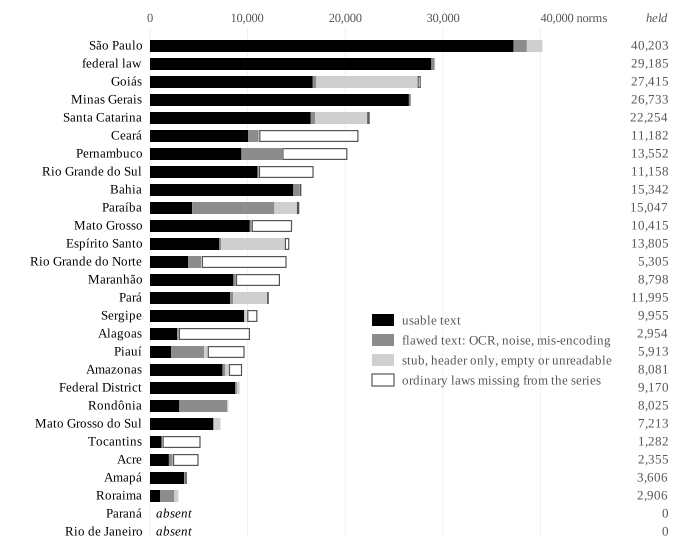
Experiment 1.1 (The corpus against its sources).
Setup: Forty norms in fifteen strata, federal and state, scanned and born-digital, drawn by a seeded hash and downloaded again from the official sources on 15 October 2026.
Parameters: Summary, article count and one random article compared by text similarity; six scans without a text layer read by eye.
Result: All 32 machine-comparable texts match, with similarity 0.88 to 1.00 (1.00 for every web page); header-only records are header-only at the source. Of the six scans, four are right word for word, one has wrong ordinals ("19 de maio" for "1º de maio") and one is degraded.
Shows: The corpus copies faithfully, so its defects are its sources'. Forty norms give no error rate per state, and federal texts were compared only with normas.leg.br, as Planalto was unreachable that day.
1:14 A clean text may still be out of date. Only Goiás, Mato Grosso and the Federal District label most of their texts consolidated, so elsewhere a state law may have been amended or revoked without its file showing it. Federal files hold the compiled text for 9.3% of federal norms, and the repair checked the amended ones.
1.3 Who can read it
Definition 1.1 (Unreadable share). The unreadable share of a part of the statute book is the share of its ordinary laws that a machine reader cannot get as clean text: one minus the coverage of its numbered series times the clean share of the laws present.
1:16 Rio de Janeiro and Paraná are wholly unreadable. Piauí and Tocantins stand at 78%, Rio Grande do Norte at 76%, Alagoas at 74% and Paraíba at 72%, against 7.6% for São Paulo, 0.7% for Minas Gerais and 1.1% for federal law. Weighted by population, 36% of state statute law is out of a machine reader's reach, an estimate in which Rio de Janeiro and Paraná carry more than a third of the weight.
1:17 Reading the law does not cost everyone the same. A firm in Paraíba finds its state's incentive rules in scans, where a firm in Minas Gerais searches them. The gap pays whoever holds clean copies or can pay to read scans, state staff, legal publishers and the large firms that buy from them, and it is paid by small firms in the unreadable states and by every machine reader, this book included.
1:18 Closing it is lawful. Laws carry no copyright: "Não são objeto de proteção como direitos autorais [...] os textos de tratados ou convenções, leis, decretos, regulamentos, decisões judiciais e demais atos oficiais", the texts of laws, decrees, rulings and other official acts are not protected (Lei 9.610/1998 art. 8). The LAI, the access-to-information law, makes a public body answer "em prazo não superior a 20 (vinte) dias", within twenty days, extendable by ten (Lei 12.527/2011 art. 11). So the 31,891 norms of Paraíba, Roraima, Piauí and Rondônia can be read again with a layout-aware OCR model, Pernambuco's encoding repaired and the missing laws requested. The line is Paraná's firewall: a portal that refuses machines gets a request for access, never a way around it (Chapter 17).
Forecast 1.1 (Paraná or Rio de Janeiro enters the corpus). By 31 December 2027, the public ctresb/leis repository holds the statutes of Paraná or of Rio de Janeiro.
- Horizon
- 2027-12-31
- Probability
- 45%
- Check
- Read the repository's coverage table on 31 December 2027. The forecast holds if Paraná or Rio de Janeiro shows at least 1,000 norms; it fails if both show fewer.
1.4 The repair
1:20 The federal texts needed repair first. Where normas.leg.br had no compiled text, the downloader took the latest publication, sometimes a correction notice or the promulgation of overridden vetoes. LC 214/2025, the law of the consumption-tax reform, held 1,263 characters: "Faço saber que o Congresso Nacional decreta e eu promulgo [...] as seguintes partes vetadas da Lei Complementar nº 214", the promulgation of the parts whose veto Congress overrode, then two items of its art. 26.
1:21 I screened all 8,584 federal norms stored as republications. 347 held a fragment: 300 correction notices, 27 promulgations of overridden vetoes and 20 false "full republications", one of them the 2023 budget law as 4.5 million characters of raw PDF code. All 347 now hold the whole law. LC 214 runs to 870,551 characters and 579 article headings, its 544 articles plus those later laws inserted, as compiled on planalto.gov.br.
1:22 I then compared 3,073 federal laws with Planalto's compilations, among them all but four of the laws the citation graph shows amended and unrevoked. 1,569 were current. 649 were replaced: 206 compiled texts missing a recent amendment (the data-protection law, Lei 13.709/2018, lacked Lei 15.352 of 2026) and 443 enacted or republished texts that later laws had changed. 854, nearly all from before 1988, kept their text for want of a Planalto page that passed the checks.
1:23 In all, 976 federal norms were rebuilt, 666 from Planalto's compiled text, 309 from the original publication and one from a genuine full republication. Nineteen are new: eleven ordinary laws, seven decree-laws and LC 227/2026, which created the management committee of the IBS (the new value-added tax shared by states and municipalities) and rewrote much of LC 214. Planalto also showed 125 laws revoked whole that the catalogue listed in force, and they went into the status counts of §6.1.
1:24 A text rebuilt from the original publication is current only if nothing amended it later, and Planalto drops revoked articles, sometimes without a note, so read federal texts here as of 16 October 2026. I would trust a count over federal law to the unit, over Minas Gerais or São Paulo to a few percent, and over Paraíba or Roraima only as a floor.
2 What the law is made of
2:1 Most of Brazil's statute book does not set rules. Of the 323,867 norms in the corpus besides the Constitution (ctresb/leis, a snapshot of 13 October 2026), about 36% honour someone or something, 24% perform a single act, 22% organize the state's own organs and staff, and about 18% set general rules for everyone else. Rules on the economy and taxes are about a tenth. I sorted the norms with a classifier and then corrected its count with a held-out audit, because left to itself it files a quarter of the book as rules.
2.1 Twelve classes
2:2 The classifier reads each norm's ementa, the one-sentence summary at the head of a Brazilian law, and applies 35 ordered rules; the first that matches decides. A norm that no rule fits takes the class of its first article, and a bare amendment the class of the law it amends. The twelve classes fall into five groups:
- symbolic acts: declarations that an association is of utilidade pública (public utility), names of places and buildings, commemorative dates, honorary titles, heritage declarations and state symbols;
- one-off acts: budget laws and credit openings, transfers of public property, single acts such as a pension to a named person, and laws that only revoke;
- the state's organization (organs, courts, schools, municipalities) and its personnel (posts, careers, pay);
- general rules, in four classes: tax, economic, social and a residual class;
- files without text.
Definition 2.1 (General rule). A general rule is a norm that sets conduct, rights, taxes or procedures for an open class of persons or situations outside the state's own organs and staff. A norm that honours, performs a single act or organizes the state is not one, whatever its wording. In the classifier, general rules are the tax, economic, social and residual classes.
2:5 As filed by the classifier, 34.6% of the 323,867 norms are symbolic, 21.5% one-off acts, 18.3% the state's organization and personnel, 24.9% general rules and 0.6% files without text. Federal law has another shape: 4.7% symbolic, 41.0% general rules, and 28.6% budget laws and credit openings. The Union's statute book is a budget instrument as much as a rule book.
2:7 To measure the error, I drew a fresh sample of 290 norms, stratified by the class the classifier gave and disjoint from every sample used to write its rules, and judged each by hand from its ementa and first article. The economic class was right 18 times in 40, the social class 21 in 38 and the residual class never: organs of the state, one-off acts, social policies and transfers of property are often written in economic or social words. An earlier audit had caught festivals the same way, such as São Paulo's Lei 10.063/1968, "É oficializada a 'Festa da Soja'" (the Soy Festival is made official).
Experiment 2.1 (Correcting the count with a held-out audit).
Setup: a fresh sample of 290 norms, stratified by predicted class (10 to 40 per class) and disjoint from every sample used to write the rules, judged by hand from ementa and first article; 280 could be judged. Two faults the sample revealed were fixed afterwards, and their small gain was measured on a separate random sample of the 1,119 norms they moved.
Parameters: precision per class with Wilson 95% intervals, totalled with weights equal to each class's share of the corpus. The corrected number of norms truly in class is , where is the number filed in class and the probabilities come from the sample.
Result: precision 0.845 (0.816 to 0.874). Symbolic acts were right 30 times in 30 and tax laws 23 in 24. General rules fall from 24.9% as filed to 17.7% (15.2% to 20.2%), about 57,000 norms; rules on the economy and taxes from 13.1% to 10.2% (8.4% to 12.1%). About 23,000 norms leave general rules: 11,700 to the state's organization and personnel, 7,200 to one-off acts and 4,400 to symbolic acts.
Shows: a word-based classifier over-files rules, because organs, single acts and honours are often written in the vocabulary of rules. The correction holds for the whole corpus only.
2:9 Corrected, the five groups are symbolic acts 36.0%, one-off acts 23.7%, the state's organization and personnel 21.9%, general rules 17.7% and files without text 0.6%. The sample is too small to correct each state or decade, so the shares below are as filed and overstate rules.
2.2 Decades and states
2:10 Symbolic law is a habit the states acquired after 1950, and federal law has caught it since 2000. Symbolic acts were about 2% of state norms before 1940, 9% in the 1950s, 18% in the 1960s, 40% in the 1970s and between 42% and 47% in every decade since. The number of states with at least 50 norms in a decade grows from 10 in the 1940s to 24 in the 1990s, so the early decades mix habit with coverage.
2:11 Federal symbolic acts went from 1.3% of federal norms in the 1990s to 10.0% in the 2000s, 18.8% in the 2010s and 23.4% in the 2020s. The 2020s brought 157 commemorative dates, 111 honours, 64 namings and 41 heritage declarations, such as Lei 14.354/2022, "Fica instituído o Dia Nacional do Espiritismo" (a National Day of Spiritism is instituted). A federal filter has existed since December 2010: Lei 12.345/2010 makes every commemorative date depend on "alta significação" (high significance) shown in documented public consultations and hearings. The symbolic share rose from 10.0% in the decade before it to 18.8% and 23.4% in the two after.
2:12 In state law, general rules grew at the expense of one-off acts and the state's own organization, while the symbolic share held. Rules were 11.9% of state norms in the 1980s and 35.9% in the 2020s, and rules on the economy went from 7.3% to 19.6%; one-off acts fell from 18.4% to 9.2%.
2:13 The states split into two families. In 2015-2024, 74.3% of São Paulo's 2,589 laws were symbolic: 851 namings of roads and buildings, 519 declarations of utilidade pública and 518 commemorative dates. A typical one is Lei 17.775/2023, "Passa a denominar-se 'Mario Paulo' a passarela para pedestres PAS 200/270" (footbridge PAS 200/270 is named Mario Paulo). Pará (69.8%), Minas Gerais (66.2%) and Bahia (59.3%) are in the same family and spend 8% to 13% of their laws on the economy. The Federal District, Mato Grosso, Pernambuco, Rio Grande do Sul and Roraima spend 12% to 28% on symbolic acts and 27% to 33% on the economy. Part of the gap is custom, where a naming needs a law, and part may be what each portal publishes; the corpus cannot tell them apart.
2:14 Output does not scale with population. Each state passed between 128 laws a year (Roraima) and 455 (Goiás) in 2015-2024, while populations differ by a factor of 62, so Roraima passes 17.3 laws a year per 100,000 inhabitants and São Paulo 0.56. What a firm meets is the count of new rules on the economy, and it is just as flat: São Paulo, with 22% of the population, adds about 25 a year, as many as Sergipe and fewer than Amapá (34), against 96 in Amazonas and 97 in Pernambuco.
Forecast 2.1 (Federal honours keep their fifth). At least 20% of the federal ordinary laws enacted in 2027 and 2028 are symbolic.
- Horizon
- 2029-03-31
- Probability
- 70%
- Check
- Count the commemorative dates, honours, namings, honorary titles and heritage declarations among the leis ordinárias of 2027 and 2028 listed on planalto.gov.br; the forecast holds at 20.0% or more.
2.3 Duties, taxes and funds
2:16 The economic tenth is a mix. A flag that marks general rules on taxes, markets, firms, consumers, work, sectors or the environment covers 48,248 norms (14.9%; 26.2% of federal and 13.8% of state norms), 42,360 of them in force. It inherits the weakness of the economic class, so it is an upper bound on the corrected 10.2%. Taxes are its largest theme (16.3% of flagged norms), then public administration (11.2%), industry and trade (10.3%), transport (9.0%), finance (6.2%) and the environment (5.5%).
2:17 State and federal rules act differently. Of the 68,739 state general rules, 21.3% carry a sanction, 20.9% an obligation, 13.5% a prohibition and 13.1% a permission, while only 10.7% grant a credit or subsidy and 7.5% a tax exemption or reduction. The 11,971 federal general rules amend more (24.6%), permit more (19.5%), subsidize more (14.6%) and exempt more (11.4%). State rules command and punish; federal rules amend, permit and pay.
2:18 The classifier also produced four lists that later chapters use:
- 5,242 general rules in force, as of October 2026, that oblige or forbid something to businesses, 3,608 of them with a sanction clause and 697 federal, such as Santa Catarina's Lei 17.727/2019, under which hotels, bars and bakeries "devem utilizar canudos fabricados com materiais biodegradáveis, recicláveis ou esterilizáveis e reutilizáveis" (must use straws made of biodegradable, recyclable or sterilizable and reusable materials);
- 2,007 state norms that grant or amend benefits in the ICMS, the state tax on goods and some services, 1,885 of them in force, led by Goiás (173), Mato Grosso (168), Pernambuco (154), Amazonas (131), Espírito Santo (121) and Santa Catarina (120);
- 2,201 laws that create a fund, 2,105 of them state laws;
- 2,163 norms with five or more definitions, led by LC 214/2025, the complementary law of the new value-added taxes, with 150, and the procurement law, Lei 14.133/2021, with 115.
2:20 Spot checks of random rows found 13 genuine duties on business in 15, 9 rows of 12 that grant or amend an ICMS benefit, and 7 fund creations in 8. Many ICMS norms depend on agreements of CONFAZ, the council of the states' finance secretaries whose unanimous approval ICMS incentives need, and the corpus holds none of them; each programme's basis is checked in §9.1.
2:21 New economic law arrives at about 990 to 1,280 statutes a year. The 24 states with data in 2015-2024 added about 1,213 a year by the flag and the Union about 64, before Paraná and Rio de Janeiro, which the corpus lacks. If the flag overstates as much as the economic and tax classes do (a ratio of 0.77 between corrected and filed counts), the figure is about 990. A firm present in many states must watch each assembly, and each writes in its own vocabulary.
2:22 The lawful opening is information. Removing the symbolic acts, the one-off acts and the state's own organization cuts what a compliance or legal-research tool must read by 75% to 85%: from 323,867 norms to 80,710 filed general rules, of which about 57,000 are truly rules. A feed of the thousand new economic statutes a year, with the duties that bind a firm marked, is a product a small team can build, of the kind Compile the law describes. The public side holds the same filter: an assembly can see how much of its output honours and how much rules.
2:23 The audit has one reader. I judged every sampled norm myself, without a second annotator, and some boundaries are conventions: a law fixing the strength of the military police counts as organization, a career law as personnel. The economic class (0.45) and the social class (0.55) are candidate lists until a second pass reads them, and comparisons between states hold only if the classifier errs alike everywhere, which I have not tested.
2:24 The corpus also bounds what can be counted. It lacks Paraná, Rio de Janeiro, decrees, provisional measures, CONFAZ agreements and municipal law. State texts are mostly original enactments, and "in force" means not known to be revoked or struck down (§6.1), so the 42,360 economic norms in force overstate the rules that bind today.
Part II. The geometry
3 No small skeleton
3:1 Brazil's statute law cannot be generated from a few principles. Turned into vectors of their words, its rules keep pointing in new directions: in a greedy orthogonal basis of federal law in force, the fiftieth law picked still has 88% of its length outside the span of the first forty-nine, and across federal and state rules together 95%. Near twins are rare, about one norm in forty, and those that cross a state line are model laws copied from one assembly to the next.
3.1 A space of words
3:2 The space holds 102,944 norms of the corpus (ctresb/leis, a snapshot of 13 October 2026), 14,443 federal and 88,501 from 24 states and the Federal District: those that a first pass of the classifier filed as rules, a wider net than the final count of Chapter 2, and that have enough clean text. Before embedding, I removed 10,495 concrete acts among them (a named school, a pension, a credit opening) and 5,428 lines of site boilerplate that recur across one portal's texts and cite no law.
3:3 Each norm becomes a vector of its words. Accents are folded and words lightly stemmed; single words and pairs of words are weighted by TF-IDF, a count damped by a logarithm and multiplied by how rare the term is across norms. The 200,000 commonest terms feed a truncated singular value decomposition (SVD) that keeps 200 dimensions and 13.1% of the variance of the weighted counts. Every vector is then scaled to length 1, so the cosine of two norms is their dot product: 1 for the same words in the same proportions, 0 for nothing in common.
3:4 A second space drops the words of action. A lexicon of ten operators (obligation, prohibition, permission, exemption, taxation, benefit, sanction, definition, authorization of the Executive, creation) is removed from the text, and what remains is the subject. Two laws on the same subject with opposite operators are close in that space and far apart in their operators; Chapter 4 reads them.
3:5 The strongest axis separates authorizing and financial laws ("executivo autorizado", "despesa": the Executive is authorized, expenditure), older on average, from social policy ("saúde", "criança", "violência": health, child, violence). Of twenty theme clusters, the largest (11,140 norms, 97% of them state law) is duties on establishments and the rights of persons with disabilities.
3.2 The basis
Definition 3.1 (Orthogonal basis). An orthogonal basis of a set of norms is built by picking one norm at a time: each pick is the norm with the largest part outside the span of the norms already picked, and that part, scaled to length 1, is the new direction it adds. The residual of a pick is the length of that part, 1 for a norm wholly new and 0 for one the earlier picks already express.
3:7 In symbols, with the unit vector of norm and the matrix whose columns are the directions found so far, the -th pick is the norm that attains
3:9 where is the set of norms already picked. This is Gram-Schmidt with pivoting, the pivoted QR of numerical linear algebra. The first pick is the medoid, the norm closest to the subset's mean direction; for federal law in force it is the 1957 reform of the customs tariff, Lei 3.244/1957. Candidates need at least 100 words of content, so that a two-line act cannot win on one rare word.
3:10 The residual falls slowly. Among the 13,051 federal norms in force, the tenth pick keeps 0.991 of its length outside the span of the earlier ones, the thirtieth 0.943, the fiftieth 0.879 and the hundredth 0.666. The fiftieth is Lei 12.089/2009, which "Proíbe que uma mesma pessoa ocupe 2 (duas) vagas simultaneamente em instituições públicas de ensino superior" (forbids one person to hold two places at once in public universities). A residual of 0.879 puts the law about 61 degrees away from the span of the forty-nine laws before it. Across all 102,944 norms the fiftieth pick keeps 0.954, and within single states 0.883 in São Paulo, 0.875 in Minas Gerais and 0.858 in Rio Grande do Sul.
3:12 The first picks are one law per genre and era. After the customs tariff come the limits of the Parque Nacional de Brasília (Lei 11.285/2006), a tourist Route of Faith in Ceará (Lei 15.445/2026), the navy's strength for 1854-1855, a campaign for the health of pets and stray animals and the military statute. By decade, the largest groups among the first fifty come from the 2020s (13), the 1940s (8) and the 2000s (7): new laws open new subjects, and the decree-laws of the Vargas years still in force keep a vocabulary of their own. None of the great codes is among them, since the rule picks extreme points and importance plays no part in it.
3:13 In federal law, duties supply the most new directions and taxes the fewest. Laws that impose one duty on one kind of establishment ("dispõe sobre a obrigatoriedade", it provides for the obligation), such as cinemas, hospitals, schools or condominiums, are 2.2% of federal law in force and supply 5 of the first fifty picks, 4.5 times their share; in São Paulo, Minas Gerais, Rio Grande do Sul, Santa Catarina and Bahia, 2.4 to 3.2 times. Tax and exemption laws are 12.3% of federal law in force and supply 3, at 0.49 times their share. They share one vocabulary ("fato gerador", "alíquota", "base de cálculo": taxable event, rate, base), so federal tax law is a dense bundle of nearly parallel vectors. The states are less clear: tax laws supply about their share in Rio Grande do Sul and more than twice it in São Paulo.
3:14 Inside a bundle of parallel laws, asymmetries are differences of parameters: a rate, a ceiling, a date. The seams with the largest sums are of that kind, numbers, borders and dates (Definition 0.1; Chapter 7, Chapter 9, Chapter 12). Duties are where the law keeps inventing subjects, one establishment at a time, and each new duty is a cost to someone that no earlier law prepared for (Chapter 13).
3.3 What the curve can show
3:15 The curve cannot stay high forever. The vectors have 200 dimensions, so 200 picks span the whole space and a 201st would add nothing: the residual must bend toward zero at the right end, and the 200th federal pick keeps only 0.112. The question is how fast it falls before then. A small skeleton would show as a cliff: if twenty principles generated the statute book, the twenty-first pick would add almost nothing. The federal curve has no cliff anywhere; the twentieth pick keeps 0.970 and the fiftieth 0.879. The spectrum agrees: within the 200 dimensions, the twenty strongest principal directions of federal law in force hold 44% of its variance and the fifty strongest 67%.
3:16 A slow fall could still be a property of any cloud of points in 200 dimensions, so I ran the same rule on clouds with no law in them.
Experiment 3.1 (The basis against clouds without law).
Setup: the greedy rule of (3.1) on federal law in force (13,051 norms) and on all norms (102,944), and on three random clouds of the same size in the same 200 dimensions: isotropic (directions drawn uniformly), shuffled (each coordinate permuted across norms independently, which keeps every axis's spread and destroys which norms load on which axes together) and matched (Gaussian with the subset's own mean and covariance, which keeps the spectrum and nothing else).
Parameters: unit vectors throughout; three seeds per random cloud, averaged; the real data start from the medoid and admit only norms with at least 100 words of content.
Result: at the fiftieth pick, federal law in force keeps 0.879, against 0.937 for the isotropic cloud, 0.901 for the shuffled one and 0.824 for the matched one; at the hundredth, 0.666 against 0.810, 0.755 and 0.617. For all norms, the fiftieth pick keeps 0.954, against 0.946, 0.916 and 0.901.
Shows: federal law has more shared structure than noise, since its curve falls faster than the isotropic and shuffled clouds, and less concentration than its own spectrum would give a smooth cloud, a sign that the rule keeps finding laws that sit almost alone on an axis. The all-norms curve stays at or above the isotropic cloud for about its first hundred picks.
3:18 So the federal curve carries the finding, and the all-norms curve is harder to read. A cloud stays above noise when its points sit in many small groups along separate axes, and among 102,944 texts the rule also finds the strangest: a Santa Catarina law of 1997 stored without an ementa, a São Paulo provincial law of 1858 on flood relief, an Amapá law that may owe its place to a site notice left in the texts. Diversity across 26 legislatures and stray texts both lift the curve, which cannot tell them apart.
3:19 Three limits remain. The space is lexical: two laws with different words can have the same effect, and Chapter 4 shows laws with the same words and opposite effects. The SVD keeps 13.1% of the weighted counts' variance, and a richer embedding would draw a different curve, with the forced bend coming later as dimensions are added. And the basis covers the norms filed as rules, about a third of the corpus, without Paraná and Rio de Janeiro.
3.4 Uniqueness and twins
Definition 3.2 (Uniqueness). The uniqueness of a norm is one minus the largest cosine between its weighted word vector and that of any other norm in the space: 0 for a norm with an exact twin, near 1 for a norm that shares almost no weighted vocabulary with any other. A near twin is a norm whose closest neighbour has a cosine of 0.95 or more.
3:22 Here is the full TF-IDF vector of norm , not its 200-dimension projection: the 20 nearest candidates of every norm are found in the reduced space and rescored with the exact cosine.
3:23 Federal law is more singular than state law. The median uniqueness is 0.742 for federal norms and 0.677 for state norms (0.687 overall). By source it runs from 0.810 in Paraíba, partly because scanned texts full of reading errors make each text lexically unique, through 0.735 in Acre and 0.726 in Roraima, down to 0.606 in Mato Grosso, 0.597 in Alagoas and 0.584 in Tocantins. Short norms are more singular than long ones (0.710 below 200 words of content, 0.574 above 1,000), because long statutes share more vocabulary. Tax laws, the parallel bundle of the basis, have the fewest twins of any class (1.9%): they share words and differ in numbers.
3:24 The most singular substantive norms are subjects no one else legislated. Paraíba's Lei 10.319/2014 assures cancer patients access to techniques that preserve their gametes (uniqueness 0.983); Bahia's Lei 2.953/1971 sets rules for exporting timber (0.983); Rondônia's Lei 3.653/2015 institutes the religious freedom of the Hoasca, a ritual tea (0.960).
3:25 Near twins are 2.40% of norms: 2,471 have a neighbour at cosine 0.95 or more, 0.87% of federal norms and 2.65% of state norms. Looser thresholds find more (9.0% at 0.8, 4.3% at 0.9). Of the 2,471, 1,748 sit in the same source, and 759 of those, at a cosine of 0.999 or more, are mostly one law stored twice, in Ceará and Santa Catarina above all, a fault of the records that says nothing about the law.
3:26 The other twins travel. Forty-one pair a federal law with a state law, and 682 (0.66% of norms) copy another state's law, mostly programmatic laws of the last fifteen years with Mato Grosso at the centre: 41 norms between Mato Grosso and Amazonas, 23 with Mato Grosso do Sul, 16 with Goiás. Alagoas's Lei 9.747/2025, which institutes a programme of fairs for rural women, re-enacts Mato Grosso's Lei 10.902/2019 at a cosine of 0.986. These are the closest members of the copy families of §5.1, which, matching five-word sequences instead of vectors, find a twin in another state for 3,479 state laws, and the places where one copy differs from another are seams of their own (§4.2).
3:27 The practical reading is that the statute book cannot be learned from templates. With fewer than one norm in forty close to another and no small set of directions behind them, a firm's obligations have to be read law by law, state by state; the basis orders that reading, most independent first, and the twins map who copies whom.
3:28 Uniqueness is lexical. Reading errors in scanned texts raise it, duplicate records lower it, and two laws may share almost all their words and differ in the one that decides who must act. State texts are mostly original enactments, so two twins may since have been amended apart.
4 Same ground, opposite pull
4:1 Where two Brazilian laws on one subject pull in opposite directions, they are usually laws of two states, and often one text copied with its verb changed. In the corpus (ctresb/leis, a snapshot of 13 October 2026; tables in Appendix B), 10,156 pairs of laws from different states sit close in subject. I read the thirty strongest families of such pairs by hand: eight held a true opposition, seven of them between states, and three more gave the same duty a fine in one state only. The seams are state borders made of one word or of a missing sanction (Definition 0.1).
4.1 Same subject, opposite operators
Definition 4.1 (Coupled pair). A coupled pair is two laws in force whose subjects nearly coincide, measured on their texts with every word of action removed, and whose operators oppose: one obliges what the other permits, permits what the other forbids, or taxes or fines what the other exempts or grants.
4:3 The action of a law is its weighted count of ten operators, from obligation to creation (§3.1). Pairs whose subject vectors and have a cosine of at least 0.6 are ranked by
4:5 where is the difference between the two laws' shares of each operator, split into positive and negative parts, holds the six opposed pairs (permission against obligation or prohibition, taxation against exemption or benefit, sanction against exemption or benefit), and is a polarity: relief (permission, exemption, benefit) minus burden, over their sum plus one. Identical profiles score zero.
4:6 At a subject cosine of 0.6 or more there are 10,156 pairs of laws from different states, 1,764 federal pairs and 501 federal-state pairs. Rules of evidence (both laws in force, a whole operator of difference on each side, no amendment linking them) keep 456, 43 and 48. States legislate on each other's subjects: in 16 of 25 state units fewer than 16% of a norm's fifteen nearest neighbours come from its own state, while 67% of a federal norm's neighbours are federal.
4.2 Thirty families read
Experiment 4.1 (Thirty families read by hand).
Setup: the three rankings of (4.1) read from the top, one entry per family of pairs from one model law: 20 families between states (the first 30 state ranks), 6 federal-state and 4 federal. Operative sentences were cut by script and read beside the full texts.
Parameters: the rules of evidence above; seven verdicts; four of the laws quoted below checked on their official sites on 16 October 2026.
Result: 8 true oppositions (7 between states, 1 between two federal land grants of the 1940s), 3 fines in one state only, 5 changes of grammar, 4 restatements of federal law, 3 federal frames with state execution, 1 rider, 6 false positives. No federal-state family opposes, and none of the four laws checked shows a later amendment as of October 2026.
Shows: opposition lives between states, inside copied texts, and the measure reads grammar. The family ranked first, a monthly cinema session for children with autism, sets Mato Grosso's "ficam ... obrigadas a reservar" (are obliged to reserve, Lei 13.256/2026 art. 1) against São Paulo's "Fica assegurado o direito" (the right is assured, Lei 18.394/2026 art. 1), but São Paulo's art. 4 gives the cinemas sixty days to comply: both bind.
4:9 The plainest opposition is one verb. Pará's schools "ficam obrigados a exporem" (are obliged to display) the harms of drugs, alcohol, tobacco and sexually transmitted infections (Lei 5.824/1994 art. 1); Amazonas's 2008 law has the same sentence with "ficam facultados a exporem" (are allowed to display, Lei 3.295/2008 art. 1). A school network in both states owes the notices in Pará only. Neither law names a sanction, and a school needs no law to post a notice, so the Amazonas text changes only the record.
4:10 In the second the duty moves to the parents. Espírito Santo (Lei 11.305/2021) and Pará (Lei 9.877/2023) both make hospitals and maternity wards train the parents of newborns in first aid before discharge. In art. 1 § 2, Espírito Santo writes "É facultado aos pais e/ou aos responsáveis a adesão ao treinamento" (parents may join) and Pará "Fica obrigatório aos pais, mães ou responsáveis legais participarem da capacitação" (parents must attend). A hospital group in both states trains every parent in Pará and only volunteers in Espírito Santo; neither law says what follows a refusal.
4:11 The third is fiscal. Federal Lei 10.604/2002 art. 5 subsidizes the electricity tariff of low-income households, and two units treated ICMS, the state tax on goods and some services, as due on that subsidy. Mato Grosso granted "a isenção do ICMS, incidente exclusivamente sobre a parcela da subvenção" (exemption on the subsidy portion alone, Lei 8.233/2004 art. 1) and forgave the tax due since May 2002. The Federal District waived only "multas e juros do ICMS devido" (fines and interest on the ICMS due) for May 2002 to August 2004 (Lei 3.563/2005 art. 1). For those twenty-eight months one federal subsidy was tax-free in Mato Grosso and taxed in the Federal District. An ICMS exemption needs the unanimous approval of CONFAZ, the council of state finance secretaries; whether either law had it, the corpus cannot show (§9.1).
4:12 The other four flip a duty or a ban into an option: breastfeeding rooms that Rio Grande do Norte requires of its public bodies and Roraima's law only "autoriza"; signage of ecological sites, compulsory in Mato Grosso do Sul and, in Pará's near-identical text (subject cosine 0.91), something the Executive "fica autorizado" to install; a census of persons with autism that Mato Grosso orders and Maranhão's government "poderá" (may) run; and a second term for the state prosecution service's ombudsman, allowed in Pernambuco and forbidden in Rio Grande do Sul.
4:13 The usual flip makes a lei autorizativa, a law that "authorizes" the Executive to do what it could already do and binds no one, or a right that no one must honour. For a firm in several states this is lawful room: each text binds only in its own state, so a cinema chain, a hospital group or a school network can budget compliance state by state rather than apply the strictest text everywhere (Chapter 17). An advocate can propose, where only the authorizing version exists, the binding one already in force in another state.
4:14 Federal and state laws restate rather than oppose. Rio Grande do Sul's 2025 suicide-prevention programme copies federal Lei 13.819/2019 but turns its "deverão informar e treinar" (must inform and train) into "poderão" (may, Lei 16.317/2025 art. 5 § 4); the federal duty binds there anyway, so the state text only misleads its reader.
4:15 Among federal laws the ranking found mostly templates, and two finds. A minimum-wage law, Lei 12.382/2011, rewrote the criminal-tax rule of Lei 9.430/1996 art. 83: an instalment plan requested before the criminal complaint is received suspends punishment, and full payment ends it (§17.1). And Lei 6.938/1981 art. 17-P lets an establishment credit the environmental inspection fee it pays a state, such as Ceará, Mato Grosso or Alagoas, against up to 60% of the federal one, the TCFA, of the same year: at most about R$5,400 a year per establishment (an estimate at the top quarterly rate the corpus stores).
4.3 Duties without a price
4:16 The second seam is a missing sanction. Of 5,242 general rules in force that oblige or forbid something to businesses, 3,608 (69%) carry a sanction clause (§2.3): 78% of federal duties and 67% of state ones, from 51% in Rio Grande do Sul to 82% in Minas Gerais among states with a hundred or more, and 63% of the duties enacted since 2020 against 72% in the 2010s. The flag is lexical; a check of fifteen rows found thirteen genuine duties.
4:17 Inside copy families the sanction is often all that differs. Goiás re-enacted São Paulo's half-price tickets for teachers (Lei 10.858/2001) in 2004 and later added "pena de multa de R$ 1.000,00 (mil reais) a R$ 5.000,00" (a fine of R$1,000 to R$5,000), doubled on recurrence (Lei 14.975/2004 art. 3-A); São Paulo's text has no sanction. Rondônia fines a refused half-price ticket for blood donors; Rio Grande do Norte does not. Of the four states that require the cinema session, only Amazonas fines the cinema, R$1,000 to R$5,000 per infraction, enforced by its Procon, the state consumer agency (Lei 4.892/2019 arts. 5 and 7).
4:18 For consumer duties, federal law supplies the missing price. Art. 56 of the consumer code, the CDC (Lei 8.078/1990), reads "As infrações das normas de defesa do consumidor ficam sujeitas, conforme o caso, às seguintes sanções administrativas" (infractions of consumer-protection rules are subject to the following administrative sanctions), from a fine to closing the establishment. Art. 57 grades the fine by the gravity of the infraction, the advantage gained and the supplier's means, from 200 to 3 million times the Ufir, a federal unit of value. The rule covers consumer-protection rules in general, so a state or municipal Procon can fine the breach of a state consumer law that names no fine. Of the 5,242 duties, 995 concern consumers and 235 of those name no sanction: for them the gap between states is narrower than the texts suggest.
4:19 A duty without a fine still binds, and the person it protects can claim it in court (Chapter 17). That person pays for the gap: a teacher refused a half-price ticket in São Paulo pays full price, while in Goiás the venue risks R$1,000 to R$5,000. The cheap fix is a clause naming a sanction, an enforcing organ and a deadline (§18.2).
4:20 Three limits matter. Thirty families are a reading, not a rate: reading the 456 eligible pairs between states would say how many of the 10,156 hide a real opposition. The measure counts words, so it read five changes of grammar as oppositions and six lexicon errors, such as a cancer's "incidência", as fiscal operators. And state texts are mostly original enactments, Paraná and Rio de Janeiro are missing, and only four of the laws quoted here were checked on their official sites (§1.2).
5 Copies
5:1 Copying is the opposite of orthogonality. Where the basis of Chapter 3 keeps finding new directions, a copy family enacts one direction again, state after state: 3,479 of the 101,839 state laws I compared (3.4%) have a near-identical twin in another state. Copies spread within about two years or almost never, they flow from a few drafting assemblies to a predictable set of copiers, and when the Supreme Federal Court (the STF) strikes one member of a family the rest stay on the books until someone challenges each. Each copy, and each missing one, is a border seam (Definition 0.1).
5.1 Families
5:2 I compared every state and federal law with every other by its five-word sequences, after removing names, numbers, dates, standard clauses and amendment notes. In the corpus (ctresb/leis, a snapshot of 13 October 2026, published in Appendix B), 2,592 pairs of laws from different states share at least half their sequences, 310 share four-fifths and 55 match almost word for word.
Definition 5.1 (Copy family). A copy family is a set of laws from two or more jurisdictions joined by near-identical texts: two laws are joined when their five-word sequences, once names, numbers and standard clauses are removed, have a Jaccard similarity of at least 0.5. The earliest member is the first adopter; every later one is a copy. A loose rule (0.3, for longer texts) adds reworded copies at some cost in precision.
5:4 The strict rule gives 1,455 families and the loose rule 2,393, leaving apart the federal deals every state signs at once. Most are pairs; 40 strict and 160 loose families reach five or more states, and the largest reach 16 of the 25 jurisdictions in the corpus: Adote uma Escola, which invites companies to help state schools (Acre 1996, 16 states by 2016); a duty on health plans to explain in writing why they deny coverage (Minas Gerais and Mato Grosso 2006, 13); Sinal Vermelho, a signal by which women facing domestic violence ask for help (Federal District 2020, 13); and the Plano Vini Jr against racism in stadiums (Amazonas 2023, 10 by 2026). Copies come fast and then stop: the median follower adopts 2.2 to 2.3 years after the first state, and a state's yearly odds of copying fall to 0.43 of the first year's at three to four years and 0.13 at eight to fifteen.
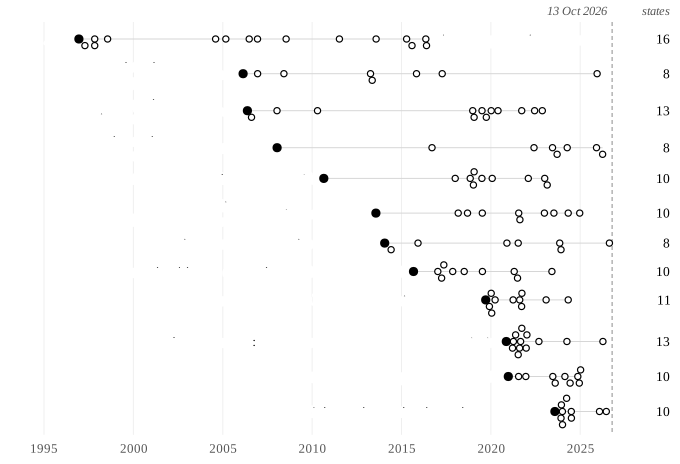
5:6 A few assemblies write and the rest copy. Minas Gerais is the first adopter in 111 of the 113 strict families it belongs to and São Paulo in 87%; Mato Grosso (229 copies made), Amazonas (222) and Amapá (162) copy the most. Borders do not decide whom a state copies: 21.3% of copies take their text from a bordering state, against 20.9% expected if each copier had picked at random among the states that had already adopted, and the busiest route, Mato Grosso to Amazonas (27 copies), crosses regions. The text travels by other channels, probably assembly staff, parties, advocacy groups and bill searches. The Union is a source in 139 loose families and a follower in 15 (equoterapia entered Federal District law in 2016 and federal law in 2019), so a state duty spreading while a federal bill is pending announces a national rule.
5.2 Missing copies
5:7 Families of four or more states leave 5,907 holes, cells where a state lacks a law most others adopted. A hole's sign depends on who looks. For a firm operating in many states, a hole in a family that obliges businesses is a duty not yet arrived; for the public side, a hole in a program that works is a law ready to take (§18.2). I priced the holes with the adoption model, tested on years it had not seen.
Experiment 5.1 (Predicting the next state).
Setup: a logistic model on family, state and year for the loose families first adopted from 1995 on; a state is at risk from a family's first adoption until it adopts. Covariates: who had adopted (all states, neighbours, region), a federal law, years since the first adoption, state and subject.
Parameters: fitted on years up to 2020; predicts adoption in 2021-2023 for the 32,328 (family, state) pairs at risk at the end of 2020.
Result: 527 pairs adopted. AUC 0.80; mean prediction 1.28% against 1.63% observed; the riskiest tenth was forecast at 4.5% and adopted at 7.3%.
Shows: the model ranks the holes well and predicts too little at the top.
5:9 The low numbers are the finding. Fitted through 2025, the model gives no hole more than 0.13 of closing by a verbatim copy in 2027-2029, and over all holes it expects about 90 adoptions in those three years after correcting for the backtest's shortfall [estimate: 70.8 × 1.27]. For families still spreading it is low by half (4.0% of their holes closed within three years in 2008-2022, against 2.05% forecast for today's), yet 58% of such families gained no state in three years. And 35% of the holes sit in states with a weak corpus, where the law may exist unseen.
5:10 The hottest family makes a clean test. Espírito Santo created it on 2 June 2025 for "o apoio às mães de crianças e de adolescentes com deficiência, com transtornos do neurodesenvolvimento ou com doenças crônicas" (Lei 12.432/2025): help for mothers of children with disabilities, neurodevelopmental disorders or chronic diseases to start businesses. Amapá, Rondônia, Pará, Alagoas and Goiás followed within sixteen months. The model gives 0.46 that a seventh state copies it verbatim in 2027-2028, 0.71 after doubling. Counting reworded laws, but allowing that two likely states may already have one, I put it at 0.65.
Forecast 5.1 (A seventh state for mães atípicas). Between 17 October 2026 and 31 December 2028, a state other than Espírito Santo, Amapá, Rondônia, Pará, Alagoas and Goiás, or the Federal District, enacts a law creating a program or policy to stimulate entrepreneurship by mães atípicas.
- Horizon
- 2028-12-31
- Probability
- 65%
- Check
- Search the other jurisdictions' legislation portals for laws enacted in the period whose summary or first article joins "mães atípicas" and "empreendedorismo"; any wording counts.
5:12 The holes that matter to firms are few and cheap. Of the 2,393 loose families, 211 mainly oblige businesses (Definition 13.1), and the model expects 3.6 new state adoptions in 2027-2029 among the 18 that reach four or more states. They impose posters, training and information: a sign in car dealers on the tax exemptions for buyers with disabilities (10 states since 2015), daily speed graphs on internet bills (6 states since 2020). Copied families still gain about 380 state adoptions a year, so matching each new state bill against the families tells a compliance team what is coming where, and a trade association when to speak at the public hearings. If 200 national firms paid R$2,000 a month for that warning, it would be worth R$4.8 million a year [estimate: 200 × R$2,000 × 12]; it needs feeds of state bills, which the corpus lacks.
5.3 Copies of struck laws
5:13 When the STF strikes a state law in an ADI (a direct action of unconstitutionality), the ruling has "efeito vinculante em relação aos órgãos do Poder Judiciário e à Administração Pública federal, estadual e municipal" (Lei 9.868/1999 art. 28, parágrafo único): it binds the courts and every administration. The assemblies are not on the list, and the ruling reaches only the law judged, so an identical law in another state stays in force until it is challenged in its own right.
5:14 Notes printed in the state texts flagged 17 families with a member the STF had ruled against; reading the decisions sorted them. In 7 the court struck the copied law (in one, only its rates) and 8 copies stand untouched; in 5 only a clause or an interpretation fell; in 3 the copy had itself been struck; in 2 the flag was wrong, since the soy-moratorium incentive laws were upheld on 12 August 2026 (STF) and the action against São Paulo's smoke-free law was dismissed as moot.
5:15 Rondônia shows why each one must be read. Its Lei 2.569/2011 obliges mobile operators to "fornecer informações sobre a localização de aparelhos de clientes a polícia judiciária do Estado" (assembly), to tell the police where customers' phones are. Its Minas Gerais twin fell in ADI 4401 in 2019, and the assembly's site shows the Rondônia law with no end date and no note. The STF had struck it too, in ADI 4739, in a virtual session ended 12 February 2021 (STF). Assembly portals do not record what the STF does to their laws, so "no action found" means something only after a search of the STF's registry by law number.
5:16 The eight copies that stand, as of October 2026 (the first two searched on the web for an action, none yet in the registry):
| Copy | What it does | Struck twin and ruling |
|---|---|---|
| Pernambuco Lei 12.816/2005 | distributors seal the tanks of stations bearing their brand | Federal District, ADI 3236, 2023 |
| São Paulo Lei 16.286/2016 | auction of unclaimed impounded vehicles | Mato Grosso, ADI 6598, 2025 |
| Rio Grande do Sul Lei 16.024/2023 | fuel stations report their prices | Goiás, one case only (ARE 1378414) |
| Rondônia Lei 4.441/2018 | off-duty guns for juvenile-detention agents | Mato Grosso, ADI 7269, 2023 |
| Minas Gerais Lei 21.068/2013 | off-duty guns for prison agents | Mato Grosso, ADI 7269, 2023 |
| Acre LC 55/1997 | ICMS (the state tax on goods and some services) | Federal District, ADI 7123, 2022, its power and telecom rates only |
| Mato Grosso Lei 12.158/2023 | a register of vehicle-paperwork agents | Bahia, ADI 6742 |
| Ceará Lei 13.019/2000 | IPVA (the state vehicle tax) debts in instalments | Rio Grande do Sul, ADI 2304, 2018 |
5:18 Copying does not read the STF's docket. The court struck Paraíba's law obliging health plans to give full care to people with disabilities in May 2022 (ADI 7029). Seven weeks later Mato Grosso enacted the same text, which fell in ADI 7208 in March 2023 under a thesis that now covers the sector: "É inconstitucional, por violação à competência da União para legislar sobre direito civil e seguros (CF/1988, art. 22, I e VII), lei estadual que estabelece obrigações contratuais para operadoras de planos de saúde" (STF), a state law setting contractual duties for health plans invades the Union's power over civil law and insurance. Rondônia's law obliging insurers to report total losses stood five years after its Mato Grosso twin fell, until ADI 4293 in 2025.
5:19 The line is clear enough to screen with. Duties to inform consumers pass: ADI 4512 upheld the 13-state template on coverage denials in 2018 as consumer protection, which the states share with the Union (CF art. 24, V). Rules that change a contract or a federally regulated service fail under the Union's exclusive powers (CF art. 22), as do rules that burden some competitors and spare others (ADI 3236). By that line the four laws of 2024-2025 that bar health plans from cancelling the contracts of people with autism, in Maranhão, Tocantins, Amazonas and Mato Grosso, are exposed; that is my legal reading, and no action against them was found.
5:20 A firm bound by an untouched copy can raise the unconstitutionality in its own suit against the state, ask a national confederation, which has standing (CF art. 103, IX), to file an ADI, or cite the precedent against a fine; the state can repeal the copy before paying to defend it. The payoffs are narrow. Pernambuco fines R$10,640 per infraction, doubled for a repeat, but the STF upheld the states' power over the subject, so Pernambuco can cure the law by extending it to unbranded stations; São Paulo's law repeats the federal traffic code's 60-day rule, so a challenge displaces only its procedure. The money in each case is unmeasured; where lawful challenge ends is in Chapter 17.
5:21 Only verbatim copies are seen, which is part of why Minas Gerais seems to copy so little; Paraná and Rio de Janeiro are missing (§1.2), so some first adopters may have copied Rio; and the struck-law list starts from annotations that only nine states print as a habit (§14.1), so it is a lower bound. The open question is how many of the untested state laws on federal matters (§14.3) copy something already struck. A screen matching each new bill against the struck laws would let the assemblies look first, before a firm pays a fine or a state pays to defend a law it cannot win.
6 The wiring
6:1 Laws cite, amend and revoke one another, and those links decide what the law says. I extracted 789,349 of them, made by 171,469 norms, 53% of the corpus (ctresb/leis, a snapshot of 13 October 2026; tables in Appendix B). They show which norms still bind, which federal laws hold state law up, and which state norms rest on a federal law that is dead or has a date of death. Most state portals do not record status, so it is a text seam (Definition 0.1): whoever can compute it knows what binds, and everyone else guesses.
6.1 Status
6:2 A norm is in force, revoked by a later act, suspended, or invalidated by the Supreme Federal Court (the STF), wholly or in part. Suspension comes from the Constitution's art. 24 § 4: "A superveniência de lei federal sobre normas gerais suspende a eficácia da lei estadual, no que lhe for contrário" (Constitution), a later federal law on general rules suspends a state law where they conflict, without revoking it. São Paulo's assembly marks its 2009 smoke-free law "com eficácia suspensa, no que lhe for contrário, pela Lei Federal n° 12.546" (ALESP), suspended where that federal law conflicts. A status tool needs these four values and a fifth: unknown.
6:3 I rebuilt every norm's status from later acts, portal notes, the federal list of revoked laws and court rulings, frozen on 16 October 2026:
| Status | Norms |
|---|---|
| In force (not known to be revoked or struck down whole) | 279,795 |
| Revoked | 42,813 |
| Struck down whole by a court, or suspended after a ruling | 1,382 |
| Struck down in part (counted as in force) | 835 |
6:5 Less the 122 norms both revoked and struck, the first three rows sum to the corpus's 323,868. The Federal District holds 929 of the norms struck whole, São Paulo 129, Santa Catarina 106. Counting revocations alone would have kept 1,260 dead norms in force, among them the 1967 press law, which the STF held incompatible with the 1988 Constitution in 2009 (ADPF 130) and whose text in the corpus carries no note of it.
6:6 Where portals annotate, revocation is common: São Paulo, Santa Catarina and Espírito Santo show 36.7% to 48.2% of their norms revoked. The 18 states whose portals publish no status show 0.04% to 8.6%; Pernambuco records 5 revocations among 13,552 norms. If the 145,129 norms of those 18 states die at the rate of the three, some 50,000 to 66,500 are revoked with no record [estimate: the three states' shares applied, less the 3,436 revocations found], and "in force" there means that nobody wrote otherwise. The payer is whoever trusts the portal: a firm with in-house research reads the later acts, a small firm reads the law as printed.
Experiment 6.1 (Revocations from the text against the portals).
Setup: revocations read from later acts ("Fica revogada a Lei nº …") and from each norm's compiler notes, compared with the status line of the portals that print one.
Parameters: São Paulo (14,775 norms), Espírito Santo (6,656), Minas Gerais (558), federal law (1,046); 30 federal disagreements read by hand.
Result: agreement of 99.8%, 98.9%, 98.0% and 70.5%. Of the 30 federal disagreements, 29 are revocations stated in the revoking act, mostly of 1937-1946 decree-laws, that the federal status line omits; one is a date I misread.
Shows: when text and portal disagree, the portal has usually missed the revocation, so status must be computed from the later acts.
6:8 Computing it has traps: a first pass read notes on articles as notes on whole laws and showed the labour code (the CLT) and the Penal Code revoked; both are in force. Where the record exists, laws live long: half of a year's laws are still unrevoked after 54 years, tax laws after 60.
6.2 Load-bearing laws
6:9 Most links are citations (513,733); amendments (172,463) and revocations (80,753) follow. Of all links, 83.4% resolve to a norm in the corpus; references to statutes resolve for 99.6% of those made in the Federal District but 28.0% in Rio Grande do Norte, whose catalogue lacks numbers for most norms. Counting citers finds the laws that bear weight.
Definition 6.1 (Load-bearing law). A load-bearing law is a law that many other norms cite, so that amending or revoking it changes what they mean. I measure the load by the number of distinct norms that cite it, and check the ranking with PageRank, which also weighs who cites the citers.
6:11 The load is fiscal. After the Constitution, cited by 8,384 state norms, the most cited statute is Lei 4.320/1964 on public budgets (Lei 4.320), cited by 6,047 state norms in all 25 jurisdictions of the corpus. Next come the fiscal-responsibility law, LC 101/2000, with 4,087 (LC: Lei Complementar, a complementary law; LC 101), and Lei 8.666/1993 on procurement, with 1,776. The consumer code has 1,400 state citers, the CLT 1,167, the national tax code 417 and LC 123, the small-business statute, 279: the two public-finance laws have three times as many as these four codes together. State law is largely the state organising its budgets, offices and purchases (§2.1), and it leans on the federal laws that say how.
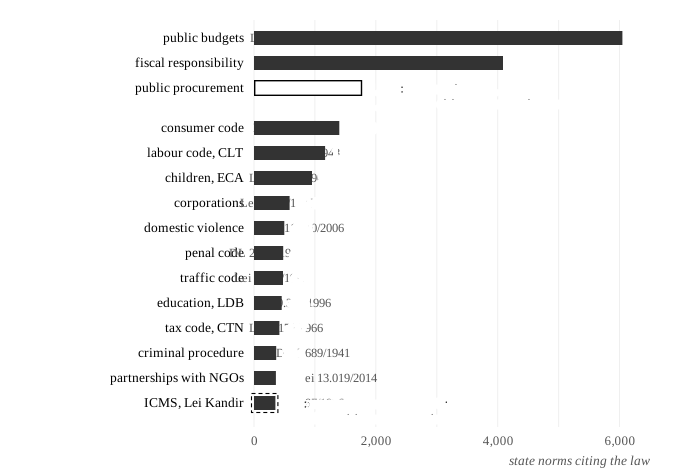
6:13 The load spreads sideways. Chains of references that name an article never run more than four steps, and the median is one. References to whole laws fan out: the Simples, the regime that collects several taxes in one monthly payment for firms up to R$4.8 million of revenue, cites 23 norms directly and reaches 840 within three steps, and every regime I followed ends in the same core of 2,852 norms. Part of the ICMS, the state tax on goods and some services, lives outside statutes: Espírito Santo's ICMS law makes 53.5 references per 100 articles to other kinds of act, mostly agreements of CONFAZ, the council of state finance secretaries.
6:14 The load-bearing laws also move. The CLT has taken 206 amending acts, 18 since 2021; Goiás' tax code 138, 42 since 2021; Espírito Santo's ICMS law 125, 57 since 2021, before the decrees and CONFAZ agreements outside the corpus. The most amended state norm, Santa Catarina's list of public-utility titles, took 666 amendments in four years, one per title (Lei 18.278/2021). A feed of which articles of each state's ICMS law changed, when and by which act, has buyers in tax departments until 2033.
6.3 Zombie citations
6:15 Lei 8.666/1993, the procurement law, died on 30 December 2023 (Lei 14.133/2021 art. 193 II), but its contracts live on. One signed before the new law took effect in April 2021 "continuará a ser regido de acordo com as regras previstas na legislação revogada" (art. 190), keeps the revoked rules, and one tendered under the old law in the transition keeps them "durante toda a sua vigência" (art. 191 sole paragraph), for its whole term. Of the 1,776 state norms in 24 states that cite Lei 8.666, 1,621 are in force as of October 2026. New norms cite the new law ten times as often (162 against 16 since 2024), so the trouble is the stock.
6:16 The new law's bridge reads "Aplica-se esta Lei às hipóteses previstas na legislação que façam referência expressa à Lei nº 8.666, de 21 de junho de 1993" (art. 189): it applies wherever legislation names the old law. That carries references to the law, and 1,167 of the 1,776 state citers name articles: the waiver of tender (art. 24, with its value limits) in 359 norms, partnership agreements (art. 116) in 283, sales of public property (art. 17) in 227, tender types set by value (art. 23) in 52. The first three now correspond to arts. 75, 184 and 76 of the new law; the last to nothing, since the new law abolished them.
6:17 Some references were written after the death. The Federal District capped a 2024 police and fire-brigade programme with "ficam limitadas ao disposto no art. 23, I, a, da Lei federal nº 8.666" (Lei 7.442/2024 art. 15 § 1º), limited by the ceiling of a tender type that no longer exists. Piauí applied the old art. 24 "enquanto sua vigência", while it lasts, seven weeks after it ended (Lei 8.306/2024 art. 15).
6:18 Lei 8.666 is the largest case of a pattern: 10,741 state norms not known to be revoked cite a revoked norm, and 47 later state norms in 18 states still cite the traffic code of 1966, replaced in 1997. A map from each state citation of Lei 8.666 to its counterpart in the new law covers about 1,200 norms in 24 states and must keep the old rules for the contracts they still govern (§18.3). It opens no gap to exploit: a procedure built on a dead article is open to dispute (Chapter 17).
6.4 The 2033 cliff
6:19 The largest scheduled death is in LC 214/2025, the consumption-tax reform law. Its art. 543, in force by art. 544 V, reads "Ficam revogados a partir de 1º de janeiro de 2033" (revoked from 1 January 2033) and lists (LC 214):
- Decreto-lei 406/1968, the old general rules of the ICMS and of the ISS, the municipal tax on services;
- arts. 1-12, 14 and 15 of LC 24/1975, the rule that an ICMS incentive needs every state's consent;
- LC 87/1996, the ICMS law (LC 87), and LC 116/2003, the ISS law;
- the ICMS and ISS provisions of LC 123/2006;
- LC 160/2017, which let states forgive and reinstate incentives granted without consent;
- LC 192/2022, on single-phase ICMS on fuels.
6:21 Art. 542 starts sooner: on 1 January 2027 it revokes seven laws on PIS and Cofins, the federal revenue contributions the CBS replaces.
6:22 In 23 states, 329 state norms in force rest on LC 87; 114 rest on LC 24 and 86 on LC 160. The stock still grows: 61 of the LC 87 citers and 52 of the LC 160 citers date from 2021 or later. On 10 July 2026 Goiás adopted incentives of Mato Grosso do Sul under LC 160 art. 3 § 8, which lets a state join incentives "concedidos ou prorrogados por outra unidade federada da mesma região" (LC 160), granted by another state of its region, and three more states passed incentive laws on LC 160 or LC 24 that year. Espírito Santo has already amended its constitution: EC 119/2026 art. 9 revokes, from 1 January 2033, the clause that gives the state its ICMS (ALES).
6:23 On 1 January 2033 those norms will point at nothing, the next wave of zombies. Until then they decide money: holders of ICMS incentives granted by 31 May 2023 for a fixed term and against conditions are compensated for the 2029-2032 phase-down only if they apply to the Receita Federal by 31 December 2028, and the incentive must meet LC 160's registration rule (§9.4). An article-by-article map of the roughly 550 state norms that lose their federal basis is the transition plan most states have not written (§18.3). Since 2021 states have enacted about ten norms a year citing LC 87, and I expect them to go on while the ICMS lives.
Forecast 6.1 (States keep building on LC 87). The states and the Federal District enact at least five new norms dated 2027 that cite LC 87/1996.
- Horizon
- 2027-12-31
- Probability
- 85%
- Check
- Search the state and Federal District legislation portals for norms dated 2027 citing LC 87/1996 by number or as the "Lei Kandir"; count distinct norms.
6:25 The graph sees only what texts name. A later law that contradicts an earlier one without naming it leaves no link; decrees, provisional measures, CONFAZ agreements, municipal law, Paraná and Rio de Janeiro are outside the corpus; state texts are mostly original enactments, so amendment counts are lower bounds; and in the 18 states that print no court outcomes, "not struck" means unknown. The open question is the unrecorded stock. A hand check of a few hundred norms in one silent state against the later acts would turn the estimate of 50,000 to 66,500 into a measurement, and tell each assembly how much of what it publishes as law is dead.
Part III. The seams
7 Lines
7:1 Brazilian law changes how a firm or a person is treated at thousands of numbers, and the few that move behaviour are those where the total owed jumps. In the norms in force of the corpus (ctresb/leis, a snapshot of 13 October 2026), I counted 49,904 numeric thresholds beside a direction word such as "até" (up to) or "superior a" (above), in 13,507 norms; a hand check puts 30 to 45% of them as genuine lines. A number is one of the eight kinds of seam (Definition 0.1).
Definition 7.1 (Notch). A notch is a line at which the total amount owed, or a benefit received, jumps when the base crosses it by one real, so that some range just above the line leaves the person worse off than at the line. A kink is a line at which only the marginal rate changes: the total stays continuous, and one more real earned always leaves more.
7.1 The MEI cliff
7:3 The MEI, the one-person firm regime with a fixed monthly payment, has the sharpest notch in Brazilian business law. Up to R$81,000 of revenue a year (LC 123/2006 art. 18-A § 1), a service MEI pays R$86.05 a month, R$1,033 a year: 5% of the R$1,621 minimum wage plus R$5 of ISS, the municipal tax on services. Up to R$97,200 it pays the Simples rate on the excess and becomes a microempresa the next January. One real more and the exit applies "retroativamente a 1º de janeiro" (back to 1 January, § 7 III b): the year's tax goes from R$2,005 to R$5,832, 6% of revenue, R$3,827 more before the owner's new social security contribution and the bookkeeping.
7:4 The line has not moved since 2018, while consumer prices (the IPCA index) rose 56.5%. The ceiling has lost 36.1% of its real value; indexed, it would be R$126,799.
7:5 PLP 186/2026, a bill for a complementary law sent by the Executive, raises the ceiling to R$110,000 for 2027 and R$140,000 from 2028. The Câmara passed it 461 to 4 on 14 October 2026 and the Senate 78 to 0 on 15 October. As of October 2026 it awaits sanction, due in early to mid November, and it also remits MEI debts in the federal register of overdue taxes up to 13 October 2026. It moves the line and keeps the cliff: the 20% tolerance follows the ceiling, so the retroactive line becomes R$132,000 in 2027 and R$168,000 in 2028 (my arithmetic). Taxing only the excess would take another complementary law.
7:6 An MEI near the line can lawfully time its invoices, since revenue received from January 2027 will count against the new ceiling once the law is published. Splitting the business among relatives or registrations to keep each part under the line is abuse, which LC 123's own anti-splitting rules catch (§17.3).
Forecast 7.1 (The MEI bill becomes law). PLP 186/2026 is sanctioned, wholly or with vetoes that leave the ceilings of R$110,000 for 2027 and R$140,000 from 2028 intact, and the law is published in the DOU by 30 November 2026.
- Horizon
- 2026-11-30
- Probability
- 90%
- Check
- The DOU and planalto.gov.br's list of 2026 complementary laws; the new wording of LC 123 art. 18-A § 1.
7.2 The Simples ceiling
7:9 The Simples Nacional, the simplified regime that collects several taxes in one monthly payment, the DAS, for firms up to R$4.8 million of revenue, hides kinks behind smooth averages. Each table applies a nominal rate less a fixed deduction, so the average rate climbs without jumps while the marginal rate in the top band, R$3.6 million to R$4.8 million, is 33% of revenue in services tables III and IV, 30.5% in table V, 30% for industry and 19% for commerce. Above R$3.6 million, ICMS (the state tax on goods) and ISS are paid outside the DAS.
7:10 The ceiling is a cliff only for labour-intensive services, because the DAS folds in the employer's 20% social security contribution (except in table IV). Just above R$4.8 million, under lucro presumido (presumed profit), a service firm in table III with payroll at 30 to 40% of revenue pays 2.9 to 5.7 points of revenue more, R$138,000 to R$271,000 a year. A retailer with 8% payroll pays 2.7 points less and an industry with 15% payroll 4.6 points less (my estimates, on assumed payroll shares and ICMS or ISS burdens). The Treasury pays for the regime as a whole: the Simples is the largest federal tax expenditure (§10.1).
7:11 One ratio moves a service firm between tables. When payroll, "incluídas retiradas de pró-labore" (partners' salaries included), is "igual ou superior a 28%" of revenue (LC 123 art. 18 § 5-J), many professional services move from table V to table III: 9.5 points of revenue cheaper at R$180,000 a year (R$17,100) and 3.76 points at R$3.6 million (R$135,540), reversing by 0.25 points at R$4.8 million. Paying partners a real, taxed salary to cross 28% is lawful planning; at R$1 million of revenue it nets about R$32,700 a year after their income tax and social security (my estimate).
7:12 Above the Simples, lucro presumido taxes a fixed share of revenue as profit and is closed above R$78 million (Lei 9.718/1998 art. 13), where lucro real, actual profit, takes over. That line costs only high-margin firms: at it, a service firm with a 5% margin pays R$4.67 million a year less under lucro real and one with a 30% margin R$1.96 million more (my estimates). Since 2026, LC 224/2025 adds a kink: presumed shares rise by a tenth on revenue above R$5 million a year, about 1.09% of the excess in services and 0.31% in trade.
7.3 Income
7:13 The personal income tax of 2026 has a hump, and no notch. Lei 15.270/2025 zeroes the monthly tax up to R$5,000 and phases the reduction out in a straight line to R$7,350: "R$ 978,62 - (0,133145 x rendimentos tributáveis sujeitos à incidência mensal)" (R$978.62 less 13.3% of monthly taxable income). The marginal income tax in the band is 35.8 to 40.8%, or 49.8 to 54.8% with the employee's social security, settling near 37% (51%) above about R$5,750; just above R$7,350 it falls to 23.7% (37.7%). A worker on R$5,000 given a R$1,000 raise keeps a little under half of it.
7:14 Dividends have a true notch. From 2026, a company paying one person more than R$50,000 in a month withholds 10% "sobre o total" (on the whole amount): R$50,000 pays nothing, R$50,000.01 pays R$5,000. The withholding is credited in the annual return, so for most people it costs cash flow. Paying R$50,000 a month instead of R$50,001 is lawful timing; interposing companies or relatives to multiply the allowance is not (§17.1).
7:15 Above it, an annual minimum tax on total income rises in a straight line from 0% at R$600,000 to 10% at R$1.2 million ("(REND/60.000) - 10", in percent), so the marginal rate inside the band runs from 10% to 30% before credits. A refund caps company tax and the minimum tax together at 34% of profit. The first return under it, for 2026, is due in 2027, and the Receita Federal, the federal tax authority, has not yet issued the annual rules.
7:16 Lines written in reais and never indexed tighten every year. The R$440,000 exemption for selling a sole home and the R$240,000 a year line of the corporate income-tax surcharge date from 1996 and have lost 83.8% of their real value; the R$20,000 a month exemption on stock sales has lost 68.8%, the Simples microempresa line of R$360,000 55.8% and the R$78 million presumido line 50.4%.
7.4 Bunching
7:17 Bunching tests whether a line binds. If crossing costs enough, firms that would have grown just past the line stop below it, and the bin just under it holds more firms than the trend of its neighbours predicts. I measure that bin's excess mass as
7:19 Here counts the firms in the last bin below the line and is the count a straight line in logs predicts for it, fitted to the bins from 45% of the line up to it, with the revenue at each bin's middle.
Experiment 7.1 (Firms under the Simples ceiling, 2009 to 2017).
Setup: The Receita's public counts of Simples firms by revenue bin (Grandes Números do Simples Nacional), summed nationally, with (7.1) applied to the bin below each year's ceiling and to placebo bins where no line sits.
Parameters: Bins of R$120,000 to 2011 and R$180,000 from 2012; the ceiling was R$2.4 million to 2011 and R$3.6 million from 2012.
Result: In 2009 the bin below R$2.4 million held 2,125 firms against 1,196 predicted, 77.7% excess mass. Every year shows 49 to 99%, against 3 to 9% in placebo bins. When the ceiling moved in 2012 the bump moved with it, and the old line fell to 7 to 13%.
Shows: Firms hold their reported revenue under the notch, and the bump belongs to the line, not to any particular size.
7:21 The band from R$3.6 million to R$4.8 million was thin in 2019: 12,865 firms, 39% fewer than the 2017 slope predicts. Published studies find bunching at an MEI-type line (295% excess mass), at R$3.6 million and at R$4.8 million, none at the internal kinks from R$180,000 to R$1.8 million, and Simples firms declaring 48 to 56% less revenue than matched presumido firms (Russy, 2024). Part of the bump is reported revenue, not real size.
7:22 Headcount lines barely bind. Labour law switches duties on at 20 workers per establishment (time records, CLT art. 74 § 2), 30 women (a nursery), 100 employees (a disability quota under Lei 8.213/1991 art. 93, pay-transparency reports, women's training) and 200 (a workers' committee). In the public files of RAIS, the annual employer census, the largest effect is 3.8% more establishments at exactly 10 workers in 2018, when time records were due above 10. After Lei 13.874/2019 moved that line to 20, the bump was gone by 2024 and none appeared at 20. Nothing shows below 100. After a quota inspection, one study finds that 58% of newly compliant firms comply by shrinking; another finds no bunching.
7:23 The missing middle of Brazilian firms is made at revenue notches, where one real can cost thousands; labour duties, whose cost grows a worker at a time, leave no trace in the counts. The public lever follows: replace notches with phase-ins, as the Simples's deductions and Lei 15.270's straight-line reduction already do, and index the lines to prices (§18.2).
7.5 Twenty-seven sets of numbers
7:24 The states draw the same lines with different numbers. Below one of them, a court award against a state is paid within months as a small-value requisition (RPV), instead of joining the queue of precatórios, paid years later. The Constitution lets each state set it no lower than the largest pension benefit (R$8,475.55 in 2026), with a default of 40 minimum wages, R$64,840. The lines run from R$15,747 in Ceará (Lei 16.382/2017) to R$48,630 in Acre and Pará and the default in five states without a law, 4.1 times; seven states cut theirs between 2015 and 2025, São Paulo among them (Lei 17.205/2019). A cut does not reach earlier claims (STF, Tema 792), and a creditor just above the line can lawfully waive the excess to be paid now. Regional minimum wages (from R$1,842 a month in Santa Catarina to R$2,388.50 in Rio Grande do Sul) and the revenue at which a state's "médio porte" begins (from R$2.4 million to R$4.8 million) vary the same way.
7:25 Three limits matter. The census counts mentions, and its precision is lowest for money and percentages, so its totals are orders of magnitude; every line quoted here was read in the official text. The cliff sizes rest on assumed payroll shares, margins and tax burdens, and leave out compliance costs and the move to IBS and CBS. The bunching test uses public counts in wide bins, which cannot tell a firm that stayed small from one that reported less. On the MEI, the Executive's original bill made the higher ceiling depend on the 2027 to 2029 budget laws providing for the revenue forgone; whether that condition survived will show in the published law.
8 Words
8:1 The same word means different things in different Brazilian laws, and whoever falls inside the wider meaning collects what the word gives. Across the corpus I found 75,529 definitional provisions ("considera-se", "entende-se por") in 27,727 norms, for 27,762 distinct terms; 5,448 terms are defined in two or more norms. A word is one of the eight kinds of seam (Definition 0.1). Of 61 terms that gate money, rights or duties, I ranked the twenty whose meanings diverge most.
Experiment 8.1 (Counting the meanings of a word).
Setup: Patterns for the ways a statute defines ("considera-se:", "Equipara-se a", "reconhece ... como") run over every article; each definition's text becomes a vector of weighted words and word pairs.
Parameters: Definitions of one term are clustered by cosine similarity, cut at 0.25, and each cluster counts as one meaning. A state definition is far when it sits below 0.25 from every federal one.
Result: "Pessoa com deficiência" has 45 meanings in 197 norms of 25 jurisdictions, "microempresa" 26 in 93, "baixa renda" 22 in 58, "pequeno produtor rural" 17 in 20. The share of state definitions that cite the federal one runs from 0% for "pequeno produtor rural" to 67% for "agricultor familiar".
Shows: Where states cite the federal text, meanings converge; where they write their own, they scatter. The counts move with the cut, so read them as ranks.
The twenty most divergent terms that gate a benefit or a duty
| Term | Norms | Meanings | What it gates |
|---|---|---|---|
| pessoa com deficiência | 197 | 45 | quotas, transport passes, car taxes |
| microempresa | 93 | 26 | tax regimes, procurement, fees |
| serviço ambiental | 47 | 27 | payments for environmental services |
| baixa renda | 58 | 22 | cash transfers, social tariffs, housing |
| pequeno produtor rural | 20 | 17 | credit, funds, environmental regimes |
| resíduo sólido | 47 | 19 | waste duties; an IBS/CBS presumed credit |
| serviço essencial | 20 | 15 | what stays open in strikes and epidemics |
| empresa de pequeno porte | 58 | 14 | tax regimes, procurement, fees |
| consumidor | 22 | 14 | consumer-code protection |
| área urbana | 20 | 13 | urban instead of rural property tax |
| cooperativa | 16 | 12 | cooperative programmes |
| economia solidária | 24 | 11 | support policies |
| família de baixa renda | 20 | 8 | housing and aid |
| microempreendedor individual | 15 | 9 | the MEI's fixed tax; state MEI benefits |
| agricultor familiar | 69 | 10 | farm credit, public food purchases |
| agroindústria familiar | 14 | 9 | food inspection regimes |
| idoso | 129 | 8 | priority, free transport, fee waivers |
| jovem | 32 | 6 | hiring subsidies, financing preferences |
| empregador | 15 | 8 | labour and severance-fund duties |
| artesanato | 9 | 7 | artisan programmes |
8.1 Small
8:3 "Microempresa" and "empresa de pequeno porte" (small firm) are defined in 93 and 58 norms, in reais and in ten indexation units, from the federal UFIR and BTN to Espírito Santo's VRTE. State ceilings run from R$36,000 to R$1.5 million of revenue, against the R$360,000 and R$4.8 million of LC 123/2006 art. 3. Most of this is dead letter, since the Simples displaced the state regimes in 2007, but many texts carry no revocation, so a reader cannot tell a live line from a dead one.
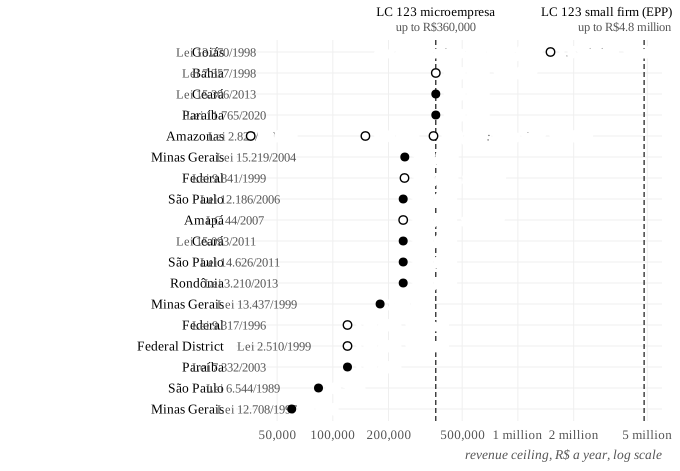
8:5 Two gaps are live. Ceará's statute for small firms still defines the MEI at R$60,000 of revenue (Lei 15.306/2013 art. 3), against R$81,000 federally. It cannot narrow the federal status, but a Ceará MEI between the two lines loses the state statute's benefits, and the gap widens to R$110,000 in 2027 if the bill raising the federal ceiling becomes law (§7.1).
8:6 The federal environmental fee, the TCFA, still defines small firms by pointing to Lei 9.841/1999 (Lei 6.938/1981 art. 17-D § 1), which LC 123 revoked; read literally, a microempresa would stop at R$244,000. IBAMA, which collects the fee, reads the reference as LC 123's current limits, R$360,000 and R$4.8 million, and starts the medium band at R$4.8 million where the statute starts it at R$1.2 million, so firms between the two pay the small-firm fee. That is a practice in the taxpayer's favour, not a strategy: no court has ruled on it, and a Senate bill (PL 3.513/2024) would write LC 123 into the text.
8:7 The fix already exists. Lei 13.988/2020 art. 6 gives small firms the best federal tax settlements, up to 70% off and 145 months to pay, and defines them by the limits of LC 123 art. 3, not by a number; Espírito Santo's environmental fee does the same (Lei 10.098/2013 art. 8). A definition by reference moves when the line moves.
8.2 Need, land and age
8:8 "Baixa renda" (low income) varies about nineteen-fold. Federal law (Lei 8.212/1991 art. 21) means a family registered in the CadÚnico, the federal register of poor households, with up to two minimum wages a month. State definitions run from R$218 per person in Piauí (Lei 8.427/2024) to ten minimum wages per family in Rio Grande do Sul, for concessions of state land (Lei 10.851/1996 art. 19). For a family of four in 2026, that is R$872 to R$16,210 a month. Only 6.9% of state definitions cite federal law or the CadÚnico.
8:9 "Pequeno produtor rural" (small farmer) is the least harmonized term. Four federal laws use four tests: family labour, at most 60 minimum wages of yearly production, at most two employees, at most 50 hectares. None of the 17 state definitions cites them; theirs run from 25 to 100 hectares, one módulo fiscal (a municipal unit of farm area), R$500,000 of revenue and "até dez mil covas de café" (up to ten thousand coffee plants, Bahia). "Agricultor familiar" (family farmer) is the most harmonized: 67% of state definitions cite Lei 11.326/2006, and 11 of 13 area limits equal its four módulos fiscais. The federal credit and food-purchase programmes follow the same law.
8:10 Ages diverge too. Federal law calls 15 to 29 young, Goiás and Mato Grosso do Sul use 16 to 30 for hiring certificates, and nine state laws in five states start old age at 65 instead of 60.
8.3 Disability
8:11 "Pessoa com deficiência" (person with disability) is the most divergent term that gates a benefit. Federal law defines it as a long-term physical, mental, intellectual or sensory impairment that, with barriers, obstructs full participation, established by a biopsychosocial assessment (Lei 13.146/2015 art. 2). Yet 134 laws in 23 states extend the status to named conditions. Sixty restate federal categories: autism (31 laws), unilateral deafness (17) and monocular vision (12). Seventy-four create state-only categories, 57 of them since 2021: fibromyalgia (18 laws in 16 states), chronic kidney disease (13 in 12), cleft palate (11 in 11) and others. Only 17 of the 134 require the federal assessment; 80 require nothing beyond a diagnosis.
8:12 Courts and Congress are pulling the extensions back to the federal test. The STF, the Supreme Federal Court, strikes state laws that ignore the biopsychosocial assessment (ADI 7.028), and Lei 15.176/2025, in force since about 20 January 2026, makes fibromyalgia count only after that assessment; state courts, starting with the Federal District's in June 2025, have suspended or struck fibromyalgia laws. The difference is one clause: Bahia's law makes the person with fibromyalgia disabled "para todos os efeitos legais" (for all legal purposes, Lei 14.886/2025 art. 3), while Pernambuco's adds "que se enquadre no conceito definido no art. 2º da Lei Federal nº 13.146" (who meets the federal concept, Lei 18.939/2025 art. 2-B) and survives.
8:13 The tax reform zeroes IBS and CBS, the new value-added taxes, on cars bought by persons with disability under a medical list (LC 214/2025 arts. 149-150), which limited intellectual disability to "severa ou profunda" and autism to "nível moderado ou grave". On 3 August 2026, in ADIs 7779 and 7790, a unanimous STF with Alexandre de Moraes as rapporteur struck those limits, because the amendment that created the taxes grants the reduction without gradations (STF). From 2027, buyers with mild intellectual disability or level-1 autism pay no IBS or CBS on the car; the Treasury pays. The rest of the list stands, so unilateral deafness, a disability under federal law since 2023, still does not qualify.
8:14 The same buyer now faces four tests. The IPI exemption on the car requires the biopsychosocial assessment and ends on 31 December 2026 (§12.2). The IBS and CBS zero rate follows LC 214's list. The ICMS exemption needs an agreement of CONFAZ, the council of state finance secretaries, and Convênio ICMS 38/2012 still says "mental severa ou profunda", so the ruling does not reach it. The IPVA, the state vehicle tax, follows each state's law. None of this is a field for arbitrage: an employer that counts a state-only category toward the federal hiring quota (Lei 8.213/1991 art. 93) commits a compliance error. The lawful work is checking which test each benefit applies.
Forecast 8.1 (One federal assessment of disability). The federal Executive publishes a decree issuing a single instrument for the biopsychosocial assessment of disability under Lei 13.146/2015 art. 2 § 2, for use across federal benefits.
- Horizon
- 2027-12-31
- Probability
- 20%
- Check
- planalto.gov.br's list of 2026 and 2027 decrees, and the human-rights ministry's page on the biopsychosocial assessment.
8.4 Startup
8:16 Federal law calls a firm a startup when its revenue was up to R$16 million in the previous year, it has been registered for up to 10 years, and it declares an innovative model or enrols in Inova Simples (LC 182/2021 art. 4); the status shields investors and opens a fast route into public procurement. Fourteen state definitions in eleven states use the word. Only Rio Grande do Sul (LC 15.639/2021 art. 13) and Maranhão (Lei 11.733/2022 art. 2) admit a firm too big or too old for LC 182: their innovation laws set no caps. Bahia copies both federal caps (Lei 14.861/2025 art. 3); Minas Gerais caps revenue at R$16 million in a fixed year, with no age cap (Lei 23.793/2021 art. 3); Ceará refers to LC 182 (LC 335/2024).
8:17 The gain goes to scale-ups past the federal caps with real research in Rio Grande do Sul or Maranhão, subject to each programme's call. Moving real research to one of those states is lawful; a unit with no activity, misstated revenue or age, or a firm split to look new is fraud in a public selection (Chapter 17).
8:18 The limits are mine. Meaning counts depend on the vectorizer and the 0.25 cut; 72 of the disability laws were screened, not read; dead state definitions still count unless a revocation is explicit; and decrees, CONFAZ agreements, municipal law, Paraná and Rio de Janeiro are outside the corpus, so a term defined by executive act, like Redata's "data center" (§10.3), has its edge outside the statute book. The policy answer is the one Espírito Santo and Pernambuco already wrote: define by reference to the federal text, revoke dead definitions, and publish definitions as machine-readable objects, so a public registry can answer who qualifies where (§18.2).
9 Borders
9:1 Brazil's largest seam (Definition 0.1) is a border. Twenty-seven states tax the same goods under twenty-seven laws of the ICMS, the state tax on goods and some services, and each sells part of the tax back to the firms that settle inside it: their budget-guideline bills for 2026 declare R$333.7 billion of relief. The 2023 reform closes the seam by abolishing ICMS in 2033. Until then it gives every incentive a price, set by a constitutional schedule of decay and a federal fund that repays part of the loss, and the price can be computed.
9.1 Twenty-seven tax laws
9:2 The incentives began as a breach. An ICMS benefit needs the unanimous approval of CONFAZ, the council of the states' finance secretaries (LC 24/1975 art. 2 § 2), and for decades states granted them anyway. LC 160/2017 amnestied the grants and set their end: benefits published and deposited with CONFAZ under Convênio ICMS 190/2017 could run until 31 December 2032, commercial, port and farm ones losing 20% a year from 2029 (art. 3 §§ 2 and 2-A), and a state may adopt any benefit a neighbour in its region grants (art. 3 § 8).
9:3 São Paulo declares the most relief, R$85.6 billion, 22.0% of its revenue. As a share of revenue Amazonas (58.0%), Santa Catarina (57.6%), Mato Grosso do Sul (50.1%) and Espírito Santo (48.4%) lead and Roraima (0.6%) trails, in FGV-Ibre's compilation of the 2026 bills. Each state measures its relief its own way, so the figures are declarations: Espírito Santo's quadrupled from one year's bill to the next.
9:4 The programmes take four shapes. Most leave part of the tax with the firm as a presumed or granted credit: 64-67% in Goiás's ProGoiás (Lei 20.787/2020 art. 5), up to 95% in Rio Grande do Norte and Maranhão, 55-90.25% in Amazonas. Bahia's Desenvolve defers up to 90% of the monthly balance for 72 months and forgives up to 90% of it on early payment (Lei 7.980/2001 arts. 2 and 7); Espírito Santo's Compete fixes an effective load of 7%; Mato Grosso's Prodeic charges up to 7% of the benefit for a state fund. The states that lose the plants pay, through a smaller common base and prices that carry the full rate.
9.2 The rate race
9:5 The states also raised their rates. From 2023 to 2026, 19 of the 27 raised the modal, or standard, ICMS rate, the mean going from 17.6% to 19.3% and the range from 17-18% to 17-23%: Maranhão from 18% to 23% (Lei 12.426/2024), Piauí to 22.5% (Lei 8.558/2024), Alagoas from 17% to 20.5%. Eight held, São Paulo and Minas Gerais among them. The corpus (ctresb/leis, a snapshot of 13 October 2026; Appendix B) lacks only Paraná's and Rio de Janeiro's laws, read on the web.
9:6 The common reading is that the reform paid states to raise rates. It is half right. From July to December 2023 the draft shared transition revenue "proporcionalmente à receita média de cada ente federativo entre 2024 e 2028" (PEC 45 in the Senate), by average revenue in those years, and Paraíba cited that window for its rise. The window was dropped before promulgation: LC 227/2026 art. 115 § 2 counts "os valores anuais de 2019 a 2026", the yearly revenue of 2019-2026, so Maranhão's three rises lift its share by about 4%, not 10% [estimate]. But LC 214/2025 art. 361 § 1 II sets the states' reference rate of the IBS, the new value-added tax of states and municipalities, on their 2024-2026 revenue, so the rises lift that common rate by about 2.9% [estimate] for every state, the eight that held included. Twelve states first raised before the window existed.
9.3 The staircase
9:7 The decay is written in the Constitution. ADCT art. 128 (the ADCT holds the Constitution's transitional provisions) fixes the ICMS rates at "9/10 (nove décimos), em 2029" of their level, falling a tenth a year to "6/10 (seis décimos), em 2032"; benefits "serão reduzidos na mesma proporção" (§ 1), shrinking in step, and from 2033 the tax is gone (art. 129). The validated terms cannot be extended (EC 132/2023 art. 12 § 7), and LC 214 art. 543 revokes LC 160 on 1 January 2033 (§6.4). Commerce, port and farm benefits gain: § 2 moves them from their 20%-a-year cut onto the same staircase, "não se aplicando a redução prevista no § 2º-A".
Definition 9.1 (Benefit-year). A benefit-year is one year of a tax benefit at its full annual value. A benefit's remaining value, in benefit-years, is the sum over the years it has left of the share of its full value it still delivers in each, discounted to the start year.
9:9 With the share a benefit still delivers in year (1 to 2028, then 0.9, 0.8, 0.7 and 0.6, and 0 from 2033), the real discount rate and each year's benefit counted at mid-year, its value at the start of year is
9:11 From 1 January 2027 a benefit is worth 5.0 benefit-years undiscounted (two full years, then 0.9 + 0.8 + 0.7 + 0.6), or 3.9 at a 10% real discount rate. An onerous benefit compensated in full keeps to 2032 and is worth 6.0, or 4.6 at 10%. Commerce, port and farm benefits are worth 5.0 and 3.9, up from 4.0 and 3.3 under their old cut, but cannot be compensated.
Experiment 9.1 (What an incentive is still worth).
Setup: the yearly shares of ADCT art. 128 and the fund rule of EC 132 art. 12, applied to one unit of a benefit's 2028 annual value, in constant real terms, discounted at mid-year to 1 January 2027 ((9.1)).
Parameters: real discount rate 6%, 10% and 15%; the fund paying 100%, 75% or 50% of each claim.
Result: without compensation 4.29, 3.91 and 3.52 benefit-years; compensated in full 5.06, 4.57 and 4.06; at 10% with half of each claim paid, 4.24.
Shows: a benefit granted today buys about four years of its annual value, and the fund adds about two-thirds of a year to those that qualify.
9:14 Lawfully, a firm can price each incentive at its decaying value, value a new site at zero ICMS benefit from 2033, and expand under an existing qualifying act, which is compensated, instead of a new grant, which is not. The line is simulation: splitting or interposing companies to stretch a concession act fails under CC art. 167 (§17.1).
9.4 The fund
9:15 The compensation fund is federal money for the phase-down's losers. EC 132 art. 12 deposits R$8, 16, 24, 32, 32, 24, 16 and 8 billion in 2025-2032, indexed to inflation (the IPCA): R$160 billion in 2023 money, R$182-190 billion in 2026 reais (IBGE's figures, 4% assumed for 2026), depending on whether 2023's inflation counts. From 2029 to 2032 it pays holders of benefits granted "por prazo certo e sob condição", for a term and on conditions, and "regularmente concedidos até 31 de maio de 2023", duly granted by that date, whose conditions were met. Commerce, port and farm benefits and those of the Manaus Free Zone and the free-trade areas are out (LC 214 art. 384; Portaria RFB 635/2025 art. 3 § 1), which leaves out Amazonas, the state that waives the largest share of its revenue.
9:16 A firm passes three gates, two outside its control. It files one request per type of benefit with the Receita Federal, the federal tax authority, between 1 January 2026 and 31 December 2028 (LC 214 art. 388 sole paragraph), holding a concession act that states its conditions and ends by 31 December 2032 (art. 389 II) and free of bars such as tax or severance-fund arrears or an improbity, environmental or anti-corruption sanction (art. 389 VI); a lapsed requirement cancels the habilitation (art. 390). The granting state must confirm that the conditions were met (art. 389 sole paragraph). And the Receita must declare the programme apt (Portaria RFB 635/2025 as amended by Portaria RFB 727/2026 art. 3 § 4): it had 72 programme files under examination in March 2026, of 195 from 17 states (Receita course material), and as of October 2026 I found no declaration published, so entitlement risk is medium. Enhancements made after 31 May 2023 earn nothing (art. 384 sole paragraph IV).
9:17 Whether the fund suffices turns on a number nobody publishes. The cut adds up to one year of onerous benefits (0.1 + 0.2 + 0.3 + 0.4), so the fund pays every claim if qualifying benefits stay below 49-57% of the R$333.7 billion declared, depending on indexation and growth; at 60% it pays 91%. Deposits are front-loaded, R$80 billion before the first payment, so a shortfall can appear only in 2032, the 40% year. Much declared relief is unconditional (food-basket cuts, input exemptions), which points to enough money, but the onerous share is the weakest number here.
9:18 If the fund falls short, two texts disagree. EC 132 art. 12 § 8 says "A União deverá complementar os recursos de que trata o § 1º em caso de insuficiência de recursos": the Union must top it up. LC 214 art. 404 repeats the duty "limitado aos montantes previstos no projeto de lei orçamentária anual", capped at what the budget bill provides. The hearing on reform disputes of the AGU, the federal government's legal service, did not take up the point, and no case is ripe before 2032. My reading [inference] is that art. 404 binds the budget and leaves the constitutional debt standing: a holder left short would sue under § 8 and be paid years later, while art. 392 § 12 lets the Receita withhold more of each claim when 2032 looks short. Count 2029-2031 as near-certain once habilitated and 2032 as possibly late.
Forecast 9.1 (The first programme declared apt). The Receita Federal publishes a declaration of aptitude for at least one state ICMS incentive programme under Portaria RFB 635/2025 art. 3 § 4.
- Horizon
- 2027-06-30
- Probability
- 80%
- Check
- A declaration naming a state programme, published by the Receita by 30 June 2027.
9.5 Inheritance across borders
9:20 The ITCMD, the state tax on inheritances and gifts, is where the reform told the states to converge. Since EC 132 it "será progressivo em razão do valor do quinhão, do legado ou da doação" (CF art. 155 § 1 VI), progressive in the value received, and LC 227 art. 156 § 2, in force since 14 January 2026, makes the brackets marginal, up to the Senate's 8%. Thirteen states are out of line (TaxUp's state table, checked 8 October 2026). Six charge a flat rate: São Paulo, Espírito Santo, Paraná and Roraima 4%, Minas Gerais 5%, Mato Grosso do Sul 6% (3% on gifts). Seven apply one bracket's rate to the whole base: Rio de Janeiro, Sergipe, Tocantins and Bahia (up to 8%), Maranhão (7%), Rio Grande do Sul and Amapá (6%).
9:21 LC 227 sets no rates, so a flat rate stands until the state legislates, and a rise waits for both anteriority rules (CF art. 150 III b and c): a table published now would apply from about 14 January 2027, to gifts dated from then by contract, deed or quota registry (LC 227 arts. 151 and 156 § 1). "Donate now at the flat rate" is the common advice. In São Paulo it is wrong if the assembly passes PL 409/2025, approved in committee and not yet voted: its marginal rates of 1%, 2%, 3% and 4%, stepping up at about R$370,000, R$3.1 million and R$10.4 million, charge every gift less than today's 4%, R$661,300 instead of R$800,000 on R$20 million [estimate]. In Minas Gerais the governor's pending amendment to PL 2.881/2024 would tax gifts at marginal rates of 2%, 4% and 6%, so donating now at the flat 5% pays only above about R$930,000 [estimate], where the new average passes 5%.
9:22 Gifts and inheritances from abroad are the sharper border. The STF, the Supreme Federal Court, held that states need a national law to tax them; EC 132 art. 16 gave them a transitional power, and only laws passed after it count (§14.2). At least nine states have one: Alagoas, Amazonas, Bahia, Goiás, Paraíba, Pernambuco, Piauí, Rio Grande do Norte and Paraná. None reaches back: Paraíba's applies from 27 August 2024, Rio Grande do Norte's from 90 days after 28 December 2024, Paraná's from 1 May 2025 (SEFA-PR resolution). Elsewhere, São Paulo, Rio de Janeiro, Minas Gerais and the Federal District included, a genuine non-resident's gift goes untaxed until the state legislates.
9:23 LC 227 narrows that window three ways. Brazilian real estate stays taxable where it lies "ainda que o de cujus ou o doador tenha domicílio ou residência no exterior" (art. 158 I), even if the deceased or the donor lived abroad; a donor is presumed to live where the income-tax return says (art. 159 § 2); and a "sale" to a related buyer, or to one without the means to pay, is presumed a gift (art. 147 VI f). Fake residence and back-dated deeds are simulation (§17.1).
9.6 Vehicles, fees and funds
9:24 The IPVA, the state vehicle tax, spreads 2.1 times on cars, from 1.9% a year in Paraná to 4% in São Paulo, Minas Gerais and Rio de Janeiro (compiled rate table, checked against official sources on 5-6 October 2026). Electric cars are exempt in nine states, taxed at a reduced rate in six and in full in twelve, and since EC 137/2025 cars 20 or more years old are exempt everywhere (CF art. 155 § 6 III e). The seam is registration: a fleet belongs where its owner keeps the establishment it serves, and registering it elsewhere is evasion. São Paulo's rules taxing rental cars registered in other states fell in August 2026 (§14.2).
9:25 Fees are the other lever, and the STF polices them by proportion. It upheld per-tonne mining inspection fees in Minas Gerais, Pará and Amapá in 2022 and struck Mato Grosso's in December 2023, a fee projected at R$158.9 million against R$34.3 million for all the state's other inspection fees. Mato Grosso enacted a smaller one eight days later.
9:26 The infrastructure funds survive by exception. ADCT art. 136 lets a state that on 30 April 2023 made ICMS relief conditional on fund contributions replace them with stand-alone ones, no higher and no broader, until 31 December 2043, and converted revenue leaves the IBS sharing base (LC 227 art. 115 § 3 I). Mato Grosso keeps its FETHAB and Mato Grosso do Sul its FUNDERSUL under their old laws (ConJur, July 2025); Goiás stopped charging FUNDEINFRA at the end of 2025 (Lei 24.133/2026). Maranhão and Piauí created new ones: 1.8% of the value of each tonne of grain leaving Maranhão for export (Lei 12.428/2024), challenged in ADI 7802, and up to 1.65% of the operation for Piauí's logistics fund (LC 327/2025). Grain producers and exporters pay them.
9:27 Two unpublished facts would change these numbers: the onerous share of the R$333.7 billion, which the Receita's monthly payment lists from 2029 will reveal (LC 214 art. 400), and the first programme declaration. The rate tables are third-party compilations and most incentive terms sit in decrees outside the corpus, so read the state's own law before acting.
10 The federal menu
10:1 Federal law sells relief by regime, and its regime seams (Definition 0.1) cost the Union R$612.8 billion in 2026, 4.43% of GDP, by the Receita Federal's own count. The menu is closing in order: PIS and Cofins, the federal contributions on revenue, end on 31 December 2026, new federal benefits are barred in 2027, and the largest investment regimes stop taking projects in 2028 and 2029. What stays open now is a set of elections with deadlines.
10.1 What the Union gives up
Definition 10.1 (Tax expenditure). A tax expenditure is revenue a government gives up through a departure from its own standard tax system (an exemption, reduced rate, credit, deduction or special regime), measured gross: the tax the beneficiaries would pay without it if they behaved the same way.
10:3 The Receita's Demonstrativo dos Gastos Tributários (DGT), its yearly statement of tax expenditures, counts R$612.8 billion for 2026. Six items pass R$25 billion: the Simples Nacional, the regime that collects several taxes in one monthly payment, the DAS, for firms up to R$4.8 million of revenue (R$134.3 billion); zero PIS and Cofins on the food basket and farm inputs (Lei 10.925/2004; R$52.5 billion); the Manaus Free Zone and the free-trade areas (R$35.2 billion); nonprofits (R$32.0 billion); the 75% cut in corporate income tax in the North and Northeast (R$26.1 billion); and individuals' tax-free real-estate and farm bonds, the LCI, LCA, CRI and CRA (R$25.8 billion). The figures trail what firms declare: for 2025 the Manaus firms declared R$65.0 billion against R$29.9 billion projected (Nota Técnica Conjunta 4/2026 of Congress's budget staff).
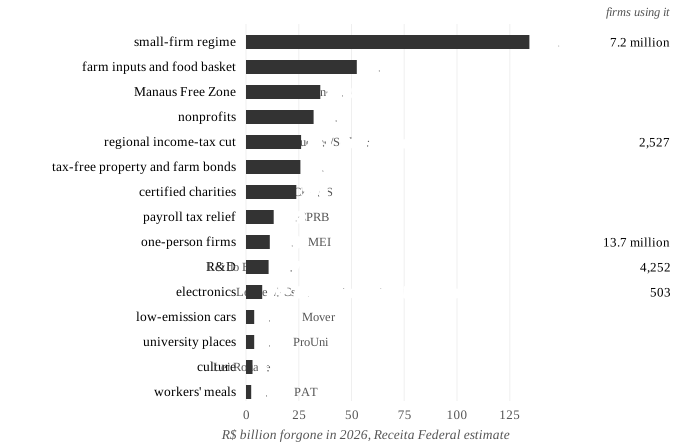
10:5 The investment regimes reach few firms because the statutes gate them. The Lei do Bem's R&D deduction and the regional income-tax cut work only in lucro real (actual profit), the regime of 268,856 firms in 2024, about 1% of active firms. The Lei do Bem had 4,252 users that year, 1.6% of those firms, 82 of them in the North (MCTI). The Lei de TICs, the IT and electronics R&D credit, paid R$5.6 billion in 2023 to 503 firms, and large ones took 88.5% (MCTI's report). The Treasury pays, and through it every firm without the benefit (§18.1).
10:6 The reform re-creates most of this relief inside the new taxes. LC 214/2025, the law of the IBS and CBS (the new value-added taxes, IBS shared by states and municipalities, CBS federal), holds 252 clauses that zero a rate, cut it, grant a presumed credit, defer or suspend the tax, 24 thresholds in reais and 408 dated provisions; I counted them in the corpus (ctresb/leis, a snapshot of 13 October 2026; Appendix B). Of the R$108.5 billion of PIS and Cofins relief outside the Simples, it carries R$67-101 billion into the CBS [estimate, from each line's new treatment]; R$3.6 billion, mostly civil and recreational associations and mineral water, has no counterpart. The 2027 DGT falls to R$440.0 billion, 2.98% of GDP, mostly because the CBS relief is not yet estimated.
10.2 Doors with dates
10:7 LC 224/2025 cut federal benefits by 10% from 2026: an exemption or zero rate becomes 10% of the standard rate, credits and tax reductions keep 90%, and presumed-profit percentages rise 10% (art. 4 § 4). It spares the Simples, the Manaus Free Zone, immunities, the food basket, nonprofits, the IT and semiconductor policies, and any regime with a global cap and prior habilitation, which covers Mover, the vehicle R&D regime (§ 8). It spares the 25% credit of Lei 14.789/2023 on state subsidies, and it touches no personal income tax (§ 1), so individuals' income from LCI, LCA, CRI and CRA stays exempt; that income also stays outside the new minimum tax on incomes above R$600,000 (Lei 9.250/1995 art. 16-A § 1 V and VI; §7.3). In lucro presumido (presumed profit) the percentages rise only on revenue above R$5 million a year (§ 5), which costs 1.09% of the excess for services and 0.31% for commerce [estimate].
10:8 Its 2%-of-GDP cap (art. 5) does not protect firms that hold a benefit: the test leaves out the excepted items, and a benefit with compensating revenue escapes it (§ 2). What binds is LC 200/2023 art. 6-A: after a primary deficit, "ficam vedadas, no exercício subsequente ao da apuração ... a promulgação de lei que conceda, amplie ou prorrogue incentivo ou benefício de natureza tributária", no law may grant, expand or extend a tax benefit the next year. The central bank measured a 2025 deficit of R$58.7 billion (BCB), and the Treasury's attorneys apply the ban in 2027 (PGFN). A holder on 31 December 2026 faces no new statutory rival in 2027.
10:9 The investment regimes end on fixed days. Lei 14.968/2024 art. 11 says the incentives of the Lei de TICs and Padis, the semiconductor regime, "vigorarão até 31 de dezembro de 2029", will run until that day; the date lives only in the amending law, and the compiled Lei 8.248 never mentions it. Mover ends on 27 June 2029, with credit caps only to 2028, R$4.1 billion that year (Lei 14.902/2024 arts. 15 and 31). REIQ's petrochemical cut ends with PIS and Cofins, and PRESIQ follows in 2027-2031 with R$2.5 billion a year of credits, bound to the budget bill and still unregulated (Lei 15.294/2025 arts. 1 and 3). Low-carbon hydrogen credits run 2030-2034 (Lei 15.269/2025).
10.3 Redata
10:10 Redata, the data-centre regime that Lei 15.504/2026 wrote into Lei 11.196, suspends PIS, Cofins, IPI (the federal tax on manufactured goods) and import duty on IT equipment for five years, but the first three "produzirão efeitos até 31 de dezembro de 2026", end with 2026 (art. 11-J sole paragraph); only the duty suspension runs to about September 2031. Every suspension "aplica-se exclusivamente aos produtos relacionados em ato do Poder Executivo federal", only to goods the Executive lists (art. 11-C § 4), after a regulation and a habilitation by the Receita (arts. 11-A § 6 and 11-B). As of October 2026 none of the three exists, so a 2026 leg is probably worth nothing.
10:11 Habilitation costs five commitments (art. 11-B § 1): offer at least 10% of capacity to the domestic market; meet sustainability indicators set by regulation; take all power from renewable or low-emission sources; keep water use "igual ou inferior a 0,05 L/kWh", at most 0.05 litres per kilowatt-hour; and invest 2% of the benefited purchases in research. The domestic offer and the research share fall 20% in the North, Northeast and Centre-West (§ 7). Breaking any of the last four makes the suspended taxes due "acrescidos de juros e multa de mora", with interest and a late-payment fine, from the original taxable event (art. 11-D).
10:12 An export-only facility can still habilitate by replacing the domestic offer with an extra 10% of the benefited purchases in research (§ 6), which from 2027 pays only on listed goods whose import duty exceeds about 12% [estimate]. The duty suspension covers only goods "sem produção nacional equivalente", without a national equivalent (art. 11-C § 6), so servers, made in Brazil and charged 18-25% duty since 6 February 2026 (Resolução Gecex 852/2026), are unlikely to be listed.
10.4 The regional cut
10:13 The longest federal window is regional. A firm with a project "protocolizado e aprovado até 31 de dezembro de 2028", filed and approved by that day, in a priority sector of the areas of Sudene or Sudam, the development agencies of the Northeast and the Amazon, gets "redução de 75%" of income tax and surtax on its operating profit for ten years (MP 2.199-14/2001 art. 1, a provisional measure as rewritten by Lei 14.753/2023), so the last cuts run to about 2038. LC 224 leaves 90% of it, 67.5%, for projects approved from 2026 and for older ones whose investment had not begun by 31 December 2025 (art. 4 §§ 4 V and 8 IV). Software, IT services and data centres are priority sectors (Sudene's manual item 2.2 e).
10:14 The useful date is earlier. Pleas filed by 30 September are decided within the year (manual item 2.4.2), so 30 September 2028 is the last useful filing, from a unit already operating. An approval issued in December covers the whole year's profit (art. 1 § 2), and December issues 43-44% of them. In Sudene's open data, 2,527 firms hold an approval running in 2026, 2,193 of them in the Northeast, where the Lei do Bem has 214 users; 25 firms hold half the declared investment, and new approvals rose to 245 in January-September 2026 from 197 a year earlier.
10:15 With income tax and surtax at 25%, a 67.5% cut removes 16.9 points, R$169,000 a year per R$1 million of operating profit [estimate]. The saving "não poderá ser distribuído aos sócios", cannot be paid to shareholders, and stays in a reserve (DL 1.598/1977 art. 19 § 3), so the 10% minimum tax on high incomes, charged on the profit paid out, claws back at most 35% of the saving under a 75% cut and 39% under 67.5% [estimate]. The global minimum tax of Lei 15.079/2024 tops up only below a 15% effective rate, and with the cut alone the rate stays near 17%. A sham seat, or a project that moves only the accounting of profit, is simulation under the Civil Code (CC art. 167; §17.1).
10.5 The Simples choice
10:16 The Simples' seam is a credit. A business buying from a Simples firm credits only the IBS and CBS inside the DAS (LC 214 art. 47 § 9), 0.6-4.4% of the price under the 2027 tables, against about 8.8-9.2% from a regular supplier. Now "É facultado ao optante pelo Simples Nacional apurar e recolher o IBS e a CBS de acordo com o regime regular" (LC 123/2006 art. 13 § 9, as written by LC 227/2026): a Simples firm may pay both taxes outside the DAS, credit its inputs and pass full credits on.
10:17 For January to June 2027 the election runs from 1 September to 30 October 2026 and can be cancelled, irrevocably, from 3 November to 20 December (Resolução CGSN 194/2026), after the Senate fixes the CBS reference rate by 15 December (LC 214 arts. 349 § 1 and 353 § 2); if the Senate is late, the firm decides on the rate the TCU, the federal audit court, calculates by 30 October. The statute names September and March (LC 123 art. 13 § 10), so October is a one-off extension. A firm that takes a refund of these credits cannot leave the regular regime in that year or the next (LC 214 art. 41 § 5). With export relief and the payroll test it moves several points of margin (Chapter 16).
10.6 The cooperative option
10:19 A cooperative's seam is membership. One that opts into its own regime trades with members at zero: "ficam reduzidas a zero as alíquotas do IBS e da CBS incidentes na operação em que: I - o associado fornece bem ou serviço à cooperativa de que participa" (LC 214 art. 271), so a member's sale to it bears neither tax, and it can transfer credits to members (art. 272). The option is made in the year before (§ 3), from 1 September to 31 October 2026 for 2027 (Decreto 12.955/2026 art. 393 § 1; Resolução CGIBS 6/2026 of the IBS managing committee; joint guidance). It is irrevocable for the year and needs the list of members with their admission dates; a cooperative that misses 31 October waits until 2028. One that hides employment is recharacterised under labour law (§17.2).
10.7 The last weeks of PIS and Cofins
10:20 The end of PIS and Cofins pays firms that hold stock. A firm in the cumulative regime of those contributions on 31 December 2026, mostly in lucro presumido, takes a CBS credit of "9,25% ... sobre o valor do estoque", 9.25% of its stock's value (LC 214 art. 381 § 3 I), counted "exclusivamente em 31 de dezembro de 2026", on that day alone (Decreto 12.955/2026 art. 608 § 1), booked by the last day of June 2027 and used in twelve monthly instalments against CBS (art. 381 § 4). R$2 million of eligible stock earns R$185,000. Beverages and fuel are not on the list of single-stage goods that earn it (art. 381 II).
10:21 Small exporters have until 31 December too. Acredita Exportação refunds Simples firms 3% of their goods exports: the decree applies that rate "Entre 1º de agosto de 2025 e 31 de dezembro de 2026", from August 2025 to the end of 2026 (Decreto 8.415/2015 art. 2 § 7-A, added by Decreto 12.565/2025; LC 123 art. 23 § 7). It is claimed each quarter, in cash or against federal taxes but not the DAS, and services do not qualify (MDIC).
10:22 The Imposto Seletivo, the new federal excise on tobacco, alcohol, sugary drinks, vehicles, minerals and betting, is instituted for 2027, but its rates "são aquelas previstas em lei ordinária", those an ordinary law sets (LC 214 art. 422), and by 16 October none had been published or sent; the government plans a provisional measure after the 25 October run-off (Agência Brasil). Both anteriority rules apply (CF art. 150 III b and c), and a provisional measure counts for 2027 only if converted into law by 31 December 2026 (CF art. 62 § 2), so collection starts at least 90 days after publication or slips to 2028. Each month of delay leaves about R$3.5 billion with producers, an upper bound: the R$41.9 billion forecast for 2027 counts betting, which MP 1.394/2026 banned (§13.1; CNN Brasil).
10:24 Three unpublished acts decide what this menu is worth: the Senate's CBS rate, which prices the Simples choice, the Redata decree and product list, and the Imposto Seletivo's rates. The DGT prints superseded end dates for nine of its 27 dated regimes, and the decrees that run most regimes sit outside the corpus (§1.2), so the dates here are the laws' own.
11 Eighteen ways to buy an hour
11:1 Brazilian law offers about eighteen lawful ways to buy the same hour of work, and the share of the buyer's money that reaches the worker runs from under half to more than nine tenths. At R$10,000 a month a formal employee keeps 62% of what the job costs; the same person invoicing through a one-person company in the Simples Nacional, the simplified regime that collects several taxes in one monthly payment, the DAS, for firms up to R$4.8 million of revenue, keeps 87%. That gap is a regime seam (Definition 0.1). One article of the labour code decides which form a job may use, and a constitutional amendment approved this week raises the price of every formal hour.
11.1 The arrangements
11:2 I mapped 88 provisions in 19 federal norms and the Constitution, each quoted from the text in force (tables in Appendix B). Under the CLT, the labour code, the same employee costs different amounts as the employer's tax regime changes: taxed on profit (lucro real or presumido), in the Simples, in the Simples as a construction, cleaning or security firm, or in one of 17 sectors with payroll relief. Around that core sit the domestic employee (LC 150/2015), the apprentice, the intern (Lei 11.788/2008), the temporary and the outsourced worker (Lei 6.019/1974), the autonomous contractor paid by receipt, the MEI, a one-person firm with a fixed monthly payment, the worker's own company in the Simples or in lucro presumido, the work cooperative, and the athlete paid partly for image rights (Lei 14.597/2023 art. 164).
11:3 One article sorts them. CLT art. 3 makes an employee of anyone who provides "serviços de natureza não eventual a empregador, sob a dependência deste e mediante salário" (non-occasional services to an employer, under the employer's direction, for a wage), and art. 9 voids acts "com o objetivo de desvirtuar, impedir ou fraudar" the code (meant to distort, prevent or defraud it). Every form outside employment holds only while those tests fail, and some carry their own tripwire: an internship that breaks its conditions "caracteriza vínculo de emprego" (becomes employment, Lei 11.788 art. 3 § 2).
11:4 Apprentices are also a quota. Each establishment must employ them for 5% to 15% of the workers whose functions demand training (CLT art. 429), 1,149,251 places at the minimum in the labour ministry's July 2026 count. The fine is R$416.18 per missing apprentice, capped at R$2,080.90 per assessment, so a firm missing fifty pays what a firm missing five pays.
11.2 The wedge
Definition 11.1 (Cost wedge). The cost wedge of a way of buying work is the part of the buyer's yearly cost that the worker does not keep: employer charges, the worker's contributions and income tax, the taxes and fees of any company in between, and intermediaries' margins. The FGTS, the severance fund the employer pays into, counts as the worker's deferred pay.
11:7 I priced every form under 2026 rules at six monthly amounts from the minimum wage to R$100,000 (Experiment 11.1). At R$10,000 a month a CLT employee of a profit-taxed company costs R$185,333 a year: 13.33 monthly pays, counting the thirteenth salary and the vacation bonus, times 1.39 for social security, accident insurance, third-party levies and the FGTS. The worker keeps R$114,101, FGTS included, or 62%. Invoiced by the worker's own Simples company, taxed under the lighter services annex because the partner's pay reaches 28% of revenue (the fator R), the same work costs R$120,000 and leaves R$104,904, or 87%. Given the whole CLT budget, the worker nets 43% more; 33% more at R$30,000; at R$3,000, 13% more through a company and 33% through a MEI.
11:8 The wedge lies between a payroll and a company. An autonomous contractor paid by receipt keeps 74%, 62% and 61% of cost at R$3,000, R$10,000 and R$30,000, what a CLT employee keeps, because the buyer owes 20% social security on contractors with no ceiling (Lei 8.212/1991 art. 22 III). A cooperative member keeps 73%, 63% and 65%. Both forms carry the risk of a disguised job and almost none of the money. Temporary agencies and outsourcers leave 53% and 47% at R$10,000, because the buyer also pays their margin; it buys flexibility, and a liability that is only subsidiary.
11:9 The lawful wedge is the employer's regime, and it is smaller than it looks. A Simples firm pays its employer contribution to social security, the CPP, inside the DAS (LC 123 art. 13 VI) and no third-party levies (art. 13 § 3), so one more CLT hire costs it 1.236 times the gross instead of 1.544. As a comparison of regimes that overstates the gain, because 43.40% of every rate in the services annex is CPP: at a payroll of 28% of revenue, that equals 9.3% of payroll at R$150,000 of revenue, 20.2% at R$1.2 million and 26% to 29% at R$3 million to R$4.5 million. What survives at every size is the 5.8% of third-party levies. Construction, cleaning and security firms pay the CPP outside the DAS (LC 123/2006 art. 18 § 5-C) and hire at about 1.480 times gross.
11:10 The 17 sectors with payroll relief pay part of their contribution on revenue: 60% of the revenue rate plus half the payroll rate in 2026, which leaves a worker 8% more at equal budget, and 40% plus three quarters in 2027, with full payroll contributions from 1 January 2028 (Lei 12.546/2011 art. 9-A, as rewritten by Lei 14.973/2024), provided the firm keeps 75% of its previous headcount. Only the municipal relief ends in 2026: small municipalities pay the full 20% from 1 January 2027.
11:11 A payroll also carries duties a contract does not. Firms with 100 or more employees publish a pay-transparency report every six months or pay up to 3% of payroll, capped at 100 minimum wages (Lei 14.611/2023 art. 5 § 3). The Supreme Federal Court (STF) upheld it unanimously on 14 May 2026; the fine punishes a missing report, not the gap a report reveals.
11:13 The Treasury and the pension system pay for the move. At the R$185,333 budget, taxes and contributions come to R$71,233 a year under the CLT and R$17,106 through a Simples company: R$54,127 less per worker-year. Of that, R$31,524, or 58%, is social security, the RGPS (the general pension system). Federal income tax loses R$21,321, partly offset by R$2,804 of other federal taxes in the DAS; the third-party bodies lose R$7,733; the municipality gains R$3,647 of ISS, its service tax. At R$30,000 a month the loss is R$121,261. The worker's own pension is built on a partner's pay of R$2,800 instead of the ceiling of R$8,475.55. The 2026 income-tax reform bites only at the top (Lei 15.270/2025): at R$100,000 a month the company still leaves 78% of cost against 60%.
Experiment 11.1 (Same budget, eighteen ways).
Setup: the eighteen forms under 2026 rules at R$1,621, R$3,000, R$10,000, R$30,000, R$60,000 and R$100,000 a month; then, by bisection, the pay each form can offer with the budget of a CLT employee at R$3,000, R$10,000 and R$30,000, and the taxes that budget yields.
Parameters: minimum wage and contribution ceiling of Portaria Interministerial MPS/MF 13/2026; CPP 20%, accident insurance 2%, third parties 5.8%, FGTS 8% plus 3.2% for the dismissal fine; an accountant at R$250 plus 1% of revenue a month; a cooperative fee of 10%; agency and outsourcing margins of 15% and 30%, both estimates; no benefits.
Result: at R$185,333 the worker nets 43% more through a Simples company in the lighter annex, 31% in the heavier one, 25% in lucro presumido, 19% as an athlete paid half in image rights, 4% in a cooperative and 0.6% by receipt; 14% less through an agency and 22% less through outsourcing.
Shows: the money sits in the move from a payroll to a company; forms that still pay social security on the whole pay gain almost nothing.
11.3 The line
11:15 The line is subordination, whatever the contract says. Once work is personal, habitual, paid and directed, art. 9 voids the arrangement and the buyer owes the difference: at R$10,000 a month, R$65,333 a year before interest and fines, for up to five years back. Even the autonomous contractor's article, under which a formal contract "afasta a qualidade de empregado" (rules out employee status, art. 442-B), holds only while the tests of art. 3 fail.
11:16 Cooperatives show the clause in full. A work cooperative must operate "sem a presença dos pressupostos da relação de emprego" (without the elements of employment) and "não pode ser utilizada para intermediação de mão de obra subordinada" (may not supply subordinate labour; Lei 12.690/2012 arts. 4 II and 5). If it does, the cooperative and each client pay R$500 per worker, doubled for repeat offenders (art. 17 § 1). CLT art. 442 § 1, under which no employment bond exists between a cooperative, its members and its clients, yields to arts. 3 and 9 once subordinate work is proven.
11:17 Who judges that proof, and who must offer it, is open. The STF's Tema 1389, a case decided once for all similar ones, asks which court judges alleged fraud in service contracts, who bears the burden of proof, and whether hiring a company or an autonomous worker for the purpose is lawful. It has no thesis, no date and no place on the October agenda. On 17 June 2026 the rapporteur let first-instance and regional labour courts resume these cases; they stop after the regional ruling, so judgments pile up below. Platform work is a separate case, Tema 1291, postponed in June with no new date.
11:18 What stays lawful is wide: choosing the employer's tax regime with the payroll in view, apprentices hired through the nonprofit bodies that may be their legal employer (CLT art. 431), interns inside the internship law, whole services outsourced to providers that direct their own staff, and genuine companies with their own clients, tools and hours. Graduates earning twice the RGPS ceiling, R$16,951.10 a month in 2026, may negotiate individually with the force of a collective agreement (CLT art. 444). Auditing company and receipt contracts against art. 3 while the lower courts are deciding again is compliance. The general rule is in Chapter 17.
Forecast 11.1 (A thesis on pejotização). By 31 December 2027 the STF publishes a thesis in Tema 1389 that fixes which court judges alleged fraud in contracts for services with companies or autonomous workers.
- Horizon
- 2027-12-31
- Probability
- 50%
- Check
- Read the STF's page for Tema 1389 (ARE 1.532.603) on 31 December 2027. The forecast holds if a thesis has been published there; it fails otherwise.
11.4 The end of the 6x1 week
11:20 The week of six days on and one off, the 6x1, ends by constitutional amendment. The Senate approved PEC 221/2019 on 14 October 2026, 75 to 1 in both rounds, in the Câmara's text, and Congress promulgated it at a session on the morning of 16 October 2026 as Emenda Constitucional nº 141/2026 (Congresso Nacional). Its dates run from publication in the DOU, the federal gazette, which had not yet happened when these tables closed that day. The normal week falls to 42 hours "2 (dois) meses após a publicação" (two months after publication) and to 40 hours "1 (um) ano após o decurso do prazo" (a year after that), with two paid rest days, one preferably on Sunday, from the first step (final text art. 6; new art. 7 XIII and XV). Art. 2 bars any pay cut, "nominal, proporcional ou de qualquer outra espécie" (nominal, proportional or of any other kind), and art. 3 voids incompatible collective clauses after two months.
11:21 At unchanged monthly pay an hour costs 4.76% more at 42 hours and 10.0% more at 40. Ipea, the federal economic research institute, counts 74% of CLT jobs with declared hours, 31.8 million, at exactly 44. Weighted by labour's share of each sector's costs, total costs at 40 hours rise most in private security (6.65%), staffing (6.30%) and building services such as cleaning (5.98%), then office support (4.08%), food service (2.80%) and retail (1.04%); the 42-hour step costs about half. In firms of up to nine workers, 87% of jobs are above 40 hours. Replacing the lost hours in full would take 1.51 million job equivalents at 42 hours and 3.18 million at 40, and rosters, payroll divisors and renegotiated collective clauses are purchases the amendment forces on a two-month clock.
11:22 Overtime is the dear way out, and how dear is unsettled. Habitual overtime raises the pay for weekly rest (TST Súmula 172) in proportion to rest days over working days. With two paid rest days the ratio becomes 2/5 instead of about 1/6, so keeping 44 hours of work on a 40-hour contract would cost 21.0% more instead of 17.5%, against 10% for rescheduling or hiring. That is the plain reading, and no court has ruled on it.
11:23 The amendment also opens a notch (Definition 7.1). Under art. 8, a graduate earning at least 2.5 times the RGPS ceiling, R$21,188.88 a month in 2026 and indexed yearly, is outside the rules on working time and time control from the day of publication (art. 10 II), unless the employer opts in or a collective agreement says otherwise; the two rest days still bind, and public employees are excluded. Its stated aim is to deter pejotização, hiring workers as companies, at the top, where the company form pays most.
11:24 Public contracts get a year. Contracts with direct labour in force at publication, concessions and public-private partnerships included, apply the shorter week only after a rebalancing amendment signed within 12 months, or when the year ends without one (art. 9). Procurement contracts rebalance under Lei 14.133/2021 arts. 124 II d and 134, for "superveniência de disposições legais, com comprovada repercussão sobre os preços contratados" (new legal provisions with proven effect on prices). At 40 hours that is 5.4% to 6.0% of contract cost under the federal method and 6.0% to 6.7% with full replacement of lost hours. The federal default of no price change and its cap of 9.09% of the item's cost are ministry guidance, not decree text, so a state that wants them must write its own decree, and a provider who proves more can claim more.
11:25 Three questions decide what these numbers become. Tema 1389 will set the burden of proof, and with it the risk of every company and receipt contract above. The overtime ratio, and whether 12x36 rosters, which average 42 hours, survive the 40-hour cap, wait for the labour courts. And the wedge is a model, without benefits, with average accident and third-party rates and estimated fees, while Ipea's sector figures use 2023 payroll data.
12 Clocks
12:1 Brazilian law treats the same act differently on either side of a date, and most of the dates that matter fall in the next three years. I read 120 dated boundaries in federal law and the Constitution: 76 in the operative text, each quote matched to its source by script, and 44 federal tax-expenditure lines whose legal end I re-read in the current law; 118 fall in 2026-2040. A wider machine pass over the corpus (ctresb/leis, a snapshot of 13 October 2026) found 2,109 dated legal events in norms in force for those years, 983 federal and 1,126 state, among 5,739 date mentions in 2,935 norms. A date is one of the eight kinds of seam (Definition 0.1).
Definition 12.1 (Window). A window is a period fixed by law in which an act (an option, a filing, a purchase, an approved project) secures a treatment that the same act after the closing date does not. A sunset is the date on which a benefit ends for everyone who holds it; grandfathering keeps an old rule for those who acted before a cut-off.
12.1 The calendar
12:3 The boundaries bunch on a few days. Nineteen close on 31 December 2028, among them the filing for the ICMS compensation fund, the Sudene and Sudam approvals, the real-estate lock-ins and Reporto; 16 close on 31 December 2029, 15 on 31 December 2026 and 8 on 31 December 2032. Of the 74 boundaries read in the text for 2026-2040, 62 start in 2026-2029. From 2034 the law barely speaks: the machine pass finds fewer than 25 dated events a year.
12:4 The spine is the consumption-tax reform, written into the Constitution's transitional provisions, the ADCT, by EC 132/2023. In 2026 the CBS, the new federal value-added tax, runs at 0.9% and the IBS, the one shared by states and municipalities, at 0.1%, offset against PIS and Cofins (ADCT art. 125). In 2027 the CBS starts in full, PIS and Cofins end and the IPI falls to zero except on goods made with incentives in the Zona Franca de Manaus (art. 126). From 2029 to 2032 the ICMS, the state tax on goods, and the ISS, the municipal tax on services, fall to 9/10, 8/10, 7/10 and 6/10 of their rates, with incentives cut in step (art. 128). The 2027 CBS rate is due from the federal audit court by 30 October 2026 and from the Senate by 15 December (LC 214/2025 arts. 349 § 1 and 353 § 2).
12:6 The first windows close within weeks. As of 16 October 2026, a firm in the Simples Nacional, the regime that collects several taxes in one monthly payment for firms up to R$4.8 million of revenue, has until 30 October to choose to pay IBS and CBS outside that payment for January to June 2027, and may cancel from 3 November to 20 December, after the Senate fixes the rate (§10.5). Cooperatives choose their IBS and CBS regime by 31 October (§10.6). Redata's suspensions of PIS, Cofins and IPI on data-centre equipment end on 31 December 2026 (§10.3). From 1 January 2027, LC 200/2023 art. 6-A bars laws that grant or extend federal tax benefits until the Central Bank measures a primary surplus, because it measured a deficit for 2025 (§10.2).
12:7 Labour costs run on their own clock. Emenda Constitucional 141/2026, promulgated on 16 October, cuts the normal week to 42 hours with two paid rest days two months after its publication and to 40 hours fourteen months after it, and public contracts must be amended within a year (§11.4). Small municipalities pay the full 20% payroll contribution from 1 January 2027, ending a relief of R$5.5 billion a year (Lei 14.973/2024 art. 3). The 17 sectors with payroll relief pay 40% of their revenue rate plus three quarters of the payroll rate in 2027 and the full payroll contribution from 1 January 2028 (Lei 12.546/2011 art. 9-A), a relief of R$7.65 billion a year.
12:8 The windows worth most close at the end of 2028 and 2029. All of it is federal money: revenue the Treasury forgoes and, for the fund, cash the Union pays to holders of state ICMS incentives (§9.4; §10.4):
| Window | Closes | R$ a year |
|---|---|---|
| Filing for the ICMS compensation fund | 31 Dec 2028 | about 40 billion in 2029-2032 (estimate: R$160 billion at 2023 prices over four years) |
| Sudene and Sudam projects filed and approved, ten years of a 75% IRPJ cut | 31 Dec 2028 | 25.2 billion |
| Lei de TICs and Padis | 31 Dec 2029 | 7.7 billion |
| Mover R&D credits | 2028 caps; law to 27 Jun 2029 | 3.9 to 4.1 billion |
| PRESIQ chemical credits | 2027 to 2031 | up to 2.5 billion |
12:10 Acting before a date is lawful when the act is real: a project approved on its merits, equipment bought and installed, an option chosen on the numbers. Backdated contracts, purchases never delivered or a project built only to beat the deadline are simulation (Chapter 17).
12.2 Sunsets
12:11 Under the current law, R$55.9 billion a year of federal tax expenditures ends between 2026 and 2040, in the Receita Federal's projections for 2026 (DGT, its yearly statement of tax expenditures). R$9.9 billion ends on 31 December 2026: the municipal payroll relief, zero PIS and Cofins on air travel (R$1.44 billion), the IPI exemption on cars for persons with disabilities (R$0.95 billion) and for taxis (Lei 8.989/1995 art. 9), aircraft leasing and petrochemicals. Then come R$7.65 billion in 2027, R$1.05 billion in 2028, R$11.7 billion in 2029 (the Lei de TICs and Mover), R$0.39 billion in 2031, R$0.06 billion in 2032 and R$25.2 billion in about 2038, when the last Sudene and Sudam cuts run out [estimate]. Beyond 2040 lies the Zona Franca de Manaus, whose term runs to 5 October 2073 (ADCT art. 92-A); with the western Amazon it costs R$34.3 billion a year.
Experiment 12.1 (Re-reading the official sunset dates).
Setup: For each of the 27 regimes, worth R$57.0 billion a year, that the DGT for 2026 dates between 2026 and 2040, the term was read in the current compiled text and in the amending laws, and the quote that fixes it was matched to its source by script.
Parameters: Four outcomes: confirmed, changed by a later law, no longer ending, already ended. Amounts are the Receita's 2026 projections.
Result: 17 regimes are confirmed (R$29.7 billion a year), 8 end on another date (R$26.3 billion), the sport incentive (R$1.10 billion) no longer ends, and Perse, the events-sector relief, ended when its R$15 billion cap was declared reached in March 2025.
Shows: A planner reading the official statement would misdate R$27.4 billion a year. The largest error is Sudene and Sudam: the DGT's 2033 is the old 2023 approval deadline plus ten years, and Lei 14.753/2023 moved approvals to 31 December 2028.
12:13 The other changes run the same way. Lei 15.513/2026, of 22 September, extends the Pronon and Pronas donations from 2026 to 2031. LC 222/2025 replaced the sport incentive law with a deduction that has no end and whose cap rises from 2% to 3% of tax due in 2028. The petrochemical cut ends a year early, on 31 December 2026, because PIS and Cofins end, and PRESIQ credits follow in 2027-2031. Padis runs to 2029, not 2026.
12:14 The Lei de TICs shows why a reader of the compiled law misses some sunsets. Lei 14.968/2024 rewrote art. 4 of Lei 8.248/1991, the article that grants the credit, without its "até 31 de dezembro de 2029" (until 31 December 2029), and added a five-yearly review from 2029 with at least 24 months to adapt. In the compiled Lei 8.248 the old term is struck through and no live article ends the credit. The amending law's own art. 11 kept the date: the incentives of Leis 8.248, 11.484 (Padis) and 13.969 "vigorarão até 31 de dezembro de 2029" (remain in force until 31 December 2029), because the 2024 budget-guidelines law (Lei 14.791/2023 art. 142) limits any new or extended benefit to five years. Continuing past 2029 needs a new law, and the deficit rule bars such laws in 2027.
Forecast 12.1 (The Lei de TICs outlives 2029). A law published in the DOU extends the Lei de TICs incentives beyond 31 December 2029, by amending or replacing Lei 14.968/2024 art. 11.
- Horizon
- 2029-06-30
- Probability
- 35%
- Check
- planalto.gov.br's compiled Lei 14.968/2024 and its lists of laws and complementary laws for 2027-2029.
12:16 Grandfathering is the other side of a sunset. Dividends approved by 31 December 2025 stay outside the new minimum income tax if paid in 2026-2028 as approved (Lei 15.270/2025; §7.3). Solar units connected or filed by 7 January 2023 keep the old net metering until 31 December 2045, while newer units pay 60% of the distribution wire charge in 2026, 75% in 2027 and 90% in 2028 (Lei 14.300/2022 arts. 26-27). Two parties doing the same thing pay differently because of when they started.
12.3 When ICMS and ISS end
12:17 The reform's last date is the largest. Every ICMS incentive validated under LC 160/2017 ends by 31 December 2032, and EC 132 art. 12 § 7 forbids extending them. On 1 January 2033 the ICMS and the ISS are extinct (ADCT art. 129), and LC 214 art. 543 revokes the ICMS and ISS laws, LC 160 and the CONFAZ unanimity rule (§6.4).
12:18 The clock runs on for holders of credits. ICMS balances left at the end of 2032 are filed for homologation within five years of 1 January 2033 and may be sold to third parties (LC 227/2026 arts. 134 and 138), then used against the IBS in 240 monthly instalments (ADCT art. 134), to about 2052. IBS revenue is shared by past revenue from 2029 to 2077 (art. 131), and sanitation contracts must reach their coverage targets by 31 December 2033, extendable to 2040 (Chapter 13).
12:19 The limits are mine. The 120 boundaries are federal; the state rows exist only as machine-extracted events, 63% of them untyped. Regulations outside the corpus fix some dates: the Simples dates come from the Receita's and Serpro's notices on a resolution of the Simples committee, while the statute says September. Thirteen of the 120 dates are estimates, the amounts are the Receita's 2026 projections, and the fund is in 2023 reais. The raw corpus lacked or truncated the texts that hold the reform's windows until they were repaired (§1.4). And dates still moving this month, the publication of EC 141/2026 and the sanction of the MEI bill (§7.1), move the calendar with them.
13 Markets the law forces
13:1 About 2,300 laws in force read as obliging private persons and firms in Brazil to buy, install, hire, train or insure something, and three in four of them truly do. Almost all are state laws, most force cheap things, and two in five name neither a sanction nor anyone to apply one, so the market they force is a fraction of the one their text describes. The markets the law opens on purpose are fewer, federal and dated. The forcing laws are mostly seams of sanction, the frameworks seams of date (Definition 0.1).
13.1 The laws that make someone buy
Definition 13.1 (Forcing law). A forcing law obliges private persons or firms to install, keep, hire, train, certify, insure or report something as a condition of doing what they already do, so that complying means spending. A law that only authorizes, names or allows something does not force.
13:3 I counted them with a classifier over the corpus this book reads (ctresb/leis, a snapshot of 13 October 2026; tables in Appendix B) and read sixty by hand (Experiment 13.1). Among laws not known to be revoked or struck, 2,291 carry obligation wording addressed to private actors: 2,245 state laws in 25 states and 46 federal ones, a narrower set than the business duties of §2.3. Of them, 1,381 name a purchasable good or service rather than a sign, a report or a label. About a hundred are added every year, 72 so far in 2026. Small assemblies pass the most (Paraíba 225, Amazonas 192, Pernambuco 174, the Federal District 167); São Paulo, the largest economy, has 60.
13:4 Signs lead, with 742 laws in 25 states, then equipment in buses (166), physical accessibility (162), reports to authorities (132), training (122), seats (116), inspections and certificates (113), toilets (102) and Braille or accessible menus (100). The equipment people picture is rarer: defibrillators in 18 laws in 15 states, cameras in 32, interpreters of Libras, the Brazilian sign language, in 31, generators in 11. São Paulo's reads "Torna-se obrigatória a disponibilização de desfibrilador em locais de grande concentração de pessoas" (a defibrillator becomes mandatory where crowds gather; Lei 12.736/2007 art. 1). The verb decides the purchase: Bahia requires a Libras interpreter in every theatre (Lei 14.180/2019), while Pernambuco only obliges hospitals "a permitir a presença" (to allow the presence) of one.
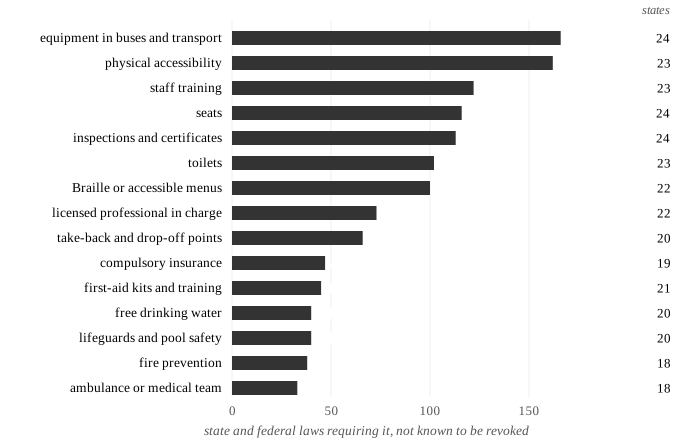
13:6 At full compliance the 22 most-legislated purchasable objects would cost about R$1.6 billion once and R$4.6 billion a year, an estimate built from establishment counts and unit prices. Most of it is people: two guards in each of 15,529 bank branches, R$1.9 billion a year that the federal private-security statute mostly requires already (Lei 14.967/2024), pool lifeguards at R$1.1 billion and compliant shopping bags at R$0.9 billion. Those three rows are 84% of the yearly total, and the last two are upper bounds. Defibrillators come to R$78 million and cameras to R$49 million. This is spending the laws demand, not revenue anyone can capture.
13:7 Two in five of these laws cannot be enforced as written. Of the 2,291, 53% carry a sanction and 22% name a body to enforce them; 909, or 40%, have neither a sanction nor anyone to apply one. The one observation of compliance I found is a newspaper's count of 3 restaurants in 11 with Braille menus on one São Paulo street, years after the state's law (Folha de S.Paulo, 2011). A forcing law creates a paying market where a licence already checks it: 55% of fire laws name a body, usually the fire brigade, and a bank branch holding cash opens only once the Polícia Federal approves its security plan (Lei 14.967 art. 31). Elsewhere it creates a liability that surfaces in a complaint, a lawsuit or an accident.
13:8 Where sanctions exist, their size is a seam of its own. The apprentice quota, a federal hiring mandate, fines R$416.18 per missing apprentice up to R$2,080.90 per assessment (§11.1). São Paulo fines providers and shops that fail to register prepaid phone users "até 10.000 (dez mil) UFESPs" (up to 10,000 of the state's fiscal units) per infraction (Lei 11.058/2002 arts. 1 § 4 and 2); the federal law on the same registry caps shops at R$500 and providers that fail a court request at R$10,000 (Lei 10.703/2003 arts. 1 § 3 and 2). Telecommunications are the Union's to legislate, so the state law is exposed, and some state forcing laws copy laws the STF, the Supreme Federal Court, has already struck (§5.3).
13:9 Knowing which of these laws bind a given shop is itself a forced purchase. A pharmacy in Paraíba and a gym in Amazonas each face their own list, and the files on the assemblies' portals are mostly the original enactment. A table of obligations per state and kind of establishment, sold to chains with the supplies bundled (defibrillator leases, Braille menus, remote Libras, first-aid training), is the lawful product this census makes possible, provided it carries each law's status at the STF, searched by law number; otherwise it sells compliance with laws already struck. These are the decisions the law forces on small firms that Compile the law proposes to compile into code that checks.
Experiment 13.1 (Counting the laws that make someone buy).
Setup: text passes over the corpus for obligation wording in each law's summary and articles ("ficam obrigados a instalar", "obrigatoriedade de"); 41 object classes, the addressee, the sanction and the enforcing body tagged by pattern; then 60 counted laws, drawn by object, read by hand.
Parameters: in force means not known to be revoked or declared unconstitutional; addressees private or unspecified; Wilson 95% intervals.
Result: 2,291 base laws, 1,381 naming a purchasable object. In the sample, 77% (65-86%) truly oblige private actors; among purchasable objects, 57% (42-70%) force buying the object. Adjusted for precision, about 1,750 forcing laws and 790 purchase mandates.
Shows: equipment named in a law's summary is classified reliably and generic nouns are not ("toilets" catches sewage works), so the counts overstate what truly forces by about a quarter.
13.2 Frameworks that opened markets
13:11 The markets the law opens on purpose are federal, and each fixes when its first duty bites. I read 26 federal frameworks of 2019-2026 that turned a public service, a grey market or an unregulated activity into a licensed one. In the six below, the date usually quoted is not the legal one; all are as of October 2026.
13:12 Sanitation is the largest. Lei 14.026/2020 made every contract set targets of 99% of the population with drinking water and 90% with sewage collection and treatment "até 31 de dezembro de 2033" (by 31 December 2033). Seventy auctions since 2020 contracted more than R$227 billion of investment, private operators serve 2,720 municipalities, and investment reached R$29.1 billion in 2024 (O Globo, from the private operators' association). Where the studies for a regional tender show 2033 is not viable, the deadline may run to 1 January 2040 with the regulator's consent (Lei 11.445/2007 art. 11-B § 9), which stretches suppliers' revenue past 2033.
13:13 Crypto providers face the nearest date. They may operate only "mediante prévia autorização" (with prior authorization; Lei 14.478/2022 art. 2), and those already operating must apply to the Banco Central by 30 October 2026 (Res. BCB 520/2025 art. 88 I). From 6 November 2026 banks, payment institutions and other authorized firms may not deal with providers that "não estejam autorizadas" (are not authorized), and the new wording (Res. BCB 589/2026) no longer spares pending applications, so a provider that filed on time may still lose its banking, payment and foreign-exchange access. Buying a provider that cannot comply, or its client book, is lawful; running its business for it without authorization is not.
13:14 Children's online safety has applied since 17 March 2026. ECA Digital, the statute on children and adolescents online, requires "mecanismos confiáveis de verificação de idade a cada acesso" (reliable age checks at each access) to content unsuitable for minors, "vedada a autodeclaração" (self-declaration forbidden; Lei 15.211/2025 art. 9 § 1). January 2027 is when the data-protection authority, the ANPD, starts inspections on its own schedule, not a grace period in law; courts, prosecutors and Procons, the consumer-protection offices, are not bound by it. Fines reach 10% of Brazilian revenue, at most R$50 million per infraction, and the method for setting them is in public consultation until 30 November 2026. A lawful age check minimizes data and keeps no biometric templates.
13:15 The carbon market will make operators emitting more than 10,000 tonnes of carbon dioxide equivalent a year report, and cap those above 25,000 (Lei 15.042/2024 art. 30): 2,188 and 693 operators by the government's impact analysis (Capital Reset). Its first operator duties, monitoring plans and emission reports, start in December 2027 at the earliest. The regulation was due within 12 months of December 2024, extendable by 12 (art. 50 I), and the Finance Ministry's carbon-market secretariat still aims to publish it by December 2026. Allowances follow around 2030.
13:16 Mutual vehicle protection becomes regulated insurance. The 2,209 associations being regularized, covering more than 5 million vehicles, must contract an administrator authorized by Susep, the insurance regulator, and file the contract by 7 May 2028 (Susep; LC 213/2025). None is authorized yet, and the date moves: associations keep six months after Susep authorizes the first administrators, and the 24-month term stretches if that runs past it (Res. CNSP 491/2026 art. 2 §§ 6 and 7). At an assumed R$100 to R$200 a vehicle a month, R$6 billion to R$12 billion a year would pass through authorized administrators. Running mutual cover without that authorization is illegal insurance.
13:17 Betting shows the risk in a licensed market. An industry with R$37 billion of gross gaming revenue in 2025 and 85 authorized operators (Estadão) was abolished by MP 1.394/2026, a provisional measure of 25 September, which extinguished every authorization on 25 October with no refund of grant fees (art. 4). If Congress never votes on it, it lapses around March 2027, but acts done under it, the extinction included, stay governed by it unless Congress passes a legislative decree within 60 days (Constitution art. 62 § 11), so a lapse would not bring licences back.
13:18 One opening date is firm: low-voltage consumers may choose their power supplier from 25 November 2027 if commercial or industrial and from 25 November 2028 otherwise, dates a decree has fixed (Decreto 13.097/2026 art. 1).
Forecast 13.1 (The mutual-protection deadline holds). Susep authorizes at least one administrator of mutual-protection operations under Resolução CNSP 491/2026 by 7 November 2027, so the 7 May 2028 deadline for associations is not extended.
- Horizon
- 2027-11-07
- Probability
- 65%
- Check
- On 8 November 2027 read Susep's pages on mutual-protection administrators. The forecast holds if an administrator is listed with an authorization dated on or before 7 November 2027; it fails otherwise.
13:20 Three limits matter. The classifier's precision is measured and its recall is not, so laws that force in phrasings I did not search for are missing, by an amount I cannot size. Enforcement rests on text signals and one press observation; I found no inspection or Procon data per object. And state texts are mostly original enactments, Paraná and Rio de Janeiro are absent (§1.2), and the decrees, provisional measures and agency resolutions that decide most frameworks sit outside the corpus and were read on official sites.
14 The Union and the states
14:1 The Constitution gives the Union the law of most of the economy, and the states keep writing it anyway. Article 22 reserves to the Union "direito civil, comercial, penal, processual, eleitoral, agrário, marítimo, aeronáutico, espacial e do trabalho" (Constitution art. 22 I), private, criminal and labour law, and with it energy, telecommunications, credit, insurance and traffic. A state law on those subjects binds until someone pays to challenge it, and 15,793 have never been tested. This is the level seam (Definition 0.1). Where the Supreme Federal Court (the STF) settles a tax dispute between the levels, money moves for years: R$3.2 million a year per 1,000 rental cars back from São Paulo, about R$35 billion a year to the states from the grid charges on electricity.
14.1 Who may legislate
14:2 In 21 of the corpus's 25 state jurisdictions, 707 state norms carry a note that the STF struck, suspended or narrowed them (ctresb/leis, a snapshot of 13 October 2026; tables in Appendix B). Nine states print such notes as a habit and hold 663, led by the Federal District with 139 and São Paulo with 138; elsewhere a missing note means unknown. In those nine, an adverse note sits on 57 of every 1,000 laws on insurance and health plans, 47 on firearms, 31 on traffic and 26 on telecom, against 1.5 on all other subjects, and a duty on firms raises the rate further, to 82 for insurance. When the STF decides such a case, the recorded outcome is adverse 82% to 100% of the time.
14:3 The typical struck law adds a rule to a federally regulated contract or service, such as Espírito Santo's maximum waiting times for health-plan users, struck in 2020 in ADI 4818, a direct action of unconstitutionality. Duties to inform consumers survive more often, because consumer protection is shared with the states (CF art. 24 V): the STF struck Mato Grosso do Sul's 2016 law putting internet speed on the bill, then upheld its 2022 one (ADI 7416).
14:4 Side by side, federal and state laws on one subject seldom collide: of 48 such pairs (§4.1), 16 state laws restate the federal one, 29 implement it and 3 conflict. The clearest is São Paulo's Lei 11.058/2002 on prepaid phones, which fines shops and operators "até 10.000 (dez mil) UFESPs, por infração cometida" (ALESP art. 1 § 4), up to R$384,200 at the 2026 value of the state's fiscal unit, where federal law caps a shop's fine at R$500 and leaves enforcement to Anatel, the telecom regulator (Lei 10.703/2003 arts. 2 and 5). The STF struck Santa Catarina's law and a later São Paulo one in 2020 (STF); a web search found no action against this one, so a fined shop or operator has a direct precedent.
14:5 Striking does not stop the copying. Text matching finds 72 laws that mirror a law the STF struck in another state; 60 carry no note of any ruling, and 33 of those were passed after the action against the original was filed. Laws granting sport shooters a presumed need to carry guns, a permit federal law leaves to the Federal Police, fell in five jurisdictions between 2022 and 2025 (STF), and on 1 April 2026 Santa Catarina passed the same text (Lei 19.781/2026). A ruling in an ADI binds courts and administrations but not assemblies, so each copy needs its own action (§5.3); taxes repeat the pattern, as Mato Grosso and Pará re-enacted fees the STF had struck (§9.6).
14.2 Settled theses that still pay
14:6 The STF and the Superior Court of Justice (the STJ) settle such disputes in a "Tema", a case decided once for all similar ones; refunds then run for five years from each payment under the national tax code (CTN art. 168 I).
14:7 The newest concerns the IPVA, the state vehicle tax, on rental cars. São Paulo taxed cars registered in other states when they were rented or offered for rent in its territory, and made renters and managers liable. In ADI 4376, in a virtual session ended 18 August 2026, the STF struck those clauses of Lei 13.296/2008: the tax belongs to the state of the owner's seat or tax domicile (Tema 708), since "o veículo continua vinculado à empresa proprietária, e não à empresa que o aluga" (STF), the car stays tied to its owner. The judgment was published on 18 September 2026 with no modulation. A rental company based elsewhere paid the full 4% on such cars, since the 1% rate for rental fleets requires registration in São Paulo (art. 9 § 1); on 1,000 cars worth R$80,000 it recovers R$3.2 million per year paid, R$16 million over five years [estimate: 4% × R$80,000 × 1,000 × 5]. Payments before 16 October 2021 are time-barred. The risk is low for owners with no São Paulo establishment and medium for cars tied to a São Paulo branch, which wait for Tema 1198 on whether a branch makes a domicile.
14:8 Ten other states keep mirror clauses: Alagoas, Ceará, Espírito Santo, Maranhão, Pará, Paraíba, Pernambuco, Piauí, Santa Catarina and Sergipe. Alagoas taxes a rental car "na data em que vier a ser locado ou colocado à disposição para locação no território deste Estado" (Lei 7.745/2015 art. 2), when it is rented or offered for rent there. The ruling binds only São Paulo's law, so a company taxed under these needs its own suit, at medium risk. Registering a fleet where the company has no real establishment is evasion (Chapter 17).
14:9 Older theses on the ICMS, the state tax on goods and some services, and on PIS and Cofins, the federal contributions on revenue, still move money as of October 2026:
| Thesis | Settled | Who gains |
|---|---|---|
| ICMS a supplier collects in advance for the chain, out of the buyer's PIS and Cofins (STJ Tema 1125) | 2023, effects from 15 March 2017 | retailers, five years back by administrative claim: R$0.9-2.3 million on R$5 million a year of such ICMS [estimate: 3.65-9.25% × 5 years] |
| DIFAL, the rate difference of ICMS owed to the buyer's state (Tema 1266) | due from 5 April 2022; not for 2022 from those who sued by 29 November 2023 and did not pay | sellers who sued; DIFAL that São Paulo and Rio Grande do Sul charged on 1-4 April 2022 is refundable until April-May 2027 |
| ICMS on goods moved between a firm's own establishments (ADC 49; Tema 1367) | none from 2024, nor on unpaid earlier years | groups with open assessments; tax paid stays with the states |
| Grid charges on electricity (TUSD, TUST) in the ICMS base (STJ) | included, 13 March 2024 | states, about R$35 billion a year (Comsefaz) |
| ISS, the municipal tax on services, out of PIS and Cofins (Tema 118) | tied 5-5, off the docket since 20 February 2026 | firms with a suit pending at judgment, if taxpayers win |
14:11 Sellers who neither sued nor paid the 2022 DIFAL can still be assessed until 31 December 2027, by my reading of CTN art. 173 I, and fifteen states still print the clause the STF killed, ICMS on goods moved "ainda que para outro estabelecimento do mesmo titular", even to another establishment of the same owner. The fees and funds the states keep winning are in §9.6. The ITCMD, the state tax on inheritances and gifts, has a vertical side too: states cannot tax gifts from abroad without a national law (Tema 825), and the transitional power in EC 132/2023 art. 16 works only through a state law passed after it (§9.5).
14:12 The ITBI, the municipal tax on property transfers, does not fall on property paid into a company's capital, "salvo se, nesses casos, a atividade preponderante do adquirente for a compra e venda desses bens ou direitos, locação de bens imóveis ou arrendamento mercantil" (CF art. 156 § 2 I), unless the company mainly trades or rents property. Municipalities apply that exception to capital contributions. On 16 September 2026 the STF stood 5-2 for the reading that the immunity "é incondicionada e, portanto, indiferente a atividade preponderantemente imobiliária", up to the capital subscribed (Tema 1348); the virtual session closes on 19 October 2026 at 23:59. A family putting R$10 million of rental property into a holding in the city of São Paulo pays about R$300,000 at 3% today and nothing up to the capital if the thesis holds [estimate]. Waiting for the published result avoids paying and suing back; a sham contribution stays taxable (Chapter 17).
Forecast 14.1 (Capital contributions escape the ITBI). The STF records a majority in Tema 1348 for ITBI immunity on property paid into a company's capital whatever the company's main activity, up to the capital subscribed.
- Horizon
- 2026-12-31
- Probability
- 80%
- Check
- The STF's page for Tema 1348 (RE 1.495.108) shows a certificate of judgment with that thesis dated by 31 December 2026.
14.3 Laws nobody has tested
14:14 Most state laws on the Union's subjects have never met a court. Of 18,100 state ordinary and complementary laws on them, 15,793 carry no note of any ruling and are not known to be revoked or struck as of 16 October 2026 (§6.1). Many only organise state agencies and 1,998 create municipalities, so two narrower counts matter more: 1,343 put duties on firms in federally regulated sectors, led by banks and credit (385), telecom (258) and civil and commercial law (154), and about 4,000 score in the top tenth of the risk model below [estimate: 4,082 before the latest revocations, scaled down]. All are upper bounds, since revocations go unrecorded where portals print no status. Of the outcomes recorded on these subjects 95% are adverse, a share biased up because annotators record strikes more than upholds; at a conservative 50-75%, 2,000 to 3,000 of the top tenth would fall if judged [estimate].
14:15 Near the top of the ranking sits the Federal District's "Fica proibida a comercialização de armas de fogo no âmbito do Distrito Federal" (Lei 2.375/1999 art. 1), a ban on selling guns. Another high scorer had in fact fallen: Rondônia's duty on insurers to report total losses, struck in 2025 (ADI 4293) in a ruling recorded only in the law's summary.
14:16 For a firm the rule is short: contest at low risk a duty from a top-tenth law whose twin has fallen, obey a duty only to inform consumers, and in between comply under protest or deposit the amount while a challenge runs. A direct action belongs to those the Constitution names (CF art. 103), among them the Prosecutor-General, governors, parties in Congress and national trade bodies.
14.4 The risk model
14:17 I trained a model to tell which state laws the STF strikes from their official summaries alone, on the 169,693 ordinary and complementary laws of the nine states that print outcomes, 612 of them struck, suspended or narrowed; it never sees the state. Trained on eight states and tested on the ninth, it ranks the held-out state's laws with an AUC of 0.73 to 0.96, median 0.89: a struck law outranks an untouched one 89 times in 100. The top 1% of scores holds 3.7 to 31.8 times the state's base rate of struck laws, median 16.
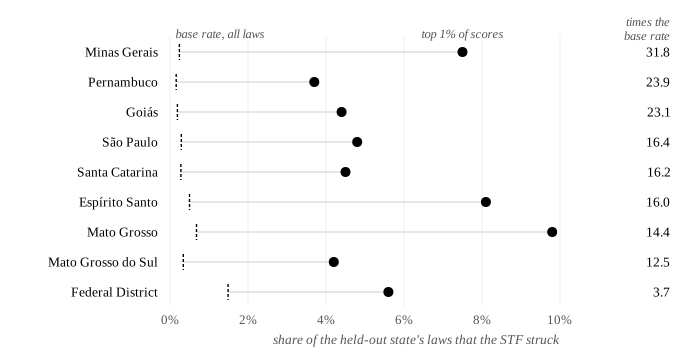
14:19 Even in the top 1% fewer than one law in ten has been struck, because most exposed laws are never challenged: the score measures exposure, not the chance of a suit. Words such as "proibe", "transito" and "empresas" raise it; "denominacao", "utilidade publica" and "institui dia", the marks of honorific laws (§2.1), lower it. It learns past strikes, so it lags a court that changes course, as on consumer information in 2024.
Experiment 14.1 (Which state laws the STF strikes, from their summaries).
Setup: logistic regression on the summaries of the nine states' ordinary and complementary laws, labelled positive where a note records an adverse STF ruling; trained on eight states and scored on the ninth, once per state.
Parameters: 169,693 laws, 612 positives; 262,144 hashed features from words and word pairs, plus theme, duty on firms, federal subject and decade; no state feature.
Result: held-out AUC 0.728 (Federal District) to 0.957 (Minas Gerais), median 0.889; the top 1% holds 3.7 to 31.8 times the base rate, median 16; in-sample AUC 0.998.
Shows: the summary alone ranks exposure; scores fitted on all nine states flatter those states and are untested on the other sixteen.
14:21 The use is a precedent engine that scores each new state law, links it to its struck twin and alerts: trade associations choose what to challenge, compliance teams what to obey, lawyers which fines to contest, and an assembly's legal office what to repeal before a firm is fined under it (§18.2).
14:22 The counts rest on notes that nine states print and sixteen do not, so the model has not seen most of the country. Themes come from keywords, and notes go stale: Mato Grosso's soy-moratorium law still shows a suspension the STF lifted in August. "No action found" is a web search, not a query of the STF's registry by law number, and the IPVA mirror laws have not been read in their current official text. The open question is which of the 1,343 duties on firms are enforced, and with what fines: that says where the money sits and who should act first.
Part IV. Capital
15 Seventy-seven strategies
15:1 The seams turn into money through seventy-seven strategies, and the ones that pay soonest cost nothing but a decision before a date. Four strategists wrote them in one form, sixty-nine lawful strategies and eight anti-stacks that cross the line, and two red teams read them against the official texts, each record at least once: none was unsound, and 44 needed a fix to a number, a date or the line between planning and abuse. Two windows close within a fortnight of 16 October 2026: a small firm's election to pay IBS and CBS, the new value-added taxes, outside its single monthly payment, by 30 October, and a cooperative's option for the regime that zero-rates its trade with members, by 31 October.
15.1 The record
Definition 15.1 (Strategy). A strategy is a lawful way for a named actor to turn a seam into money, written as one record: the mechanism, the law and article that allow it with their operative words, a size with its arithmetic, the capital and skills it needs, its window, three first steps, a legal risk of low, medium or high, and the abuse line beyond which the same moves stop being planning.
15:3 Each record also names its kind, the type of seam, who can act, a confidence, its evidence in the corpus, a snapshot of 13 October 2026 (ctresb/leis; Appendix B), and the date and address of its official check. The common form lets records from different hands be merged, ranked and audited. The kinds are seven:
- structure and location choices for operating firms;
- products and services for whoever must cross a seam;
- plays on a window that opens or closes;
- vehicles the law favours, such as incentivized debentures and agribusiness funds;
- recovery and litigation on theses the courts have settled;
- markets that a legal obligation or a new framework creates;
- information products built from the statute book itself.
15:4 Four strategist agents wrote the records: a builder looking for products a small software team can build (14), a capital strategist for structure, place, timing, vehicles, claims and new markets (25), a public-interest strategist for the side that pays (20), and a stacks strategist for combinations, ten that add up and eight anti-stacks that only seem to (18). Fifty records are private and 27 public. Dates dominate: 33 records cross a date seam, against 21 a regime, 12 a level between the Union and the states, 10 a border and 7 a number.
15:5 Sizes follow (0.1) where the evidence allows, and most are worked examples for one firm, project or family, in the unit the record states: a semester, a year, a single gift. They order strategies and cannot be added. I ranked on the middle of each range, the geometric mean of its ends, or their average when the low end is zero.
15:6 Urgency comes first and size second. With the red teams' corrections applied, 3 strategies close within a month of 16 October 2026, 3 within three months, 4 within a year, 10 within three years, 12 later, and 45 have no closing date, mostly public tools and claims on settled law. The third of the month is a family holding whose transfer-tax question waits on the STF session that ends on 19 October (§16.2). The large dated sums sit in 2028 and 2029, when the Sudene approvals, the compensation-fund filings and the federal R&D regimes close (§A.1).
Experiment 15.1 (Ranking the strategies).
Setup: I merged the 77 corrected records and sorted them by urgency band, then by the middle of the size range.
Parameters: days left from 16 October 2026; bands closing at 30, 90, 365 and 1,095 days, then later and open-ended; size middle as the geometric mean of the range, in each record's own unit.
Result: 3, 3, 4, 10, 12 and 45 strategies in the six bands; 53 carry low legal risk, 14 medium and 10 high, eight of the ten being anti-stacks.
Shows: Few windows close in 2026, and nearly all are transition dates of the consumption-tax reform.
15.2 What closes in 2026
15:9 The Simples election closes on 30 October. The Simples Nacional collects several taxes in one monthly payment, the DAS, for firms with up to R$4.8 million of revenue, and now "É facultado ao optante pelo Simples Nacional apurar e recolher o IBS e a CBS de acordo com o regime regular" (LC 123/2006 art. 13 § 9): a Simples firm may pay IBS and CBS under the regular regime, so its business buyers credit the full CBS (§10.5). With CBS at 8.8%, a trader at R$3.6 million a year selling only to businesses, with inputs at 60% of price, gains 5.47% of a semester's R$1.8 million, R$98,460, of which 5.28 points are the CBS credited on its inputs (8.8% × 60%); a manufacturer at R$1.8 million selling 60% to businesses gains R$10,728. The election can be cancelled from 3 November to 20 December, after the Senate fixes the CBS rate (Receita Federal), which makes it close to a free option. The steps: measure sales to businesses and inputs bearing full CBS, elect wherever the break-even is within reach, and cancel where the Senate's rate erases the gain. Risk is low. Invoicing consumers as businesses, or splitting a firm so that half opts, crosses the line, and LC 123 art. 3 § 4 adds the halves back together.
15:10 The cooperative option closes a day later. Under it "ficam reduzidas a zero as alíquotas do IBS e da CBS incidentes na operação em que: I - o associado fornece bem ou serviço à cooperativa de que participa" (LC 214/2025 art. 271): trade between members and their cooperative bears no IBS or CBS. The option is made in the year before (§ 3), from 1 September to 31 October, irrevocably and with the list of members and their admission dates (Decreto 12.955/2026 art. 393 § 1; Receita and IBS committee), and a cooperative that misses it waits for 2028 (§10.6). The record sizes the whole cooperative stack: a grain cooperative with R$80 million of surplus on member trade owes no IRPJ or CSLL, the federal taxes on company profit, which would cost a company R$27.2 million a year (§16.2). The steps: separate member and non-member results, file the option with the member list, and map members under R$3.6 million of revenue, whose sales carry presumed credits. Risk is low. Fewer than 20 natural-person members, votes by capital or surplus not returned by operations make a company dressed as a cooperative (Lei 5.764/1971 arts. 4 and 6), and a work cooperative that supplies subordinate labour pays R$500 per worker, as does its client (Lei 12.690/2012 arts. 5 and 17).
15:11 Redata, the new regime for data centres, runs five years, but "Os benefícios fiscais relativos aos tributos previstos nos incisos I, II e III do caput do art. 11-C desta Lei produzirão efeitos até 31 de dezembro de 2026" (Lei 11.196/2005 art. 11-J, from Lei 15.504/2026): the suspensions of PIS, Cofins and IPI end with 2026. They need a regulation, a product list and a habilitation, and as of October 2026 none exists, so the strategy counts the 2026 leg at zero (§10.3). On R$500 million of equipment the low case is R$0; the ceiling is the import duty to 2031, 16% on R$400 million of listed goods with no national equivalent, R$64 million. The steps: watch the Receita's norms weekly, pull deliveries into 2026 only for equipment already needed and only once habilitated, and budget the five commitments, whose breach claws the tax back with interest (art. 11-D). Risk is medium. Buying equipment the project will not use, or invoicing in 2026 goods delivered in 2027, is simulation (Código Civil art. 167).
Forecast 15.1 (Redata's 2026 leg stays empty). No data centre is habilitated under Redata, with its regulation and product list in force, before 1 January 2027.
- Horizon
- 2027-01-31
- Probability
- 75%
- Check
- Search the Diário Oficial and the Receita's norms system for the Redata decree, the product list of Lei 11.196 art. 11-C § 4 and an act habilitating a named company, all dated by 31 December 2026.
15:13 Small exporters have until 31 December for a 3% refund on goods exports: "Entre 1º de agosto de 2025 e 31 de dezembro de 2026, o percentual de 3% (três por cento) de que trata o caput será aplicado para microempreendedores individuais, microempresas e empresas de pequeno porte" (Decreto 8.415/2015 art. 2 § 7-A), the rate for small firms and one-person MEIs. R$100,000 of goods exports a month earns R$36,000 a year, R$51,000 over the window, claimed each quarter once the export declaration clears, in cash or against federal taxes but not the DAS; past quarters can still be claimed, services cannot. The Acredita Exportação refund is one layer of the small-exporter stack, R$124,366-177,766 a year in all (§16.2). Risk is low; domestic sales relabelled as exports through a related trading company are simulation.
15:14 The opening-stock credit is counted on one day. Firms in the cumulative PIS and Cofins regime, mostly lucro presumido (presumed profit) firms, and regular firms holding stock bought under the listed single-stage regimes take a CBS credit "mediante aplicação de percentual de 9,25% (nove inteiros e vinte e cinco centésimos por cento) sobre o valor do estoque" (LC 214/2025 art. 381 § 3 I), on an inventory "realizado exclusivamente em 31 de dezembro de 2026" (Decreto 12.955/2026 art. 608 § 1). R$2 million of eligible stock gives R$185,000, and R$10 million gives R$925,000. The steps: count item by item on that day, valuing a manufacturer's goods at their raw materials and packaging and leaving out beverages and fuel; book the credit by the end of June 2027 for twelve monthly instalments; record PIS and Cofins balances in the same pass. The builder sells this as a kit that ties each item to its purchase invoice, R$0.3-3.2 million of one-off revenue. Risk is low; stock inflated with purchases reversed in January is fraud (Lei 8.137/1990 art. 1).
15:15 Gifts from donors who really live abroad escape ITCMD, the state tax on gifts and inheritances, wherever the donee's state has not legislated. The Constitution leaves the case "se o doador tiver domicilio ou residência no exterior" to a complementary law (CF art. 155 § 1 III), and EC 132/2023 art. 16 hands it to the donee's state through a new law, which cannot bite in its own year nor "antes de decorridos noventa dias da data em que haja sido publicada" (CF art. 150 III c). Nine states have one; elsewhere a law published now bites from 14 January 2027 at the earliest (§9.5). A R$10 million gift of cash, securities or quotas saves R$400,000 at 4% to R$800,000 at 8%. The steps: confirm that the donee's state has no law and that the donor filed a departure return and no resident one; complete the gift, registering quota gifts, before any law applies; declare non-incidence under Tema 825, the Supreme Federal Court's ruling for all such cases. Risk is low for a genuine non-resident. A fake residence, a back-dated deed, or a "sale" to a related buyer without means, which LC 227/2026 art. 147 presumes a gift, is evasion.
15:16 Three more dates fall early in 2027. Payroll relief is re-chosen with the January payment, due 19 February, and saves an IT firm with R$50 million of revenue R$325,000, down from R$800,000 in 2026. Gifts in the five flat-rate ITCMD states lock today's rate before progressive tables bite. The end of the six-day week starts two months after the amendment's publication (§11.4).
15.3 Private strategies
15:17 Of the 50 private records, 16 are structure and location, 12 windows, 7 claims, 6 new markets, 3 products, 3 vehicles and 3 information products. Operating companies can act on 32, investors on 17, professional firms on 15 and small software teams on 12.
15:18 Half the structure-and-location records are anti-stacks, combinations that cross the abuse line, kept so that the line has examples (§16.3). The rest choose a regime, a place or a payout. A lucro real (actual profit) project that Sudene or Sudam, the development agencies of the Northeast and the Amazon, approve by 31 December 2028 cuts income tax on operating profit by 67.5% for ten years, R$1.67 million a year on R$10 million of profit (§10.4). An ICMS incentive, a cut in the state tax on goods, is worth 3.9 benefit-years from 2027 at a 10% discount, so a new R$30 million-a-year grant is worth R$117 million (§9.3). A service firm that pays its partners a real pro-labore, lifting payroll to 28% of revenue, nets R$35,000-47,000 a year on R$1 million of revenue from a cheaper Simples table (§7.2).
15:19 The later windows follow the reform's calendar. Developers selling homes to individuals can lock IBS and CBS at 2.08% of receipts with an option effective before 1 January 2029. Chemical producers queue for PRESIQ credits, capped at R$2.5 billion a year from 2027 to 2031 and still unregulated. Mover, the vehicle R&D regime, ends on 27 June 2029 with a R$4.1 billion cap for 2028, and the Lei de TICs, the electronics R&D credit the Receita projects at R$7.7 billion for 2026, on 31 December 2029 (§10.2). A data centre, a plant and a startup in the Northeast each need a Sudene filing by 30 September 2028 (§16.2).
15:20 The builder's products sell to firms that must cross a dated line and prove something when they do: a workflow for holders of state incentives to file with the compensation fund (R$20,000-150,000 per holder), and rebalancing claims for public contracts after the end of the six-day week (R$10,000-60,000 per provider). The best free product is a calendar of every legal window with its norm, article and quote, given away because statutes carry no copyright and because its audience, 103,689 accounting firms, is the one the paid products need. Feeds of new duties and compliance kits complete the list. Each is the law compiled into code that checks (Compile the law). Simples calculators and cliff monitors were dropped: at least five tax-software firms already sell them.
15:21 The vehicles and claims are smaller and steadier. Tax-free debentures, property and farm credit notes and listed funds yield R$115,000-172,500 a year more per R$10 million than taxed alternatives. Retailers recover the tax-substitution ICMS the Superior Court of Justice took out of their PIS and Cofins, R$0.9-2.3 million over five years for R$5 million a year of it. Rental fleets registered outside São Paulo reclaim IPVA, the state vehicle tax, under ADI 4376, R$3.2 million a year per 1,000 cars (§14.2). Holders of onerous ICMS incentives granted by 31 May 2023 claim one benefit-year in cash from the compensation fund (§9.4). The new markets are free low-voltage energy, biomethane certificates (R$0.9-1.3 billion in 2027) and hydrogen credits (R$18.3 billion over 2030-2034, at high risk) (§13.2).
15.4 Public strategies
15:22 The 27 public records come from the public-interest strategist (20), the builder (6 corpus products that should be free) and the stacks strategist (1); their sizes measure the money at stake. They ask for audits and data on the largest seams: the ICMS compensation fund (R$40-45.5 billion), the R$333.7 billion of ICMS relief the states declared, the federal incentives ending in 2029 (R$44.5 billion a year), and the Imposto Seletivo, the new excise, whose rates law must be converted by 31 December 2026 for any of its R$41.9 billion forecast for 2027 to be collected. They build free tools, from a 2033 transition map to a checker of whether a law is in force, and draft model bills, from progressive ITCMD to a phase-in for the MEI's exit. §18.2 takes them up.
15:23 The public strategist also read the private records for who pays, and flagged nine. Five pay only large estates or high incomes, among them the tax-free notes that cost R$25.8 billion a year. Three flags changed records: energy retailers must not sell to households on the social tariff, which lose it when they switch; duties may not be ranked by how rarely they are enforced; the copy warning is free for the groups the copied laws protect. The ninth asked that the cooperative's abuse line cover disguised employment, and the labour red team wrote it (§17.2).
15.5 Verdicts
15:24 Every record was read by at least one red team, and none was unsound. The tax red team read the records of the builder, the capital strategist and the stacks strategist; the labour and regulation red team read every record except twelve stacks, and found nothing in its scope in 20.
| red team | read | sound | fix | unsound |
|---|---|---|---|---|
| tax | 57 | 26 | 31 | 0 |
| labour and regulation | 65 | 47 | 18 | 0 |
| either | 77 | 33 | 44 | 0 |
15:26 No strategy rested on a wrong statute or a quotation that does not exist. Six abuse lines leaned on CTN art. 116 sole paragraph, the anti-avoidance clause that still has no procedure law, and now cite simulation or a specific rule (§17.1). Incentives were counted before their regulation existed: Redata's 2026 leg, PRESIQ, the annual minimum tax. Dates were wrong or missing, the cooperative's 31 October and the Sudene filing by 30 September 2028 among them. Arithmetic missed rules: Simples exports take the rate of their own revenue, which raised one exporter's relief from R$79,126 to R$124,366, and a Sudene saving cannot be distributed, which cut the minimum-tax claw-back from 45-49% to 35-39%. Scope was off: law firms always sit in the Simples' fourth services table, beverages and fuel earn no stock credit, and public-contract claims rest on Lei 14.133/2021 art. 134, not art. 135. One labour line ran backwards: converting employees into contractors breaks the payroll-relief headcount floor.
15:27 The counts are the verdicts given before any fix. The builder, the capital strategist and the public strategist applied every fix to their 59 records, and the stacks strategist corrected its 18 on the morning of 16 October; the figures here and in Chapter 16 are the corrected ones.
15:28 The ranking measures urgency better than value, since national totals would need counts of firms that the statute book does not hold. Several strategies wait on acts not yet published: Redata's decree, PRESIQ's regulation, the annual minimum-tax rules, the Imposto Seletivo's rates, the Senate's CBS rate due on 15 December, and the sanction of the bill raising the MEI ceiling (§7.1). A record is true on its date, and the two windows that close this month will be gone in a fortnight.
16 Stacks
16:1 Benefits stack when they act on different bases and exclude each other when they act on the same one. Of 72 pairs of large seams checked against the law, 26 add, 18 exclude each other and 28 add only past a condition. The best lawful stacks run from R$120,000 a year for a 20-person software house to R$55.5 million a year for a data centre in the Northeast; eight combinations look as good and are worth nothing, or a fine.
Definition 16.1 (Stack). A stack is a set of benefits that one actor combines on purpose, each acting on its own base or decision, whose values add, less the overlap where two share a base and the claw-back that one layer triggers in another. An anti-stack looks additive and is not: its layers share a base, a statute bars the pair, or the moves that produce it cross the abuse line.
16.1 The matrix
16:3 The stacks strategist paired 27 of the largest seams and the rules around them, from the R$333.7 billion of ICMS incentives the states declared to the Simples' new IBS/CBS option. Each pair records what each side acts on, the legal reason, the article and its operative words, checked against the corpus (ctresb/leis; Appendix B) or a saved official copy. A last legal check on 16 October 2026 moved three pairs to conditional, among them a rental holding's claim to immunity from ITBI, the municipal tax on property transfers.
16:4 The first decision splits the stacks into two families. The Simples Nacional collects several taxes in one monthly payment for firms up to R$4.8 million of revenue, and its firms "não poderão utilizar ou destinar qualquer valor a título de incentivo fiscal" (LC 123/2006 art. 24): no tax incentive at all. Its base is the whole firm, so it overlaps every base a lucro real (actual profit) incentive acts on, and nine of the 18 exclusions are the Simples against one, such as Sudene's income-tax cut in the Northeast or the state ICMS programmes. Inside the box, the layers LC 123 builds in stack: the fator r, which moves service firms whose payroll reaches 28% of revenue to a cheaper table, export relief, local relief for small firms and the hybrid option (§7.2).
16:5 On a shared base the second benefit acts only on what the first left. If benefit removes a share of a tax and is the part of benefit 's value that falls on that tax, then On disjoint bases the last term is zero and the values add, like components along orthogonal axes (Definition 3.1). Sudene cuts 67.5% of a manufacturer's income tax, and the Lei do Bem takes 54% of R&D off the base of that tax and of CSLL: on R$4 million of R&D it saves R$734,400 alone and R$369,900 under Sudene, about half.
16:6 Other couplings cross taxpayers. The minimum tax of Lei 15.270/2025 rises from zero at R$600,000 of yearly income to 10% at R$1.2 million, and is refunded only where "a soma da alíquota efetiva de tributação dos lucros da pessoa jurídica [...] ultrapassa" 34% (Lei 9.250/1995 art. 16-B): where company and owner together pay more than 34%. A Sudene firm pays about 17%, and its saving "não poderá ser distribuído aos sócios" (DL 1.598/1977 art. 19 § 3), so of 100 of profit 66 can be paid out, and the owners' 6.6 claws back 35.2% of the saving at a 75% cut and 39.1% at 67.5%. Retained profit keeps it all; a holding only defers. A state ICMS incentive is taxed as profit too, with a 25% credit under Lei 14.789/2023 art. 6 only on the part matched to depreciation of the incentivized plant, so R$1 of ICMS benefit nets R$0.66-0.91.
Experiment 16.1 (Does the base predict the verdict?).
Setup: I sorted the 72 pairs by hand by the tax, taxpayer or decision each side changes, reading the legal reason for each verdict.
Parameters: verdicts after the legal check of 16 October 2026.
Result: of 26 compatible pairs, 13 act on different bases, 6 are layers one regime builds in, 4 are regimes spared by the 10% cut of federal benefits in LC 224/2025 and 3 are public data sets that join; 17 of 18 exclusive pairs share a base or decision, the other being the fiscal trigger that bars new federal benefits in 2027; of 28 conditional pairs, 7 share a base in part, 8 are couplings or cuts and 13 pass a gate: a date, an approval, a registration or a court.
Shows: The base predicts the verdict; where it does not, the law built the layer in or wrote the exclusion down.
16.2 Named stacks
16:9 Ten named stacks combine compatible layers for one kind of actor, with a worked case, the order of moves and an abuse line; sums are yearly unless marked.
The ten stacks
| stack | R$ a year | date that binds |
|---|---|---|
| software house, 20 people, Simples | 119,700-243,093 | 30 Oct 2026 |
| services firm near R$4.8 million | 137,760 once to 336,858 | each December |
| small exporter, Simples | 124,366-177,766 | 31 Dec 2026 |
| startup in Recife | 103,540, then 527,512 | 30 Sep 2028 |
| manufacturer in the Sudene area | 2.7-18.9 million | 30 Sep 2028 |
| data centre in Ceará | 25.3-55.5 million | 30 Sep 2028 |
| grain cooperative | 27.2 million | 31 Oct 2026 |
| family holding, São Paulo | 172,020-193,920 | 19 Oct 2026 |
| rental fleet, 2,000 cars | 5.4-8.4 million | open |
| public-interest data join | 232.5-930 million protected | 2029 |
16:10 The manufacturer shows layers adding and then leaking. A firm with R$200 million of revenue opens a plant in the Sudene area in 2028, with R$24 million of operating profit, R$12 million of ICMS due and R$4 million of R&D. Sudene saves R$4,033,800 of its R$5,976,000 income tax. A state incentive of 75% of the ICMS nets R$5.94-8.19 million if the state acted first: the credit needs an "ato concessivo da subvenção editado pelo ente federativo anterior à implantação ou à expansão" (Lei 14.789/2023 art. 4). With the Lei do Bem's R$369,900, the retained stack is worth up to R$12,593,700 a year; paid to owners above R$1.2 million, it loses R$1,607,526 to the minimum tax, 36.5% of the federal saving, and keeps R$10,986,174. Across R$50-300 million of revenue the range is R$2.7-18.9 million a year. Sudene projects must be approved by 31 December 2028 (MP 2.199-14/2001 art. 1) and filed by 30 September to be decided that year; a 2029 start probably loses Sudene, and the ten-year total falls from R$76.8 million to R$31.9 million.
16:11 The data centre lost most to the last legal check. A 50 MW campus in Ceará with R$150 million of operating profit from 2028 gets Sudene, where informatics is a priority sector: R$25,296,300 a year. Redata adds at most the suspension of import duty on listed goods with no national equivalent until about September 2031, R$36 million a year at an illustrative 10% on R$360 million of imports, less an R&D commitment of 1.6% of benefited purchases in the Northeast, R$5,760,000 (Lei 11.196/2005 art. 11-B § 7). The stack nets R$25.3-55.5 million a year. Its 2026 leg, R$64 million in the first version, is worth R$0: as of October 2026 there is no regulation, product list or habilitation, and servers are made in Brazil and unlikely to be listed (§10.3).
16:12 The small exporter turns on a rule the first version missed. The Simples rates export revenue apart: "serão consideradas separadamente as receitas brutas auferidas no mercado interno e aquelas decorrentes da exportação" (LC 123/2006 art. 3 § 15). A manufacturer pays 11.1375% on R$2.4 million of domestic sales, and on R$1.2 million of exports its own band, 9.325%, less the PIS, Cofins, IPI and ICMS shares dropped on exports (art. 18 § 14): 4.34%. It pays R$319,334 instead of R$443,700, R$124,366 a year less; the hybrid option adds R$53,400 of input credits from 2027, and Acredita Exportação's 3% adds R$36,000 a year until 31 December 2026. The fator r still counts total revenue.
16:13 The cooperative adds layers on different bases; the family holding has layers that pay only together. A grain cooperative with R$80 million of surplus on member trade pays no IRPJ on it (Lei 5.764/1971 arts. 79 and 111), and "relativamente aos atos cooperativos, ficam isentas da Contribuição Social sobre o Lucro Líquido - CSLL" (Lei 10.865/2004 art. 39): R$27.2 million a year against a company, with its IBS/CBS option due by 31 October 2026 under Decreto 12.955/2026 art. 393 § 1. A São Paulo founder with R$1.8 million of dividends and R$600,000 of rents pays R$240,000 a year. Giving three children 75% of both companies leaves four owners R$583,005 each, below the R$600,000 where the minimum tax starts, and rents in a holding pay R$67,980: R$172,020 saved a year. The holding alone costs R$61,182 more than today. Its R$300,000 of ITBI hangs on Tema 1348, whose virtual session at the STF, the Supreme Federal Court, ends on 19 October 2026 with a majority, not yet final, for immunity.
16.3 Anti-stacks
16:14 The eight anti-stacks carry high legal risk; their sizes are gains that look available and are not.
| looks like | apparent gain | fails on |
|---|---|---|
| splitting a R$9.6 million services firm in two | R$408,960 a year | one ceiling for related firms |
| hiring 20 employees as contractors | R$1,082,540 a year | the labour code's nullity rule |
| an ICMS incentive without CONFAZ approval | R$8.19 million a year | unanimity of the states |
| a fund claim for an incentive granted after 31 May 2023 | R$8.19 million once | the fund's cut-off date |
| dividend lines through nominees | R$240,000 a year | lines per real recipient |
| one gift split inside the state's window | bracket savings | aggregation of gifts |
| holding quotas at book value | R$400,000 once | the market-value floor |
| one R&D budget under Mover and the Lei de TICs | a second credit | Mover's counterpart bar |
16:16 They fail in three ways. Some put two benefits on one base: related firms share one ceiling (LC 123 art. 3 § 4), gifts within the state's window are added up (LC 227/2026 art. 155), and quotas are worth at least the "patrimônio líquido ajustado pela avaliação de ativos e passivos a valor de mercado" (art. 154). Some need a consent the law gives to others: "decisão unânime dos Estados representados" (LC 24/1975 art. 2 § 2), or benefits "regularmente concedidos até 31 de maio de 2023" (EC 132/2023 art. 12 § 4 I). The rest work only if the facts differ from the papers: an employee called a contractor, which the labour code makes "nulos de pleno direito" (CLT art. 9), a child who hands the dividends back, a quota sold to an heir "que não comprove capacidade financeira" (LC 227 art. 147). Most have a lawful neighbour, from real gifts in separate windows to the Simples employer regime, whose marginal payroll cost is 1.236 times the wage against 1.544 outside it (§11.2).
16:17 Two exclusions proved narrower than they looked. Mover's bar (Lei 14.902/2024 art. 21) covers R&D done for the Lei de TICs, Padis and the regional auto regimes, and leaves out the Lei do Bem. A Lei de TICs firm keeps a 160-180% deduction for its IT R&D (Lei 11.196/2005 art. 26 §§ 1-2) on top of the TICs credit; whether the Receita accepts both on the same spending is unverified.
16:18 With the general anti-avoidance clause, CTN art. 116 sole paragraph, still lacking its procedure law, the line rests on simulation (Código Civil art. 167) and specific rules such as these (Chapter 17). Crossing it costs the tax plus a fine of up to 75%, 100% with fraud and 150% for repeat offenders (CTN art. 113-A § 1).
16:19 The base cases are illustrative and none is advice for a particular firm. Several layers wait on acts not yet published as of October 2026: Redata's regulation and list, and the duty on whatever it lists; the annual minimum-tax rules, before the first annual return in 2027; São Paulo's bill to make ITCMD progressive; the final word on Tema 1348. Each layer also has an end date, from 31 December 2026 for Acredita to 2033 for ICMS (§12.1).
17 The line
17:1 Every lawful strategy stops at the same line: the facts must fill the form. Choosing among options the law offers, a regime, a place, a date inside a window or a vehicle the law names, is planning, and the Supreme Federal Court (STF) has said the law does not stop anyone from seeking tax savings "pelas vias legítimas" (by legitimate means; ADI 2446, 2022). A form the facts do not fill is abuse: a company that does not operate, a price never paid, an employee invoicing as a firm. As of October 2026 Brazil attacks it as simulation or under specific rules, because its general anti-avoidance clause still cannot be used.
Definition 17.1 (Abuse line). The abuse line of a strategy is the act that would turn it from planning into abuse, named together with the rule that would catch it: the sham step, the false fact or the disguised relationship, and the article on simulation, fraud, evasion or recharacterization that undoes it.
17.1 Tax
17:3 The general clause exists and cannot be used. The national tax code lets the authority disregard acts done "com a finalidade de dissimular a ocorrência do fato gerador" (to conceal that a taxable event occurred), "observados os procedimentos a serem estabelecidos em lei ordinária" (following procedures to be set by ordinary law; CTN art. 116 sole paragraph). The STF upheld it in 2022 as a rule against hiding a taxable event that did occur. The procedure law has never been passed, and the two 2026 laws that reformed the code and created a taxpayer code, LC 236 and LC 225, left the paragraph alone. On 5 May 2026 the Superior Court of Justice (STJ) annulled an assessment based only on it: disregard "fundamentada exclusivamente no referido dispositivo legal, sem a devida lei ordinária regulamentadora" (based solely on that provision, without the regulating ordinary law) is illegal (Informativo 888).
17:4 So the line is simulation. "É nulo o negócio jurídico simulado, mas subsistirá o que se dissimulou, se válido for na substância e na forma" (a simulated transaction is void, but what it concealed stands if valid in substance and form; Código Civil art. 167), and the authority may assess on its own initiative when the taxpayer "agiu com dolo, fraude ou simulação" (acted with intent, fraud or simulation; CTN art. 149 VII). CARF, the federal tax appeals board, still asks what a step does besides saving tax and reads "nothing" as evidence of simulation, often by casting vote, as in a March 2026 ruling against a parent that shifted margin to a presumed-profit subsidiary (Acórdão 1301-008.162). Its red flags are entities without staff, risk or money of their own, steps unwound within months, prices never paid and operations unchanged after a restructuring. A regulatory or commercial reason documented at the time wins.
17:5 Specific rules decide most cases without any general clause. LC 123, the Simples statute, bars splitting and nominees (§17.3). For the state tax on inheritances and gifts, the ITCMD, a "sale" is presumed a disguised gift when the buyer is a person "que não comprove capacidade financeira" (who cannot show financial capacity) or "vinculada ao real destinatário da liberalidade" (linked to the real recipient of the gift; LC 227/2026 art. 147 sole paragraph), and successive gifts between the same people are added up and the tax recomputed (art. 155). For state taxes, Minas Gerais and Ceará name "falta de propósito negocial" (lack of business purpose) and "abuso de forma jurídica" (abuse of legal form) as grounds to disregard acts, and Minas counts "a opção pela forma mais complexa ou mais onerosa" (choosing the more complex or costly form) as a sign of the first (Lei 6.763/1975 art. 205-A; Lei 18.665/2023 art. 130).
17:6 Crossing the line costs more than the saving. Penalties may reach 75% of the tax, 100% where fraud, evasion or collusion is shown and 150% for repeat offenders (CTN art. 113-A § 1, added by LC 236/2026); the authority has five years from the first day of the year after the one in which it could have assessed (art. 173 I); and evasion is a crime, since to "suprimir ou reduzir tributo" (suppress or reduce tax) through false statements or fraud carries two to five years in prison (Lei 8.137/1990 art. 1). The working test is a skeptical auditor who asks what happens besides tax. If the only documented answer is less tax, the strategy is out.
17.2 Labour
17:7 The labour line is subordination, and §11.3 gives the detail. Work that is personal, habitual, paid and directed is employment under CLT art. 3 whatever the contract says, and art. 9 makes acts meant to "desvirtuar, impedir ou fraudar" the labour code (distort, prevent or defraud it) void. A company contract for an employee at R$10,000 a month looks like R$54,127 a year less tax and contributions (§11.2); once recharacterized it becomes back pay, FGTS deposits, thirteenth salaries, vacations and contributions for up to five years. Who must prove subordination is the open question of the STF's Tema 1389, and the labour courts resumed these cases in June 2026.
17:8 The lawful side is wide, and one line runs backwards. A graduate earning at least twice the ceiling of the general pension system may negotiate individually (CLT art. 444 sole paragraph), and from the 6x1 amendment's publication one earning 2.5 times it falls outside the working-time rules unless the employer opts in (§11.4); a genuine company with its own clients, tools and hours remains a company. Payroll relief requires keeping the average headcount at 75% of the previous year's (Lei 14.973/2024 art. 4), so turning employees into companies breaks the floor and loses the relief as well as the case; the abuse that would fake the floor is the opposite, sham hires or transfers from related firms. A cooperative that supplies subordinate labour pays R$500 per worker, and so does each client (Lei 12.690/2012 art. 17).
17.3 Thresholds
17:9 Splitting a business to stay under a line is the threshold abuse, and LC 123 names its forms. A firm cannot use the Simples when a partner holds "mais de 10% (dez por cento) do capital de outra empresa" (more than 10% of another firm's capital) and their combined revenue passes the ceiling, or when it is "resultante ou remanescente de cisão ou qualquer outra forma de desmembramento" (the product or remainder of a split) from the previous five years (LC 123/2006 art. 3 § 4 IV and IX). A firm set up "por interpostas pessoas" (through nominees) is excluded (art. 29 IV), and fraud bars it from returning for ten years instead of three (art. 29 §§ 1 and 2). Where no specific rule exists, as for splitting a presumed-profit business to keep each company under the R$5 million above which LC 224/2025 raises the presumed margins, the attack is simulation under CARF's business-purpose test.
17:10 The lines themselves may be approached. Firms bunch just below revenue lines (§7.4), and staying below by choosing when real revenue is earned is planning: once the bill raising the ceiling for MEIs, the one-person firms with a fixed monthly payment, is sanctioned, deferring late-2026 revenue into 2027 is one such play (§7.1). Paying partners a real wage that carries social security, to reach the payroll ratio of the lighter Simples annex, is planning; a wage paid and handed back is fiction. A second business with its own staff, premises and customers is lawful. The same business under two names is not.
17.4 The rest
17:11 Outside tax and labour the same test applies. Residence must be real: LC 227 presumes that a donor who still files a resident income-tax return is domiciled in Brazil for the gift tax (arts. 158 § 2 and 159 § 2). Influence cannot be bought, and the anti-corruption law holds firms strictly liable for acts that "manipular ou fraudar o equilíbrio econômico-financeiro dos contratos celebrados com a administração pública" (manipulate or defraud the economic balance of public contracts; Lei 12.846/2013 art. 5 IV g), which is where a padded claim for 6x1 rebalancing ends (§11.4). Nothing that harms vulnerable people is in scope: moving households on the social tariff to the free power market strips their discounts (Decreto 13.097/2026 art. 4), and an age check that keeps children's biometric templates turns a duty into a harm (§13.2).
17.5 How the strategies were held to it
17:12 All but one of the strategies in Chapter 15 record an abuse line in a field of its own; the exception is a correction note to the Receita, which has nothing to abuse. Eight of the records are anti-stacks, combinations that look like gains and collapse at the line, among them splitting a firm to multiply Simples ceilings and company contracts for employees (Definition 16.1). Two red teams then checked every strategy against the compiled law and the courts (Experiment 17.1). The verdict counts are in §15.5.
Experiment 17.1 (Seventy-seven abuse lines).
Setup: each strategy states its legal basis, the operative words of the law and its abuse line; on 16 October 2026 a tax red team and a labour and regulatory red team checked each against the compiled law, the courts' sites and the official calendars.
Parameters: verdicts sound, fix or unsound; an abuse line resting only on CTN art. 116 sole paragraph counted as a fix.
Result: 76 of 77 strategies carry an abuse line; none was found unsound; six tax lines were rewritten to cite simulation or a specific rule, one labour line was reversed, and a public-contract line gained the anti-corruption law.
Shows: the working line is simulation plus specific rules, and a strategy stays lawful only while the facts its form claims stay true.
Forecast 17.1 (A procedure law for the general clause). By 31 December 2028 a federal ordinary law sets the procedures that CTN art. 116 sole paragraph requires for disregarding acts or transactions.
- Horizon
- 2028-12-31
- Probability
- 15%
- Check
- On 31 December 2028 search planalto.gov.br for a law regulating the procedures of CTN art. 116 sole paragraph. The forecast holds if one has been published in the DOU, the federal gazette; it fails otherwise.
17:15 Two things could move the line. A procedure law could pass in any session and would let the Receita, the federal tax authority, disregard acts without proving simulation. And the courts are split where structures are oldest: on goodwill amortized through vehicle companies the STJ's two public-law panels disagree, and the attempt to unify them was dismissed on procedural grounds in May 2026 (ConJur). The CARF rulings I cite come from secondary reports, not from the board's own site.
Part V. The public
18 Who pays
18:1 Every seam has a payer. What a firm keeps by crossing one lawfully is collected from someone else: the Treasury, a state, the pension system, a worker, a consumer, or the small firm that cannot buy the advice to cross and competes with the firm that did (Definition 0.1). Most of these transfers can be made visible for the price of a letter, a clause or a few days of a developer's time.
18.1 The payers
18:2 The largest payer is the Treasury, which means every taxpayer without a benefit. The Receita Federal, the federal tax authority, puts federal tax expenditures at R$612.8 billion for 2026, 4.43% of GDP, in its Demonstrativo dos Gastos Tributários (§10.1). The money is concentrated: in the firms' own declarations for 2024, 47 of 86,259 firms took 30% of R$339.9 billion of benefits, about R$2.2 billion each [estimate]. Small firms are kept out by statute. Firms in the Simples Nacional, the regime that collects several taxes in one monthly payment for firms up to R$4.8 million of revenue, "não poderão aderir ao Reidi", may not join the infrastructure regime (Lei 11.488/2007 art. 2 § 1), and the R&D incentive of the Lei do Bem works only "na determinação do lucro real", on actual profit (Lei 11.196/2005 art. 19), a regime 99% of firms are outside.
18:3 Two federal losses have dates. Without a valid rates act by 31 December 2026, up to R$41.9 billion of 2027 revenue from the Imposto Seletivo, the new excise on goods harmful to health or the environment, stays with the makers of tobacco, alcohol, sugary drinks, vehicles and minerals; the figure is an upper bound, since the forecast counts betting, now banned (Chapter 10). And the income of tax-free real-estate and farm bonds, which cost R$25.8 billion a year, is left out of the base of the new minimum tax on incomes above R$600,000 (Lei 9.250/1995 art. 16-A § 1 V and VI), so the households that tax was written for can lower it with them.
18:4 The states pay for their tax war, and the Union pays for its end. The states' 2026 budget-guideline bills declare R$333.7 billion of waivers of ICMS, the state tax on goods and some services, up to 58.0% of revenue in Amazonas, and no state publishes who holds them (§9.1). As the reform phases ICMS out in 2029-2032, a federal fund created by EC 132/2023 art. 12 pays the holders of onerous incentives for what they lose: R$160 billion at 2023 prices, about R$40-45 billion a year [estimate] (§9.4).
18:5 Under the reform itself, hardly any state loses on net. The eight that held their standard ICMS rate while 19 raised it in 2023-2026 (a mean of 17.6% to 19.3%) lose about 1% of their share of the new state tax during the transition. But the state reference rate of IBS, the new value-added tax of states and municipalities, reproduces "a média da razão entre a receita de referência dos Estados e o PIB nos anos de 2024 a 2026" (LC 214/2025 art. 361 § 1 II), so the rises lift every state's rate by about 2.9% [estimate] and the eight gain more than they lose (§9.3). The rate race is paid by consumers, in every state.
18:6 Social security pays for the commonest labour seam. Hiring a worker as a company, a PJ, instead of as an employee under the CLT, the labour code, cuts tax and contributions by R$54,127 a year at a budget of R$185,333, a salary of R$10,000 a month with its charges (§11.2); R$31,524 of it, 58%, is lost by the RGPS, the general pension system (Experiment 18.1). The worker loses the FGTS severance fund, unemployment insurance, the 13th salary and paid vacation, and contributes on a pro-labore of 28% of revenue, so the pension shrinks too. The CLT voids acts meant to "desvirtuar, impedir ou fraudar" its rules (art. 9), and §17.2 draws the line.
Experiment 18.1 (Who loses the gap of one PJ conversion).
Setup: A second reading rebuilt the gap from its inputs and assigned each real to the public body that loses or gains it.
Parameters: R$185,333 a year for the same work, as a CLT salary of R$10,000 a month with the employer's charges, or invoiced by the worker's company in the Simples services annex (6.15% effective), with 11% to the INSS on a pro-labore of 28% of revenue.
Result: The public take falls from R$71,233 to R$17,106. The gap of R$54,127 is R$31,524 lost by the RGPS, R$18,517 of federal income tax net of other federal taxes and R$7,733 of third-party contributions, less R$3,647 of ISS, the municipal tax on services, that the municipality gains.
Shows: Most of the gap is the pension system's, paid now by everyone who funds it and later by the worker, in a smaller pension.
18:8 Workers also pay at caps and lines. Firms must fill 5-15% of qualifying jobs with apprentices (CLT art. 429), yet 431,665-516,014 places are empty, R$8.2-9.9 billion a year of youth wages [estimate at R$19,100 per apprentice-year], and the fine stops at R$2,080.90 per assessment (Portaria MTE 66/2024), about a ninth of one apprentice's yearly cost. Middle earners pay at the income-tax line, where a worker in the phase-out band keeps a little under half of a raise (§7.3).
18:9 Consumers and the people a duty protects pay for the missing sanction. In the corpus (ctresb/leis, a snapshot of 13 October 2026; tables in Appendix B), 909 of 2,291 laws that oblige someone to buy or provide something name neither a sanction nor an enforcing organ (§2.3). Laws requiring interpreters of Libras, the Brazilian sign language, carry a sanction in 45% of cases and name an organ in 3% (§13.1).
18:10 Small firms pay where a large firm pays an adviser: every strategy the book records needs someone who reads the law (§15.3), and a firm of five buys that reading or goes without. They also meet the cliffs. One real above R$97,200 makes a service MEI's exit from the one-person regime retroactive to 1 January, and the year's tax goes from R$2,005 to R$5,832; the bill awaiting sanction moves the line to R$110,000 in 2027 and keeps the retroactive exit (§7.1). Four lawful plans in the record, from tax-free bonds to gifts of company quotas, pay only at the top, and their payer is progressivity.
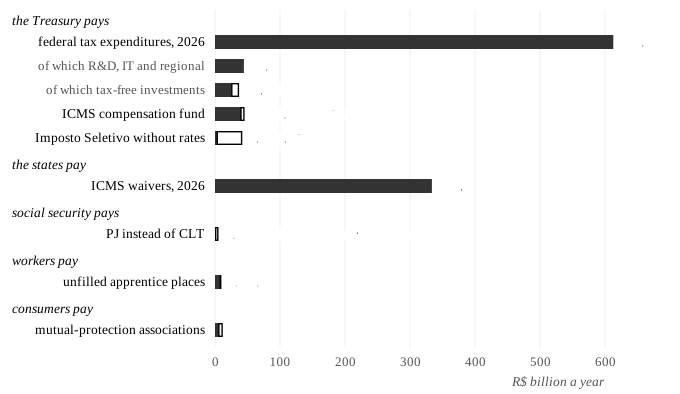
18.2 Cheap levers
18:12 The first lever is a request under the LAI, the access-to-information law, and it has a date. Holders of ICMS incentives must ask the Receita to qualify them for the fund "no período de 1º de janeiro de 2026 a 31 de dezembro de 2028" (LC 214/2025 art. 388 sole paragraph). The Receita must publish "a relação mensal dos beneficiários da compensação" (art. 400), but only from the payments of 2029, so the habilitations of 2026-2028 are visible only on request. As of October 2026 it has published the procedure and declared no state's programme eligible.
18:13 A journalist, an NGO or a legislator files one request with the Receita for the habilitations granted, by state, and one with each of the 27 state finance secretariats for their incentive holders, asking for holder, act, benefit, yearly amount and conditions met. The national tax code allows publishing any "incentivo, renúncia, benefício ou imunidade de natureza tributária cujo beneficiário seja pessoa jurídica" (CTN art. 198 § 3 IV), and the answer is due "em prazo não superior a 20 (vinte) dias", extendable "por mais 10 (dez) dias, mediante justificativa expressa" (Lei 12.527/2011 art. 11 §§ 1-2). The cost is a day for 28 requests and weeks of follow-up; ask for existing exports, since new compilations can be refused, and repeat each quarter. The Receita, as regulator, could publish the habilitations under the same article today.
Forecast 18.1 (The habilitations come out before the money). Before the first compensation payment of 2029, the Receita publishes by company the ICMS compensation-fund habilitations it has granted, without a court order.
- Horizon
- 2028-12-31
- Probability
- 30%
- Check
- The Receita's pages on the compensation of ICMS benefits, and the answers to access-to-information requests about it.
18:15 The second lever is a clause, drafted once by a legislator's staff in two or three days and asked for by a governor's office before signing. A state bill that imposes a duty should name a sanction, an enforcing organ and a deadline for its regulation (§4.3; §2.3), and define its beneficiaries by reference: low income by CadÚnico, the federal registry of poor families, rather than a frozen line like Piauí's "renda mensal per capita igual ou inferior a R$ 218,00" (Lei 8.427/2024 art. 2), and disability by the biopsychosocial assessment of Lei 13.146/2015 art. 2 § 1. For duties already on the books, Procons, the consumer agencies, can fine under CDC art. 56 wherever the duty is consumer law.
18:16 The third lever is a status field with four values (§6.1): in force, revoked, suspended (a later federal general rule suspends a conflicting state law, Constitution art. 24 § 4) and invalidated by a ruling of the STF, the Supreme Federal Court. A checker needs a fifth, "unknown", and must test both failures: the corpus shows Santa Catarina's 2026 regional wage floor as revoked through a download error, and Rondônia's assembly still shows in force a law the STF struck in 2021 (§5.3). A civic-tech group can build it in about two weeks and host it for R$0-60 a month. An assembly can cure the source by resolution, in a few days of drafting: a status field, revocation clauses that name what they revoke, as LC 95/1998 art. 9 requires of federal law only, and the machine-readable open formats the LAI already demands (art. 8 § 3 III).
18:17 The fourth lever is triage. 15,793 state laws on matters the Constitution gives the Union have never been tested, and a model trained on the STF's rulings ranks the laws of states it has not seen with a median AUC of 0.89 (§14.3; §14.4). The ranking tells an assembly's legal office what to repeal before a firm is fined under it, and tells beneficiaries which rights may fall, such as the 74 state laws that create disability categories federal law does not know (§8.3). Rulings in an ADI, a direct action of unconstitutionality, bind courts and administrations but not legislatures (Lei 9.868/1999 art. 28 sole paragraph), so a copy of a struck law stands until its own ADI or repeal. A civic-tech group runs the screen in about a week, and assembly staff, the Prosecutor-General or a party in Congress act on it.
18:18 The fifth lever is the consolidated text. Planalto, the presidency's legal site, publishes federal laws as amended; few states do, and only 7.8% of the federal texts in the corpus are the compiled current version (§1.2). About 145,000 state norms carry no status, and an estimated 50,000-66,500 of them are revoked without a record (§6.1). An assembly holds the amendment chain and can publish a compiled text beside each original; a civic-tech group can build point-in-time texts from the amendment links, at a cost nobody has estimated. Copyright is no obstacle (Lei 9.610/1998 art. 8 IV). For Paraná and Rio de Janeiro, absent from the corpus, a LAI request to each assembly for its database costs a day.
Forecast 18.2 (States publish their incentive holders). At least five states publish the holders of their ICMS incentives with a yearly amount for each holder.
- Horizon
- 2028-12-31
- Probability
- 20%
- Check
- Each state finance secretariat's transparency portal, and the log of answers to the requests above.
18.3 Public goods
18:20 The tables that rank the seams make a dozen public goods, and four take days because their data exist: a map from each state citation of Lei 8.666 to its counterpart in Lei 14.133/2021; a map of the state norms that lose their federal basis in 2033 (§6.4); a calculator for rebalancing public contracts as the six-day week ends; and a cliff monitor with bill text that replaces the MEI's retroactive exit with a phase-in. The calculator has a deadline. Public contracts must be amended within twelve months of the amendment's publication (§11.4), and a governor's or mayor's decree that writes out the federal rule (no price change by default, any rise capped at 9.09% of the item) as a rebuttable ceiling keeps procurement claims near 5.4-6.0% of contract cost instead of 6.0-6.7% [estimate]. The other eight take one or two weeks each: the incentive registry built from LAI answers, the in-force checker, the STF-exposure screener, a registry of definitions, a feed of new duties, clean texts for the unreadable states, a note correcting R$27.4 billion of wrong end dates in the DGT (§12.2), and a count of what each assembly legislated.
18:21 Data go out under CC BY 4.0 and code under MIT, every row carrying the norm, the article, the verbatim quote and the official link; static pages that query the files in the browser cost R$0 a month [estimate]. Institutions that already have the audience carry them: Atricon and the Instituto Rui Barbosa to the audit courts, Abraji and Fiquem Sabendo to journalists, Sebrae to small firms, Interlegis to the assemblies.
18:22 Each product needs a guardrail, because a table that shows a payer also shows a target. The checker says "unknown" where it does not know. The cliff monitor never suggests splitting a firm (§17.3). A calculator comparing CLT and PJ opens with the employment test of CLT art. 3. A kit that ranks duties by how rarely they are enforced shows each duty's exposure and never presents one as optional, since the least enforced are accessibility duties.
18:23 The map, the tables and the code are given away, for the reasons in The gift must move: sold, a map of seams would widen the asymmetry it describes, because the firms that already buy advice would buy it and the payers named here would not (§20.2).
18:24 Three limits hold. Tax expenditures are gross revenue forgone, so repeal would raise less. The payer is often an inference: nobody counts converted PJ workers, MEIs near the line or the holders of tax-free bonds. Paraná and Rio de Janeiro are absent and state statuses are weak, so every state count is a lower bound. And three decisions that move these numbers were still open on 16 October 2026: the Imposto Seletivo rates act, the sanction of the MEI bill, and the Receita's first declaration that a state's ICMS programme qualifies for the fund.
19 The machine
19:1 I read the statute book with AI agents over two days, on one machine with 8 GB of memory, and the cheapest part of the work, the checking, changed the most. Fourteen agents spent 15 October and the night after finding things in 323,868 norms. Two red teams then spent a few hours checking what the strategies rested on against official sources, and changed 43 of the 105 claims they checked.
19.1 The harness
19:2 On 15 October I cloned the corpus shallow, because a full clone died under memory pressure, and loaded it into DuckDB, a database that runs inside one process: 323,849 norms and 1,698,291 articles in 23 minutes, done at 10:08. The repair later added 19 norms (§1.4).
19:3 Fourteen agents each took one question: the verification of the corpus, the classes of law, orthogonality, copies across states, the citation graph, thresholds, definitions, state tax, federal regimes, labour, time, forced markets and conflicts between federal and state law, plus the repair of federal texts. All worked under the same rules. A claim about a law cites the norm, its article and a verbatim quote. A number comes from a saved script or a fetched page, or is marked as an estimate with its arithmetic. Strategies must be lawful, and every write-up has the same six parts, from summary to limits and leads for the others.
19:4 The shared tables each had one owner who alone could write them: the repaired federal texts, the quality grade of every text, the classes, and the citations and status of every norm. The others read them. The machine's memory was shared too, so anything that needed more than about a gigabyte or ten minutes of processor time, such as vectorizing tens of thousands of documents, waited for one lock: a directory only one process can create, polled every 20 seconds, cleared when its holder died, and run at low priority. Heavy work queued on purpose, one job at a time.
19:5 Phase two began at 01:00 on 16 October. Four strategists, for products a small team can build, for capital, for the public side and for stacks of seams, wrote 77 strategies in one fixed record of 21 fields, from the legal basis and its quote to the window, the money, the risk and the line past which the strategy becomes abuse (§15.1). Two red teams checked them. Eight writer agents then drafted most chapters of this book from what the agents had filed, under one set of rules for voice and evidence, and I edited them.
19:6 By the end the run had filed twenty write-ups, 284 tables, about 180 scripts and about 196,000 words: 135,137 from the fourteen readers, about 50,000 from the strategists and 11,297 from the red teams. Scripts matched 426 quotes word for word against the texts, and each of the red teams' 105 claims carries a verbatim quote from its source.
19.2 Crashes
19:7 At about 15:30 on 15 October the agents' tool environment went down. The last file of the afternoon was written at 15:31, and none for almost four hours after it. At 19:16 the editor's extension host, the process that runs the agents, restarted, and all fourteen died without reporting. They had saved many tables, because the rules told them to save as they went, so I resumed each with its context; the first file after the restart came at 19:21, and the agents filed through the night, several from their saved outputs. One loss stuck: the labour agent came back with some web facts whose addresses were gone, and a fact without its source cannot be used.
19:8 The larger cost was coordination. Every agent read the shared tables, so every rebuild forced reruns. The repaired federal texts changed at 21:07 and again at midnight, and at 21:30 I rebuilt the base tables because the article splitter had missed headings with markup between the word and the number (**Art**. 1º). That bug had left 10,348 federal texts, 35.5%, with no articles; after the fix 451 had none. The agents that counted articles ran again, and one census of numeric thresholds fell from 63,631 mentions to 49,904.
19:9 Then the shared tables ran in series. The repair finished at about 02:50; the citation graph rebuilt citations and status on the repaired texts and froze them at 05:42; the classification rebuilt on the frozen tables and finished at 06:57. That chain set the length of the night, because each link waited for the one before and no number of extra agents could have shortened it.
19:10 Phase two crashed differently. Agents failed several times with "Connection failed repeatedly" and lost what they had not saved, so I relaunched them with a rule to save each row as soon as it was verified, and a crash then cost at most one check. The harness made one hazard of its own: a background shell that finished after an agent's reply woke the agent in a second turn running alongside a later one, and two turns of the same agent edited the same files at once. The rule since is to stop every background shell before the last reply.
19.3 The red teams
19:11 The red teams checked what the strategies rested on. Official sources came first (Planalto, normas.leg.br, the courts, the Receita, CONFAZ, the state treasuries and assemblies), at most one request a second per site; secondary sources were labelled, and a point resting on them stood only when two independent ones agreed. Each claim got a verdict (confirmed, corrected, refuted or unresolved), the correct statement, the source and a verbatim quote. The tax team made three passes: 31 claims by 02:44, the products and capital strategies by 04:10, and the stacks by 07:44. The labour and regulatory team, which also took the conflicts between federal and state law, checked 41 claims by 02:20, the products strategies by 03:08 and the rest by 04:18. Between them they audited 164 strategy rows, some strategies once by each team, and sent 70 back to be fixed. The strategists read every verdict and fixed what it found, the last fixes landing after 09:00.
Experiment 19.1 (Two red teams against the official text).
Setup: Two agents, one for tax and one for labour, regulation and conflicts between federal and state law, checked the claims the strategies rested on and then the strategies themselves, in three passes each between 01:00 and 07:44 on 16 October 2026.
Parameters: Official sources first, one request a second per site, a verbatim quote for every verdict, four verdicts for a claim; when two readings disagreed, the law decided or the point was flagged, and nothing was averaged.
Result: Of 105 claims, 60 were confirmed, 40 corrected, 3 refuted and 2 left unresolved; of 164 strategy rows, 94 were sound and 70 went back to be fixed. The labour team checked its first 41 claims in about 70 minutes; the two teams wrote 11,297 words in all.
Shows: A check costs a page and a quote, and it changed 41% of the claims it reached. The strategy verdicts are in §15.5.
19:13 By my reading, about a quarter of the 43 changed claims were dates, a quarter laws or rulings the first reading had missed, a sixth numbers, and the rest readings of the text: an article number, a cap sitting in the next article, a legal basis that did not say what was claimed. Five changes, among the claims and the strategy rows, altered what a reader should do, as of October 2026:
- Redata, the regime for data centres, suspends PIS, Cofins and IPI, federal taxes on revenue and manufactured goods, only until 31 December 2026, and on 16 October it had no decree, product list or habilitation, so that leg is probably worth nothing (§10.3).
- A cooperative that wants the cooperative regime of IBS and CBS, the new value-added taxes, in 2027 must opt between 1 September and 31 October 2026, with its list of members and their admission dates. The option binds for the year, a cooperative that misses it waits until 2028, and the first reading had no deadline at all (§10.6).
- The steps of Emenda Constitucional nº 141/2026, which ends the 6x1, the week of six working days and one of rest, fall two months and fourteen months after its publication in the Diário Oficial. The first reading had counted the terms in days and quoted the articles of a committee substitute instead of the Câmara's final wording (§11.4).
- A bill passed by both houses on 14 and 15 October, PLP 186/2026, raises the ceiling of the MEI, a regime in which a one-person firm pays a small fixed monthly sum, from R$81,000 to R$110,000 for 2027 and R$140,000 from 2028. It awaited sanction on 16 October; once sanctioned, strategies built on the old line lose most of their value from January 2027 (§7.1).
- "Donate now at the flat 4%" is wrong for São Paulo if the assembly's bill PL 409/2025 passes, since its brackets for the ITCMD, the state tax on gifts and inheritances, run from 1% to 4% and no gift would pay more by waiting; in Minas Gerais donating now pays only for very large gifts (§9.5).
19:15 Checking was cheap because each claim carried its address: a norm, an article, a quote. The Asymmetry Engine calls this the verification asymmetry, the ratio of the cost of finding an answer to the cost of checking one. Finding took fourteen agents most of a day and 135,137 words over 323,868 norms; checking took the red teams two or three minutes a claim and 11,297 words. Compile the law draws the consequence for any system built from a proposer and a checker: its error comes from the checker and its cost from the proposer. Here the error left is whatever the proposers wrote where no check reached. The red teams covered what strategies rest on; the class shares, the geometry, the copy counts and the risk model were checked only by their own agents' samples.
19.4 What not to trust
- "In force" means not known to be revoked or struck: 18 state parts publish no court notes, tacit revocation leaves no trace, and state texts are mostly as enacted (§6.1).
- The classes come from rules checked by one annotator at a precision of 0.845, and the economic and social classes are weak, at 0.45 and 0.55 (§2.1).
- Counts extracted by pattern are orders of magnitude: between 30% and 45% of extracted thresholds are genuine eligibility lines.
- The geometry is lexical, so laws on one subject in different words look far apart, and of 30 opposed families read by hand, 8 were true oppositions (§4.2).
- Money is estimated from stated parameters, and tax expenditures are gross revenue forgone (§10.1).
- "No court action found" means a search came back empty; one such claim missed a ruling that had struck the law in 2021 (§5.3).
19:17 Every web fact is as of 15 or 16 October 2026, and the dates still moving (the publication of the 6x1 amendment, the sanction of the MEI bill, the Redata decree) move the strategies with them (§12.1). The tables behind every number are published with the book (Appendix B), and the asymmetry runs in the reader's favour too: a doubted count costs less to recheck than it cost to find.
20 What closes
20.1 What the reform closes
20:1 A seam stops paying the few in one of two ways: the legislature erases the line, or everyone learns where it runs. The tax reform does the first for the largest seam in the country. From 2033 the IBS is charged where goods and services are consumed, under one national law, and a state can no longer buy a factory with a tax it gives up. The ICMS law and the CONFAZ unanimity rule go on 1 January 2033 (§6.4). The relief that the states' 2026 budget-guideline bills declare, R$333.7 billion a year and mostly ICMS, shrinks with the tax from 2029 and ends with it (§9.3), and a fund the Union pays for compensates the holders of incentives granted in exchange for investment for the years the phase-down takes away (§9.4).
20:2 The reform moves the other seams instead of erasing them. LC 214/2025, the law that runs the new taxes, holds in its 579 articles 252 clauses that cut a rate, zero it, grant a presumed credit, defer or suspend the tax, 24 lines in reais and 408 dated provisions (§10.1). Rural producers below R$3.6 million of revenue stay outside the tax and their buyers take a presumed credit, an individual who owns more than three properties and earns more than R$240,000 a year from them becomes a taxpayer, and eighteen regulated professions pay 30% less (LC 214 arts. 164, 251 § 1 and 127). Each of those is a new number or a new word, and the old ones show what follows: firms crowd below a revenue line, as they do below the MEI ceiling, and litigate a word, as they did over who counts as a person with disability (§7.4; §8.3). The border seam was one large gradient that factories descended. What replaces it is many small gradients, and the firms that descend them are the ones that can read.
20:3 The supply of seams doesn't stop either. The statute book gains between about 990 and 1,280 new statutes on the economy a year (§2.2), and nothing in the reform touches the seams between the Union and the states, the labour regimes or the duties nobody enforces. State laws on matters the Constitution gives the Union keep being passed, some of them copies of laws the STF has already struck (§14.3; §5.3). The STF still hasn't said when hiring a worker as a company is lawful, and until it does the largest labour seam stays open (§11.3). Of the laws that force a purchase or a service, two in five name no sanction and no organ to enforce them (§13.1).
20:4 So the money moves from location to reading. Under (0.1) the reform shrinks the largest on the map to zero, and the many seams it leaves are worth little in total and a great deal to whoever crosses them at the right moment. What decides who collects them is the cost of crossing, : knowing that the line exists, which side a firm is on, and what the window is. That cost has been the price of a tax lawyer's hour. A machine that reads the whole statute book and checks each claim against the official text lowers it for everyone at once, and when falls the seam's value spreads from the firms that could afford the reading to the firms that must cross.
Forecast 20.1 (A state registry of ICMS incentive holders). By 31 December 2028 at least one state, or the Federal District, publishes on an official site the ICMS incentives it grants by beneficiary, with each company's identification and the amount or the programme.
- Horizon
- 2028-12-31
- Probability
- 35%
- Check
- On 31 December 2028 read the transparency portals and finance-secretariat sites of the 27 units. The forecast holds if at least one publishes, for each beneficiary company, its CNPJ or name and the ICMS benefit it receives, in amount or by programme; it fails if every unit publishes only totals.
20.2 Why the map is free
20:6 A map of seams cuts both ways. The table that tells a firm where it can lawfully save is the table that tells an auditor where the Treasury loses, and a journalist which benefit went to whom. Sold, the map would go to the firms that already pay for advice and widen the gap the payers chapter measures (§18.1). Given away, it reaches both sides at once. That is the argument of The gift must move: a gift spreads only as fast as strangers can earn from passing it on, so it has to come with what lets them earn.
20:7 The carriers are easy to name. An accountant can run the Simples hybrid comparison and the cooperative option for every client before 30 and 31 October (§10.5; §10.6). A procurement lawyer can prepare the amendments that labour-intensive public contracts need within the year the six-day-week amendment allows, with the proof of lost hours that the federal method asks for (§11.4). A civic-tech group can publish the list that remaps 1,621 state norms from Lei 8.666 to Lei 14.133, or the map of the norms that lose their basis in 2033 (§18.3). A journalist can send access-to-information requests on who has filed for the compensation fund, which the Receita Federal will list only from 2029 (§9.4). A legislator's staff can take the model clauses on definitions and enforcement and put them into the next bill (§15.4).
20:8 The tables stop on 16 October 2026, and the law won't. The Senate fixes the CBS rate by 15 December. The amendment that ends the six-day week starts its clock on the day the Diário Oficial publishes it. The bill that raises the MEI ceiling to R$110,000 awaits sanction, the STF's session on whether property paid into the capital of a real-estate company escapes the transfer tax ends on 19 October, and its case on workers hired as companies has no date (§A.1). Every number here carries its date so that a reader can tell when it has gone stale, and the code that made them is published so that anyone can run it again on a newer snapshot (§B.2).
20:9 The reform closes the largest seam by drawing the line out of the law. This book tries the other way for the rest: it publishes where every line it found runs, what crossing it is worth, who pays when someone does, and the step that would take a crossing over the line into abuse. A seam that everyone can see is one that the next legislature can price, and a gradient that everyone can descend stops paying a premium to the few who could find it.
Appendices
A The calendar
A:1 The statute book keeps time, and from October 2026 to 2040 its dates fall thick: elections that close within days, regimes that expire, two taxes cut by a tenth a year from 2029 and abolished in 2033. Each row is a date set by a law or a dated official act as of October 2026, many of them the close of a window (Definition 12.1), with the chapter that explains it.
A.1 The dates
| Date | What happens or closes | Who it concerns | Law | Chapter |
|---|---|---|---|---|
| Publication | The amendment ending the 6x1 week takes effect; graduates paid at least 2.5 times the RGPS pension ceiling may be excluded from working-time rules | employers under the CLT, the labour code | EC 141/2026 art. 8 | §11.4 |
| 19 October 2026 | The Supreme Federal Court (STF) ends its virtual session on Tema 1348, 5-2 for immunity on 16 September: ITBI, the municipal transfer tax, on property paid into a real-estate company | family holdings; municipalities | CF art. 156 § 2 I | §14.2 |
| 25 October 2026 | Fixed-odds betting licences end without refund; if never voted, the measure lapses about 4 March 2027 without reviving them | 85 licensed operators | MP 1.394/2026 art. 4 | §13.1 |
| 30 October 2026 | Last day to elect, from 1 September, to pay IBS and CBS, the new value-added taxes, in the regular regime for January-June 2027 | small firms in the Simples Nacional selling to businesses | Resolução CGSN 194/2026 | §10.5 |
| 30 October 2026 | Crypto-asset providers file for Central Bank authorization | about 120 providers | Res. BCB 520/2025 | §13.2 |
| 31 October 2026 | Cooperatives opt, irrevocably for 2027, for zero IBS and CBS on trade with members | cooperatives | LC 214/2025 art. 271 § 3 | §10.6 |
| 3 November to 20 December 2026 | Simples firms that elected may cancel as the Senate's CBS rate arrives | those firms | Resolução CGSN 194/2026 | §10.5 |
| 6 November 2026 | Banks and payment institutions stop serving crypto-asset providers not yet authorized | providers and their clients | Res. BCB 589/2026 | §13.2 |
| Early to mid November 2026 | Sanction due on the bill lifting the MEI ceiling from R$81,000 to R$110,000 in 2027 and R$140,000 from 2028 | MEIs, one-person firms | PLP 186/2026 | §7.1 |
| 15 December 2026 | The Senate fixes the 2027 CBS reference rate | all firms | LC 214/2025 art. 353 § 2 | §12.1 |
| Publication + 2 months | 42-hour week with two paid rest days and no pay cut; incompatible collective clauses lapse | CLT employers | EC 141/2026 arts. 2, 3 and 6 I | §11.4 |
| 31 December 2026 | Acredita Exportação's 3% refund on goods exports ends | small exporters | Decreto 8.415/2015 art. 2 § 7-A | §15.2 |
| 31 December 2026 | Redata's PIS, Cofins and IPI suspensions end, unregulated as of October | data-centre builders | Lei 11.196/2005 art. 11-J | §10.3 |
| 31 December 2026 | Inventory day for the opening-stock CBS credit, 9.25% of eligible stock | presumed-profit firms | LC 214/2025 art. 381 | §15.2 |
| 31 December 2026 | Last day for a law, or a converted provisional measure, setting the rates of the Imposto Seletivo, the excise on harmful goods, to tax any of 2027 | makers of the listed goods | CF art. 150 III | Chapter 10; §18.1 |
| 31 December 2026 | Municipal payroll relief (R$5.5 billion in 2026) and zero PIS and Cofins on air travel (R$1.44 billion) end | municipalities; airlines | Lei 14.973/2024; Lei 14.592/2023 | §12.2 |
| 1 January 2027 | CBS in full; PIS and Cofins abolished; IPI zero except on goods also made in the Manaus Free Zone; IBS at 0.1% | all firms | ADCT arts. 126 and 127 | §12.1 |
| 1 January 2027 | New or extended federal tax benefits barred until a primary surplus is measured | Congress | LC 200/2023 art. 6-A | §10.2 |
| January 2027 | The ANPD, the data-protection authority, starts inspecting age assurance | digital services, app stores | Lei 15.211/2025 | §13.2 |
| 14 January 2027 | Earliest day a state tax on gifts from donors abroad, enacted now, can bite | donees in states without one | EC 132/2023 art. 16 | §9.5 |
| 19 February 2027 | The January payroll payment fixes the year's choice to contribute on revenue | the 17 relieved sectors | Lei 12.546/2011 art. 9 § 13 | §11.2 |
| 1-31 March 2027 | Simples firms choose their IBS and CBS regime for July-December, as each March and September | Simples firms | LC 123/2006 art. 13 § 10 | §10.5 |
| April-May 2027 | Refund claims lapse on the rate difference of ICMS, the state tax on goods, charged on 1-4 April 2022 | sellers to consumers in other states | CTN art. 168; STF Tema 1266 | §14.2 |
| 30 June 2027 | Last day to book the opening-stock credit, used over 12 months | presumed-profit firms | LC 214/2025 art. 381 | §15.2 |
| Publication + 12 months | Deadline to amend public contracts with direct labour, concessions and public-private partnerships for the shorter week, which then applies anyway | public bodies; contractors | EC 141/2026 art. 9 | §11.4 |
| 25 November 2027 | Low-voltage businesses may choose their electricity supplier; households from 25 November 2028 | low-voltage consumers; energy traders | Lei 15.269/2025 | §13.2 |
| Publication + 14 months | 40-hour week | CLT employers | EC 141/2026 art. 6 II | §11.4 |
| December 2027 at the earliest | The carbon market's first duties: monitoring plans and emission reports | emitters above 10,000 tCO2e a year | Lei 15.042/2024 art. 50 | §13.2 |
| 31 December 2027 | Payroll relief for 17 sectors ends (R$7.65 billion in 2026); full contributions from 2028 | firms in those sectors | Lei 12.546/2011 art. 9-A | §11.2 |
| 7 May 2028 | Mutual-protection associations must contract an administrator authorized by the insurance regulator; none is yet | 2,209 associations, over 5 million vehicles | LC 213/2025; Susep | §13.2 |
| 30 September 2028 | Last useful day to file a Sudene project for approval in 2028 | investors in the Northeast | Sudene manual | §10.4 |
| 31 December 2028 | Filing for the ICMS compensation fund closes; R$160 billion at 2023 prices for 2029-2032 | holders of onerous incentives granted by 31 May 2023 | LC 214/2025 art. 388 | §9.4 |
| 31 December 2028 | Sudene and Sudam, the Northeast and Amazon agencies, approve their last projects for ten years of reduced income tax, to 2038 (R$25.2 billion of tax expenditure in 2026) | investors in the North and Northeast | MP 2.199-14/2001 art. 1 | §10.4 |
| 31 December 2028 | Developers' last day to lock IBS and CBS at 2.08% of receipts through the RET, their special regime; purchases under Reporto, the port-equipment regime, end | developers; port operators | LC 214/2025 arts. 485 and 105 § 7 | §15.3 |
| 1 January 2029 | ICMS and ISS, the municipal tax on services, fall to 9/10, then 8/10, 7/10 and 6/10 by 2032, and incentives with them; the fund pays, listed monthly | all firms; states; municipalities | ADCT art. 128; LC 214/2025 arts. 384 and 400 | §9.3; §18.2 |
| 27 June 2029 | Mover, the vehicle R&D regime, ends | automakers | Lei 14.902/2024 art. 31 | §10.2 |
| 31 December 2029 | The Lei de TICs and Padis, the electronics and chip incentives, end | hardware and chip makers | Lei 14.968/2024 art. 11 | §10.2 |
| 1 January 2030 | Low-carbon hydrogen credits start, capped at R$18.3 billion to 2034 | hydrogen producers | Lei 14.990/2024, amended by Lei 15.269/2025 | §13.2 |
| 31 December 2031 | PRESIQ, the chemical-input credit capped at R$2.5 billion a year, ends | chemical makers | Lei 15.294/2025 | §10.2 |
| 31 December 2032 | Last day of compensable ICMS benefits; incentives reinstated by LC 160/2017 end and cannot be extended | incentive holders | EC 132/2023 art. 12 § 7 | §9.4 |
| 1 January 2033 | ICMS and ISS abolished, IBS and CBS alone; their laws are revoked, LC 87/1996 among them, on which 329 state norms in force rest | all firms; states | ADCT art. 129; LC 214/2025 art. 543 | §6.4 |
| 31 December 2033 | Sanitation targets: 99% drinking water, 90% sewage collected and treated | water utilities | Lei 11.445/2007 art. 11-B | §13.2 |
| 31 December 2037 | Last day to file ICMS credit balances for homologation, then offset against IBS over 240 months | holders of ICMS credits | LC 227/2026 art. 134 | §12.3 |
| 1 January 2040 | Latest extended deadline for the sanitation targets | water utilities | Lei 11.445/2007 art. 11-B § 9 | §13.2 |
A:3 Some dates will move. The 6x1 steps run from the day Emenda Constitucional nº 141/2026 appears in the DOU, the federal gazette, hence publication + 2, + 12 and + 14 months. The MEI ceilings bind only if the bill is sanctioned, and a justice's request to review Tema 1348 would stop its clock. Redata's 2026 leg, the Imposto Seletivo, the carbon market and the low-voltage opening wait on acts not yet published, and fund claims on the Receita's first declaration that a state programme qualifies. Sudene's 30 September is an administrative date, and the sanitation targets can slip to 2040.
B The data
B.1 The package
B:1 The tables behind every chapter are published under the Creative Commons Attribution 4.0 licence, and the code that made them under the MIT licence. The dataset card says what is where. datapackage.json is a Frictionless Data Package that gives every table's schema, the type and meaning of each column and the file it came from. the-seams-of-the-law-data.xlsx holds every table as a sheet, with a catalogue and a field dictionary, and the-seams-of-the-law-data.zip holds the whole package, with the research reports, the method notes and the code; SHA256SUMS gives the hash of both. The 102 tables hold 37,848 rows.
B:2 Five tables carry most of the book. strategies holds the seventy-seven strategies with their legal basis, the quote it rests on, the window, the size, the abuse line and both red teams' verdicts (§15.5). calendar-2026-2040 holds the dated windows, each checked against the law that sets it (§A.1), and who-pays the payer of each seam and the public lever against it (§18.1). classes-corrected gives what the statute book is made of, with intervals (§2.1), and scheduled-revocations the revocations that wait for a date, the largest on 1 January 2033 (§6.4). In tables with one row per norm, the column id is the norm's key in the corpus, a path of sphere, folder, year and file name, and it joins them to each other and to the texts.
B:3 Every table, grouped by the chapter that reads it:
| Table | Chapter | Rows | What it holds |
|---|---|---|---|
| federal-repairs | The corpus | 976 | Federal norms whose corpus text was replaced or completed from the official compilation |
| federal-missing | The corpus | 214 | Federal norms the official index lists and the corpus lacks |
| federal-revocations-confirmed | The corpus | 125 | Federal revocations confirmed against the official compilation |
| census-by-part | The corpus | 119 | Norms in the corpus by part (the Union, each state) and folder |
| census-reconciliation | The corpus | 29 | Corpus counts reconciled against official indexes |
| completeness-by-series | The corpus | 53 | Share of each numbered series present in the corpus |
| completeness-by-decade | The corpus | 332 | Completeness of the corpus by decade |
| text-fidelity | The corpus | 40 | Corpus texts compared with the official source |
| quality-by-part | The corpus | 27 | Empty, unreadable and readable texts by part |
| informational-asymmetries | The corpus | 28 | Where the statute book cannot be read, ranked |
| output-by-state-year | The corpus | 26 | Statutes enacted by each state each year |
| output-per-capita | The corpus | 27 | Statutes per inhabitant by state |
| status-coverage | The corpus | 27 | How far the corpus records whether each norm is in force |
| classes | What the law is made of | 3 | Norms by functional class, as filed by the classifier |
| classes-corrected | What the law is made of | 16 | Class shares corrected with the held-out audit, with intervals |
| classes-by-state | What the law is made of | 26 | Class shares by state |
| classes-by-decade | What the law is made of | 30 | Class shares by decade |
| classifier-precision | What the law is made of | 13 | Precision of each class on the held-out audit sample |
| business-duties | What the law is made of | 5,242 | Norms that impose a duty on a kind of business, with their sanction |
| icms-incentive-norms | What the law is made of | 2,007 | State norms that grant or change an ICMS incentive |
| fund-creations | What the law is made of | 2,201 | Norms that create a public fund |
| basis-federal-in-force | No small skeleton | 200 | Greedy orthogonal basis of federal law in force, in order of pick, with residuals |
| basis-all | No small skeleton | 200 | Greedy orthogonal basis of all normative norms |
| basis-summary | No small skeleton | 54 | Residual at each basis size, by corpus part |
| basis-themes | No small skeleton | 138 | Themes of the first fifty basis laws against their share of the corpus |
| uniqueness-top | No small skeleton | 60 | The most singular norms (largest distance to their nearest neighbour) |
| axes | No small skeleton | 40 | Principal axes of the space and the words that load on them |
| coupled-pairs-read | Same ground, opposite pull | 30 | Thirty families of same-subject, opposite-action pairs, read by hand |
| coupled-pairs-states | Same ground, opposite pull | 400 | Cross-state pairs with high subject similarity and opposed action |
| coupled-pairs-federal-state | Same ground, opposite pull | 48 | Federal-state pairs with high subject similarity and opposed action |
| copy-families | Copies | 1,474 | Families of state laws copied across states (strict rule) |
| copy-family-members | Copies | 3,546 | Each law in each copy family, with its state and year |
| adoption-gaps | Copies | 395 | States missing a widely adopted law, ranked |
| struck-law-copies | Copies | 40 | Copies of laws the STF struck, checked against the court's records |
| state-roles | Copies | 25 | Each state as first adopter, supplier and copier |
| copy-network | Copies | 433 | Who copies whom: state-to-state copy counts |
| status-summary | The wiring | 40 | Norms in force, revoked and struck by courts |
| load-bearing-federal | The wiring | 300 | Federal laws ranked by the norms that cite them |
| federal-cited-by-states | The wiring | 100 | Federal laws cited by state norms, by state |
| scheduled-revocations | The wiring | 85 | Revocations scheduled for a future date, including 1 January 2033 |
| lei-8666-dependants | The wiring | 200 | State norms in force that cite the revoked Lei 8.666/1993, by article |
| churn-top | The wiring | 436 | The most amended laws |
| complexity-by-regime | The wiring | 25 | Size and churn of the main tax regimes' laws |
| threshold-catalog | Lines | 137 | Numeric lines in the law (revenue, headcount, area, value), verified |
| bunching-revenue | Lines | 203 | Firms by revenue bin around the regime lines |
| bunching-headcount | Lines | 40 | Establishments by headcount around the headcount lines |
| mei-exit | Lines | 6 | Tax before and after the MEI line |
| simples-marginal | Lines | 30 | Marginal rates inside the Simples bands |
| fator-r | Lines | 8 | The payroll-to-revenue ratio rule and its effect on the rate |
| presumed-versus-actual-profit | Lines | 12 | Lucro presumido against lucro real at several margins |
| irpf-2026-marginal | Lines | 37 | Marginal income-tax rates under Lei 15.270/2025 |
| small-claims-lines | Lines | 25 | State small-claim (RPV) payment lines |
| definitions-top20 | Words | 183 | Twenty terms with the most legal definitions, and the definitions |
| concepts-ranked | Words | 61 | Defined concepts ranked by how far their definitions diverge |
| disability-census | Words | 134 | State laws that extend the legal meaning of pessoa com deficiência |
| icms-incentive-programs | Borders | 32 | ICMS incentive programmes by state |
| icms-incentive-value-by-year | Borders | 5 | Value of an ICMS incentive through the 2029-2032 phase-down |
| icms-incentive-present-value | Borders | 13 | Benefit-years and present value of an incentive from 2027 |
| compensation-fund-sufficiency | Borders | 24 | Whether the ICMS compensation fund covers the claims |
| icms-standard-rates | Borders | 36 | Standard ICMS rates by state, 2023 and 2026 |
| itcmd-rates | Borders | 27 | Inheritance and gift tax rates by state |
| ipva-rates | Borders | 27 | Vehicle tax rates by state |
| state-waivers | Borders | 27 | ICMS waivers declared in the states' 2026 budget guidelines |
| state-fees-and-funds | Borders | 17 | State fees and funds charged on top of ICMS |
| federal-regimes | The federal menu | 44 | Federal tax regimes with their legal basis, beneficiaries and end dates |
| federal-regimes-ranked | The federal menu | 44 | Federal regimes ranked by size and underuse |
| tax-expenditures-2026-by-tax | The federal menu | 216 | Federal tax expenditures in the DGT 2026 by tax |
| tax-expenditures-2026-largest | The federal menu | 65 | The largest federal tax expenditures in the DGT 2026 |
| simples-hybrid-2027 | The federal menu | 60 | Who gains from the Simples hybrid choice for 2027 |
| sudene-active-2026 | The federal menu | 159 | Active Sudene incentive holders in 2026 |
| pis-cofins-to-lc214 | The federal menu | 37 | Where each PIS/Cofins benefit lands under LC 214/2025 |
| lc214-dates | The federal menu | 408 | Every date in LC 214/2025 |
| lc214-thresholds | The federal menu | 24 | Every numeric line in LC 214/2025 |
| cost-wedge | Eighteen ways to buy an hour | 108 | Employer cost and worker net under each way of buying work |
| cost-wedge-equal-budget | Eighteen ways to buy an hour | 54 | The same budget spent under each arrangement |
| cost-wedge-public-take | Eighteen ways to buy an hour | 54 | What the Treasury and social security collect under each arrangement |
| six-by-one-sectors | Eighteen ways to buy an hour | 65 | Workers and cost of the end of the 6x1 week by sector |
| six-by-one-effects | Eighteen ways to buy an hour | 23 | Hourly cost and staffing effects of the 42- and 40-hour steps |
| labor-corpus-map | Eighteen ways to buy an hour | 88 | Where each work arrangement lives in the statute book |
| calendar-2026-2040 | Clocks | 120 | Dated windows from 2026 to 2040, checked against the laws |
| closing-dates | Clocks | 11 | Dates on which a regime, benefit or option closes |
| tax-expenditure-sunsets | Clocks | 63 | Federal tax expenditures by end year |
| tax-expenditure-term-check | Clocks | 27 | End dates in the DGT checked against the laws |
| timing-ranking | Clocks | 26 | Windows ranked by what acting inside them is worth |
| forcing-laws | Markets the law forces | 8,171 | Laws that force a purchase or a service, with object, organ and sanction |
| forced-objects | Markets the law forces | 5,720 | The goods and services the law forces, counted |
| forced-markets-ranked | Markets the law forces | 24 | Forced markets ranked |
| forced-markets-sizing | Markets the law forces | 22 | Size of the twenty largest forced markets |
| stf-adverse-state-norms | The Union and the states | 707 | State norms the STF struck, suspended or narrowed |
| struck-by-state | The Union and the states | 25 | Struck state norms by state |
| struck-by-theme | The Union and the states | 24 | Struck state norms by theme, per thousand laws |
| risk-by-theme | The Union and the states | 24 | Untested state laws on federal matters and their modelled risk, by theme |
| tax-theses-2026 | The Union and the states | 14 | Settled tax theses that still pay in 2026 |
| rental-car-ipva-siblings | The Union and the states | 14 | State IPVA rules on rental cars like the one struck in ADI 4376 |
| strategies | Seventy-seven strategies | 77 | Seventy-seven strategy records, sixty-nine lawful strategies and eight anti-stacks, ranked by urgency and size, with both red teams' verdicts |
| strategy-calendar | Seventy-seven strategies | 44 | The capital strategies' dated steps |
| stack-compatibility | Stacks | 72 | Which strategies combine, which exclude each other, and why |
| tax-claims-checked | The line | 31 | Tax claims checked against the official text, with the corrected fact |
| tax-strategy-audit | The line | 68 | The tax red team's audit of each strategy |
| labor-claims-checked | The line | 74 | Labour and regulatory claims checked against the official text |
| labor-strategy-audit | The line | 96 | The labour red team's audit of each strategy |
| who-pays | Who pays | 31 | Who loses from each seam, and the public lever against it |
B:5 The rest of the package is text and code. The modules folder holds the twenty folders of the research, fourteen modules, two red teams and four strategy tracks, each with its report and its other outputs, 371 files in all. The code folder holds the 212 scripts that loaded the corpus, repaired it, ran every module, merged the strategies and drew the figures, with the versions of the libraries they ran on. The methods folder holds the research plan, the rules every agent followed and the synthesis brief, whose reconciled facts every chapter uses (§19.1).
B:6 MANIFEST.csv lists the 2,547 files and folders the project produced, each with its size, a SHA-256 hash and its fate: 690 published and 1,857 withheld. Most of the withheld are the modules' scratch files and caches, and copies of official and third-party pages and files, which the tables cite by URL instead. The rest are earlier versions of reports and outputs, intermediate Parquet tables, two embedding matrices, run logs, the book's own working files, and the 746 MB of corpus tables and repaired texts, which the code rebuilds from the repository and the official sites. Every published file passed a scan for personal data and secrets, and the ementas lose the clauses that name a bill's author and the names in governors' signatures, which no chapter reads.
B.2 Running it again
B:7 The corpus is ctresb/leis at commit 51dc03f, whose files were downloaded from the official sources on 13 October 2026 (§1.1). To rebuild the tables, clone it at that commit, install the libraries in code/requirements.txt under Python 3.12, load the corpus with code/build_corpus.py, run the repair, then run the fourteen modules in the order of their numbers; each module's README lists its scripts in the order they run. The strategy tracks and the red teams read the modules' outputs, and one merge script joins them into the strategies table. The heaviest steps queue behind a lock so that one runs at a time, because the whole reading ran on one computer with 8 GB of memory (§19.2).
B:8 What the corpus can't say was checked on the web: court dockets, the official gazette, the Receita's statement of tax expenditures, the states' budget bills and the pages of ministries and agencies. The tables give the source of each such fact and, where the page could change, the date it was read, between 13 and 16 October 2026; the red teams' tables give, for every claim they checked, the text of the law that confirms or corrects it (§19.3). A rebuild on a newer snapshot will differ wherever the law has changed since, and that is the reason to run it again: the same code run each month turns the map into a list of the seams that opened and the ones that closed (Chapter 20).
B:9 Nothing here is legal or tax advice. Every row that a decision would rest on names the law it reads, and the official text decides. If a number is wrong, write to the address on the agents page, or better, fix it and publish the fix.
C Forecasts
Every forecast in the book, in order, with the date it resolves by, the probability given and how to check it.
Forecast 1.1 (Paraná or Rio de Janeiro enters the corpus). By 31 December 2027, the public ctresb/leis repository holds the statutes of Paraná or of Rio de Janeiro.
Horizon 2027-12-31 · probability 45% · check: Read the repository's coverage table on 31 December 2027. The forecast holds if Paraná or Rio de Janeiro shows at least 1,000 norms; it fails if both show fewer.
Forecast 2.1 (Federal honours keep their fifth). At least 20% of the federal ordinary laws enacted in 2027 and 2028 are symbolic.
Horizon 2029-03-31 · probability 70% · check: Count the commemorative dates, honours, namings, honorary titles and heritage declarations among the leis ordinárias of 2027 and 2028 listed on planalto.gov.br; the forecast holds at 20.0% or more.
Forecast 5.1 (A seventh state for mães atípicas). Between 17 October 2026 and 31 December 2028, a state other than Espírito Santo, Amapá, Rondônia, Pará, Alagoas and Goiás, or the Federal District, enacts a law creating a program or policy to stimulate entrepreneurship by mães atípicas.
Horizon 2028-12-31 · probability 65% · check: Search the other jurisdictions' legislation portals for laws enacted in the period whose summary or first article joins "mães atípicas" and "empreendedorismo"; any wording counts.
Forecast 6.1 (States keep building on LC 87). The states and the Federal District enact at least five new norms dated 2027 that cite LC 87/1996.
Horizon 2027-12-31 · probability 85% · check: Search the state and Federal District legislation portals for norms dated 2027 citing LC 87/1996 by number or as the "Lei Kandir"; count distinct norms.
Forecast 7.1 (The MEI bill becomes law). PLP 186/2026 is sanctioned, wholly or with vetoes that leave the ceilings of R$110,000 for 2027 and R$140,000 from 2028 intact, and the law is published in the DOU by 30 November 2026.
Horizon 2026-11-30 · probability 90% · check: The DOU and planalto.gov.br's list of 2026 complementary laws; the new wording of LC 123 art. 18-A § 1.
Forecast 8.1 (One federal assessment of disability). The federal Executive publishes a decree issuing a single instrument for the biopsychosocial assessment of disability under Lei 13.146/2015 art. 2 § 2, for use across federal benefits.
Horizon 2027-12-31 · probability 20% · check: planalto.gov.br's list of 2026 and 2027 decrees, and the human-rights ministry's page on the biopsychosocial assessment.
Forecast 9.1 (The first programme declared apt). The Receita Federal publishes a declaration of aptitude for at least one state ICMS incentive programme under Portaria RFB 635/2025 art. 3 § 4.
Horizon 2027-06-30 · probability 80% · check: A declaration naming a state programme, published by the Receita by 30 June 2027.
Forecast 10.1 (The Imposto Seletivo's rates in time for 2027). A law fixing the Imposto Seletivo's rates, or a provisional measure converted into law, is published by 31 December 2026, so the tax can be charged in 2027.
Horizon 2026-12-31 · probability 25% · check: The Diário Oficial da União carries a law setting Imposto Seletivo rates, dated on or before 31 December 2026.
Forecast 11.1 (A thesis on pejotização). By 31 December 2027 the STF publishes a thesis in Tema 1389 that fixes which court judges alleged fraud in contracts for services with companies or autonomous workers.
Horizon 2027-12-31 · probability 50% · check: Read the STF's page for Tema 1389 (ARE 1.532.603) on 31 December 2027. The forecast holds if a thesis has been published there; it fails otherwise.
Forecast 12.1 (The Lei de TICs outlives 2029). A law published in the DOU extends the Lei de TICs incentives beyond 31 December 2029, by amending or replacing Lei 14.968/2024 art. 11.
Horizon 2029-06-30 · probability 35% · check: planalto.gov.br's compiled Lei 14.968/2024 and its lists of laws and complementary laws for 2027-2029.
Forecast 13.1 (The mutual-protection deadline holds). Susep authorizes at least one administrator of mutual-protection operations under Resolução CNSP 491/2026 by 7 November 2027, so the 7 May 2028 deadline for associations is not extended.
Horizon 2027-11-07 · probability 65% · check: On 8 November 2027 read Susep's pages on mutual-protection administrators. The forecast holds if an administrator is listed with an authorization dated on or before 7 November 2027; it fails otherwise.
Forecast 14.1 (Capital contributions escape the ITBI). The STF records a majority in Tema 1348 for ITBI immunity on property paid into a company's capital whatever the company's main activity, up to the capital subscribed.
Horizon 2026-12-31 · probability 80% · check: The STF's page for Tema 1348 (RE 1.495.108) shows a certificate of judgment with that thesis dated by 31 December 2026.
Forecast 15.1 (Redata's 2026 leg stays empty). No data centre is habilitated under Redata, with its regulation and product list in force, before 1 January 2027.
Horizon 2027-01-31 · probability 75% · check: Search the Diário Oficial and the Receita's norms system for the Redata decree, the product list of Lei 11.196 art. 11-C § 4 and an act habilitating a named company, all dated by 31 December 2026.
Forecast 17.1 (A procedure law for the general clause). By 31 December 2028 a federal ordinary law sets the procedures that CTN art. 116 sole paragraph requires for disregarding acts or transactions.
Horizon 2028-12-31 · probability 15% · check: On 31 December 2028 search planalto.gov.br for a law regulating the procedures of CTN art. 116 sole paragraph. The forecast holds if one has been published in the DOU, the federal gazette; it fails otherwise.
Forecast 18.1 (The habilitations come out before the money). Before the first compensation payment of 2029, the Receita publishes by company the ICMS compensation-fund habilitations it has granted, without a court order.
Horizon 2028-12-31 · probability 30% · check: The Receita's pages on the compensation of ICMS benefits, and the answers to access-to-information requests about it.
Forecast 18.2 (States publish their incentive holders). At least five states publish the holders of their ICMS incentives with a yearly amount for each holder.
Horizon 2028-12-31 · probability 20% · check: Each state finance secretariat's transparency portal, and the log of answers to the requests above.
Forecast 20.1 (A state registry of ICMS incentive holders). By 31 December 2028 at least one state, or the Federal District, publishes on an official site the ICMS incentives it grants by beneficiary, with each company's identification and the amount or the programme.
Horizon 2028-12-31 · probability 35% · check: On 31 December 2028 read the transparency portals and finance-secretariat sites of the 27 units. The forecast holds if at least one publishes, for each beneficiary company, its CNPJ or name and the ICMS benefit it receives, in amount or by programme; it fails if every unit publishes only totals.
D Index
Definitions
- Definition 0.1 Seam
- Definition 0.2 Magnitude
- Definition 1.1 Unreadable share
- Definition 2.1 General rule
- Definition 3.1 Orthogonal basis
- Definition 3.2 Uniqueness
- Definition 4.1 Coupled pair
- Definition 5.1 Copy family
- Definition 6.1 Load-bearing law
- Definition 7.1 Notch
- Definition 9.1 Benefit-year
- Definition 10.1 Tax expenditure
- Definition 11.1 Cost wedge
- Definition 12.1 Window
- Definition 13.1 Forcing law
- Definition 15.1 Strategy
- Definition 16.1 Stack
- Definition 17.1 Abuse line
Equations
E Concordance
Each defined word and the verses where it occurs; the verse that defines it comes first, in bold.
abuse line 17:2, 15:2, 15:18, 15:23, 15:26, 16:2, 16:9, 17:12, 17:13, B:2
anti-stack 16:2, 0:12, 0:18, 15:1, 15:4, 15:8, 15:18, 16:14, 17:12, B:4
benefit-year 9:8, 9:11, 9:12, 9:13, 15:18, 15:21, B:4
copy family 5:3, 3:26, 4:17, 5:1, 5:5, B:4
forcing law 13:2, 13:1, 13:5, 13:7, 13:8, 13:10
general rule 2:4, 0:2, 0:22, 2:1, 2:3, 2:5, 2:6, 2:8, 2:9, 2:12, 2:16, 2:17, 2:19, 2:22, 4:16, 6:2, 6:20, 11:18, 18:16
notch 7:2, 7:3, 7:13, 7:14, 7:20, 7:23, 11:23
orthogonal basis 3:6, 3:1, 3:11, B:4
seam 0:5, 0:6, 0:8, 0:10, 0:11, 0:12, 0:13, 0:14, 0:20, 0:21, 0:23, 1:1, 3:14, 3:26, 4:1, 4:16, 5:1, 6:1, 7:1, 8:1, 9:1, 9:24, 10:1, 10:16, 10:19, 11:1, 12:1, 13:1, 13:8, 14:1, 15:1, 15:2, 15:3, 15:4, 15:22, 16:1, 16:3, 18:1, 18:6, 18:11, 18:20, 18:23, 19:5, 20:1, 20:2, 20:3, 20:4, 20:6, 20:9, B:2, B:4, B:8
stack 16:2, 15:4, 15:10, 15:13, 15:22, 15:24, 15:27, 16:1, 16:3, 16:4, 16:7, 16:9, 16:10, 16:11, 19:5, 19:11, B:4
strategy 15:2, 0:12, 0:18, 0:19, 0:23, 8:6, 15:1, 15:5, 15:6, 15:7, 15:8, 15:11, 15:26, 15:28, 17:1, 17:2, 17:6, 17:12, 17:13, 18:10, 19:1, 19:3, 19:5, 19:11, 19:12, 19:13, 19:14, 19:15, 19:17, B:2, B:4, B:5, B:7
tax expenditure 10:2, 0:11, 7:10, 10:3, 10:4, 12:5, 12:11, 18:2, 18:24, 19:16, A:2, B:4, B:8
uniqueness 3:20, 3:23, 3:24, 3:28
window 12:2, 0:7, 0:12, 0:15, 0:18, 9:6, 9:23, 10:13, 12:5, 12:6, 12:8, 12:9, 12:19, 15:1, 15:2, 15:3, 15:7, 15:8, 15:13, 15:17, 15:19, 15:20, 15:28, 16:15, 16:16, 17:1, 19:5, 20:4, A:1, B:2, B:4
F Chains
Each chain follows one theme through the book. The margin beside a verse on a chain steps to the previous and next verse on it.
reform
The 2023-2033 consumption-tax reform, what it closes, what it opens and when.
- 0:13 The largest seam-closing event in Brazilian history is under way. Emenda Constitucional …
- 0:14 On its way the reform opens seams with dates on them, and …
- 0:17 Other doors close for good. New federal tax benefits are barred in …
- 1:20 The federal texts needed repair first. Where normas.leg.br had no compiled text, …
- 1:21 I screened all 8,584 federal norms stored as republications. 347 held a …
- 1:23 In all, 976 federal norms were rebuilt, 666 from Planalto's compiled text, …
- 6:21 Art. 542 starts sooner: on 1 January 2027 it revokes seven laws …
- 6:23 On 1 January 2033 those norms will point at nothing, the next …
- 8:13 The tax reform zeroes IBS and CBS, the new value-added taxes, on …
- 9:1 Brazil's largest seam (Definition 0.1) is a border. Twenty-seven states tax the …
- 9:6 The common reading is that the reform paid states to raise rates. …
- 9:7 The decay is written in the Constitution. ADCT art. 128 (the ADCT …
- 9:11 From 1 January 2027 a benefit is worth 5.0 benefit-years undiscounted (two …
- 9:15 The compensation fund is federal money for the phase-down's losers. EC 132 …
- 9:26 The infrastructure funds survive by exception. ADCT art. 136 lets a state …
- 10:1 Federal law sells relief by regime, and its regime seams (Definition 0.1) …
- 10:6 The reform re-creates most of this relief inside the new taxes. LC …
- 10:16 The Simples' seam is a credit. A business buying from a Simples …
- 12:4 The spine is the consumption-tax reform, written into the Constitution's transitional provisions, …
- 12:17 The reform's last date is the largest. Every ICMS incentive validated under …
- 15:4 Four strategist agents wrote the records: a builder looking for products a …
- 15:9 The Simples election closes on 30 October. The Simples Nacional collects several …
- 15:10 The cooperative option closes a day later. Under it "ficam reduzidas a …
- 15:14 The opening-stock credit is counted on one day. Firms in the cumulative …
- 15:19 The later windows follow the reform's calendar. Developers selling homes to individuals …
- 18:4 The states pay for their tax war, and the Union pays for …
- 18:5 Under the reform itself, hardly any state loses on net. The eight …
- 20:1 A seam stops paying the few in one of two ways: the …
- 20:2 The reform moves the other seams instead of erasing them. LC 214/2025, …
deadlines
Dates that open or close a window, and what each one forces.
- 0:12 Setup: the 77 entries of the strategy record (§15.1), each tagged with …
- 0:14 On its way the reform opens seams with dates on them, and …
- 0:15 The longer windows are worth more. A holder of an onerous ICMS …
- 0:16 Labour law moved in the same week. On 14 October the Senate …
- 0:17 Other doors close for good. New federal tax benefits are barred in …
- 1:6 The gap has a cost. Planalto, the presidency's legal portal, marks most …
- 6:15 Lei 8.666/1993, the procurement law, died on 30 December 2023 (Lei 14.133/2021 …
- 6:21 Art. 542 starts sooner: on 1 January 2027 it revokes seven laws …
- 7:5 PLP 186/2026, a bill for a complementary law sent by the Executive, …
- 9:7 The decay is written in the Constitution. ADCT art. 128 (the ADCT …
- 9:16 A firm passes three gates, two outside its control. It files one …
- 9:21 LC 227 sets no rates, so a flat rate stands until the …
- 9:22 Gifts and inheritances from abroad are the sharper border. The STF, the …
- 10:8 Its 2%-of-GDP cap (art. 5) does not protect firms that hold a …
- 10:9 The investment regimes end on fixed days. Lei 14.968/2024 art. 11 says …
- 10:10 Redata, the data-centre regime that Lei 15.504/2026 wrote into Lei 11.196, suspends …
- 10:13 The longest federal window is regional. A firm with a project "protocolizado …
- 10:14 The useful date is earlier. Pleas filed by 30 September are decided …
- 10:17 For January to June 2027 the election runs from 1 September to …
- 10:19 A cooperative's seam is membership. One that opts into its own regime …
- 10:20 The end of PIS and Cofins pays firms that hold stock. A …
- 10:21 Small exporters have until 31 December too. Acredita Exportação refunds Simples firms …
- 10:22 The Imposto Seletivo, the new federal excise on tobacco, alcohol, sugary drinks, …
- 11:10 The 17 sectors with payroll relief pay part of their contribution on …
- 11:20 The week of six days on and one off, the 6x1, ends …
- 11:24 Public contracts get a year. Contracts with direct labour in force at …
- 12:4 The spine is the consumption-tax reform, written into the Constitution's transitional provisions, …
- 12:6 The first windows close within weeks. As of 16 October 2026, a …
- 12:14 The Lei de TICs shows why a reader of the compiled law …
- 13:1 About 2,300 laws in force read as obliging private persons and firms …
- 13:12 Sanitation is the largest. Lei 14.026/2020 made every contract set targets of …
- 13:13 Crypto providers face the nearest date. They may operate only "mediante prévia …
- 13:14 Children's online safety has applied since 17 March 2026. ECA Digital, the …
- 13:15 The carbon market will make operators emitting more than 10,000 tonnes of …
- 13:16 Mutual vehicle protection becomes regulated insurance. The 2,209 associations being regularized, covering …
- 13:17 Betting shows the risk in a licensed market. An industry with R$37 …
- 14:10 Thesis Settled Who gains ICMS a supplier collects in advance for the …
- 14:12 The ITBI, the municipal tax on property transfers, does not fall on …
- 15:1 The seams turn into money through seventy-seven strategies, and the ones that …
- 15:6 Urgency comes first and size second. With the red teams' corrections applied, …
- 15:9 The Simples election closes on 30 October. The Simples Nacional collects several …
- 15:10 The cooperative option closes a day later. Under it "ficam reduzidas a …
- 15:11 Redata, the new regime for data centres, runs five years, but "Os …
- 15:13 Small exporters have until 31 December for a 3% refund on goods …
- 15:14 The opening-stock credit is counted on one day. Firms in the cumulative …
- 15:15 Gifts from donors who really live abroad escape ITCMD, the state tax …
- 15:16 Three more dates fall early in 2027. Payroll relief is re-chosen with …
- 15:19 The later windows follow the reform's calendar. Developers selling homes to individuals …
- 15:28 The ranking measures urgency better than value, since national totals would need …
- 16:10 The manufacturer shows layers adding and then leaking. A firm with R$200 …
- 16:11 The data centre lost most to the last legal check. A 50 …
- 16:13 The cooperative adds layers on different bases; the family holding has layers …
- 16:19 The base cases are illustrative and none is advice for a particular …
- 18:3 Two federal losses have dates. Without a valid rates act by 31 …
- 18:12 The first lever is a request under the LAI, the access-to-information law, …
- 18:20 The tables that rank the seams make a dozen public goods, and …
- 19:14 Redata, the regime for data centres, suspends PIS, Cofins and IPI, federal …
- 20:7 The carriers are easy to name. An accountant can run the Simples …
- 20:8 The tables stop on 16 October 2026, and the law won't. The …
- A:1 The statute book keeps time, and from October 2026 to 2040 its …
- A:3 Some dates will move. The 6x1 steps run from the day Emenda …
- B:8 What the corpus can't say was checked on the web: court dockets, …
money
What a seam is worth, and who receives it.
- 0:10 Here is the gap per real of base, a rate gap …
- 0:11 Reading the whole statute book at once turns the seams into a …
- 0:15 The longer windows are worth more. A holder of an onerous ICMS …
- 0:20 Every seam has a payer. When a benefit sits on a regime …
- 2:19 5,242 general rules in force, as of October 2026, that oblige or …
- 2:21 New economic law arrives at about 990 to 1,280 statutes a year. …
- 3:14 Inside a bundle of parallel laws, asymmetries are differences of parameters: a …
- 4:11 The third is fiscal. Federal Lei 10.604/2002 art. 5 subsidizes the electricity …
- 4:17 Inside copy families the sanction is often all that differs. Goiás re-enacted …
- 5:12 The holes that matter to firms are few and cheap. Of the …
- 5:20 A firm bound by an untouched copy can raise the unconstitutionality in …
- 6:23 On 1 January 2033 those norms will point at nothing, the next …
- 7:3 The MEI, the one-person firm regime with a fixed monthly payment, has …
- 7:10 The ceiling is a cliff only for labour-intensive services, because the DAS …
- 7:14 Dividends have a true notch. From 2026, a company paying one person …
- 8:13 The tax reform zeroes IBS and CBS, the new value-added taxes, on …
- 9:3 São Paulo declares the most relief, R$85.6 billion, 22.0% of its revenue. …
- 9:11 From 1 January 2027 a benefit is worth 5.0 benefit-years undiscounted (two …
- 9:14 Lawfully, a firm can price each incentive at its decaying value, value …
- 9:15 The compensation fund is federal money for the phase-down's losers. EC 132 …
- 9:17 Whether the fund suffices turns on a number nobody publishes. The cut …
- 10:1 Federal law sells relief by regime, and its regime seams (Definition 0.1) …
- 10:3 The Receita's Demonstrativo dos Gastos Tributários (DGT), its yearly statement of tax …
- 10:5 The investment regimes reach few firms because the statutes gate them. The …
- 10:7 LC 224/2025 cut federal benefits by 10% from 2026: an exemption or …
- 10:13 The longest federal window is regional. A firm with a project "protocolizado …
- 10:15 With income tax and surtax at 25%, a 67.5% cut removes 16.9 …
- 10:20 The end of PIS and Cofins pays firms that hold stock. A …
- 11:1 Brazilian law offers about eighteen lawful ways to buy the same hour …
- 11:7 I priced every form under 2026 rules at six monthly amounts from …
- 11:13 The Treasury and the pension system pay for the move. At the …
- 11:21 At unchanged monthly pay an hour costs 4.76% more at 42 hours …
- 12:9 Window Closes R$ a year Filing for the ICMS compensation fund 31 …
- 12:11 Under the current law, R$55.9 billion a year of federal tax expenditures …
- 13:6 At full compliance the 22 most-legislated purchasable objects would cost about R$1.6 …
- 13:12 Sanitation is the largest. Lei 14.026/2020 made every contract set targets of …
- 13:16 Mutual vehicle protection becomes regulated insurance. The 2,209 associations being regularized, covering …
- 14:7 The newest concerns the IPVA, the state vehicle tax, on rental cars. …
- 14:10 Thesis Settled Who gains ICMS a supplier collects in advance for the …
- 14:12 The ITBI, the municipal tax on property transfers, does not fall on …
- 15:1 The seams turn into money through seventy-seven strategies, and the ones that …
- 15:5 Sizes follow (0.1) where the evidence allows, and most are worked examples …
- 15:9 The Simples election closes on 30 October. The Simples Nacional collects several …
- 15:11 Redata, the new regime for data centres, runs five years, but "Os …
- 15:13 Small exporters have until 31 December for a 3% refund on goods …
- 15:18 Half the structure-and-location records are anti-stacks, combinations that cross the abuse line, …
- 15:20 The builder's products sell to firms that must cross a dated line …
- 15:21 The vehicles and claims are smaller and steadier. Tax-free debentures, property and …
- 16:1 Benefits stack when they act on different bases and exclude each other …
- 16:5 On a shared base the second benefit acts only on what the …
- 16:6 Other couplings cross taxpayers. The minimum tax of Lei 15.270/2025 rises from …
- 16:10 The manufacturer shows layers adding and then leaking. A firm with R$200 …
- 16:11 The data centre lost most to the last legal check. A 50 …
- 16:13 The cooperative adds layers on different bases; the family holding has layers …
- 17:6 Crossing the line costs more than the saving. Penalties may reach 75% …
- 18:1 Every seam has a payer. What a firm keeps by crossing one …
- 18:2 The largest payer is the Treasury, which means every taxpayer without a …
- 18:3 Two federal losses have dates. Without a valid rates act by 31 …
- 18:4 The states pay for their tax war, and the Union pays for …
- 18:6 Social security pays for the commonest labour seam. Hiring a worker as …
- 18:8 Workers also pay at caps and lines. Firms must fill 5-15% of …
- 20:4 So the money moves from location to reading. Under (0.1) the reform …
states
One country, twenty-seven tax laws, and the Union above them.
- 0:2 Read at once, the statute book is mostly not rules. Corrected for …
- 0:4 The geometry also finds texts that share a subject and pull in …
- 1:1 The book reads one snapshot of Brazil's statute book, as uneven as …
- 1:4 State law is lopsided: São Paulo has 40,203 norms, Goiás 27,415 and …
- 1:9 Paraná and Rio de Janeiro hold 27.5 million people, and what is …
- 1:16 Rio de Janeiro and Paraná are wholly unreadable. Piauí and Tocantins stand …
- 2:10 Symbolic law is a habit the states acquired after 1950, and federal …
- 2:12 In state law, general rules grew at the expense of one-off acts …
- 2:13 The states split into two families. In 2015-2024, 74.3% of São Paulo's …
- 2:14 Output does not scale with population. Each state passed between 128 laws …
- 2:20 Spot checks of random rows found 13 genuine duties on business in …
- 2:21 New economic law arrives at about 990 to 1,280 statutes a year. …
- 3:23 Federal law is more singular than state law. The median uniqueness is …
- 3:26 The other twins travel. Forty-one pair a federal law with a state …
- 4:1 Where two Brazilian laws on one subject pull in opposite directions, they …
- 4:11 The third is fiscal. Federal Lei 10.604/2002 art. 5 subsidizes the electricity …
- 4:17 Inside copy families the sanction is often all that differs. Goiás re-enacted …
- 5:1 Copying is the opposite of orthogonality. Where the basis of Chapter 3 …
- 5:4 The strict rule gives 1,455 families and the loose rule 2,393, leaving …
- 5:6 A few assemblies write and the rest copy. Minas Gerais is the …
- 5:13 When the STF strikes a state law in an ADI (a direct …
- 5:18 Copying does not read the STF's docket. The court struck Paraíba's law …
- 5:19 The line is clear enough to screen with. Duties to inform consumers …
- 6:11 The load is fiscal. After the Constitution, cited by 8,384 state norms, …
- 6:22 In 23 states, 329 state norms in force rest on LC 87; …
- 7:24 The states draw the same lines with different numbers. Below one of …
- 8:3 "Microempresa" and "empresa de pequeno porte" (small firm) are defined in 93 …
- 8:8 "Baixa renda" (low income) varies about nineteen-fold. Federal law (Lei 8.212/1991 art. …
- 8:16 Federal law calls a firm a startup when its revenue was up …
- 9:1 Brazil's largest seam (Definition 0.1) is a border. Twenty-seven states tax the …
- 9:2 The incentives began as a breach. An ICMS benefit needs the unanimous …
- 9:3 São Paulo declares the most relief, R$85.6 billion, 22.0% of its revenue. …
- 9:4 The programmes take four shapes. Most leave part of the tax with …
- 9:5 The states also raised their rates. From 2023 to 2026, 19 of …
- 9:6 The common reading is that the reform paid states to raise rates. …
- 9:18 If the fund falls short, two texts disagree. EC 132 art. 12 …
- 9:20 The ITCMD, the state tax on inheritances and gifts, is where the …
- 9:22 Gifts and inheritances from abroad are the sharper border. The STF, the …
- 9:24 The IPVA, the state vehicle tax, spreads 2.1 times on cars, from …
- 9:25 Fees are the other lever, and the STF polices them by proportion. …
- 9:26 The infrastructure funds survive by exception. ADCT art. 136 lets a state …
- 12:17 The reform's last date is the largest. Every ICMS incentive validated under …
- 14:1 The Constitution gives the Union the law of most of the economy, …
- 14:2 In 21 of the corpus's 25 state jurisdictions, 707 state norms carry …
- 14:5 Striking does not stop the copying. Text matching finds 72 laws that …
- 14:14 Most state laws on the Union's subjects have never met a court. …
- 15:15 Gifts from donors who really live abroad escape ITCMD, the state tax …
- 15:18 Half the structure-and-location records are anti-stacks, combinations that cross the abuse line, …
- 18:4 The states pay for their tax war, and the Union pays for …
- 18:5 Under the reform itself, hardly any state loses on net. The eight …
- 18:13 A journalist, an NGO or a legislator files one request with the …
- 18:17 The fourth lever is triage. 15,793 state laws on matters the Constitution …
- 20:1 A seam stops paying the few in one of two ways: the …
- 20:3 The supply of seams doesn't stop either. The statute book gains between …
geometry
The statute book as a space of vectors: bases, distances, copies.
- 0:3 The rules that remain have no small skeleton. Turn every normative text …
- 0:4 The geometry also finds texts that share a subject and pull in …
- 3:1 Brazil's statute law cannot be generated from a few principles. Turned into …
- 3:3 Each norm becomes a vector of its words. Accents are folded and …
- 3:4 A second space drops the words of action. A lexicon of ten …
- 3:9 where is the set of norms already picked. This is Gram-Schmidt …
- 3:10 The residual falls slowly. Among the 13,051 federal norms in force, the …
- 3:13 In federal law, duties supply the most new directions and taxes the …
- 3:14 Inside a bundle of parallel laws, asymmetries are differences of parameters: a …
- 3:15 The curve cannot stay high forever. The vectors have 200 dimensions, so …
- 3:17 Setup: the greedy rule of (3.1) on federal law in force (13,051 …
- 3:23 Federal law is more singular than state law. The median uniqueness is …
- 3:25 Near twins are 2.40% of norms: 2,471 have a neighbour at cosine …
- 3:26 The other twins travel. Forty-one pair a federal law with a state …
- 4:1 Where two Brazilian laws on one subject pull in opposite directions, they …
- 5:1 Copying is the opposite of orthogonality. Where the basis of Chapter 3 …
- 8:2 Setup: Patterns for the ways a statute defines ("considera-se:", "Equipara-se a", "reconhece …
- 16:1 Benefits stack when they act on different bases and exclude each other …
- 16:5 On a shared base the second benefit acts only on what the …
verification
Checking claims against the official text, the courts and a second reader.
- 0:1 Above its 5,570 municipalities, Brazil has twenty-eight legislatures that make statutes: the …
- 0:18 The strategy record holds 77 entries (§15.1). Sixty-nine are lawful strategies, each …
- 0:19 Everything here is planning, which the law allows, and none of it …
- 1:13 Setup: Forty norms in fifteen strata, federal and state, scanned and born-digital, …
- 1:21 I screened all 8,584 federal norms stored as republications. 347 held a …
- 1:22 I then compared 3,073 federal laws with Planalto's compilations, among them all …
- 2:1 Most of Brazil's statute book does not set rules. Of the 323,867 …
- 2:7 To measure the error, I drew a fresh sample of 290 norms, …
- 2:8 Setup: a fresh sample of 290 norms, stratified by predicted class (10 …
- 2:20 Spot checks of random rows found 13 genuine duties on business in …
- 2:23 The audit has one reader. I judged every sampled norm myself, without …
- 3:17 Setup: the greedy rule of (3.1) on federal law in force (13,051 …
- 3:18 So the federal curve carries the finding, and the all-norms curve is …
- 3:19 Three limits remain. The space is lexical: two laws with different words …
- 3:28 Uniqueness is lexical. Reading errors in scanned texts raise it, duplicate records …
- 4:8 Setup: the three rankings of (4.1) read from the top, one entry …
- 4:20 Three limits matter. Thirty families are a reading, not a rate: reading …
- 5:9 The low numbers are the finding. Fitted through 2025, the model gives …
- 5:15 Rondônia shows why each one must be read. Its Lei 2.569/2011 obliges …
- 5:21 Only verbatim copies are seen, which is part of why Minas Gerais …
- 6:1 Laws cite, amend and revoke one another, and those links decide what …
- 6:5 Less the 122 norms both revoked and struck, the first three rows …
- 6:25 The graph sees only what texts name. A later law that contradicts …
- 7:20 Setup: The Receita's public counts of Simples firms by revenue bin (Grandes …
- 8:2 Setup: Patterns for the ways a statute defines ("considera-se:", "Equipara-se a", "reconhece …
- 8:6 The federal environmental fee, the TCFA, still defines small firms by pointing …
- 9:16 A firm passes three gates, two outside its control. It files one …
- 9:18 If the fund falls short, two texts disagree. EC 132 art. 12 …
- 9:27 Two unpublished facts would change these numbers: the onerous share of the …
- 10:9 The investment regimes end on fixed days. Lei 14.968/2024 art. 11 says …
- 10:10 Redata, the data-centre regime that Lei 15.504/2026 wrote into Lei 11.196, suspends …
- 10:24 Three unpublished acts decide what this menu is worth: the Senate's CBS …
- 11:17 Who judges that proof, and who must offer it, is open. The …
- 12:12 Setup: For each of the 27 regimes, worth R$57.0 billion a year, …
- 12:14 The Lei de TICs shows why a reader of the compiled law …
- 14:17 I trained a model to tell which state laws the STF strikes …
- 14:22 The counts rest on notes that nine states print and sixteen do …
- 15:3 Each record also names its kind, the type of seam, who can …
- 15:20 The builder's products sell to firms that must cross a dated line …
- 15:25 red team read sound fix unsound tax 57 26 31 0 labour …
- 15:26 No strategy rested on a wrong statute or a quotation that does …
- 15:27 The counts are the verdicts given before any fix. The builder, the …
- 15:28 The ranking measures urgency better than value, since national totals would need …
- 16:16 They fail in three ways. Some put two benefits on one base: …
- 16:18 With the general anti-avoidance clause, CTN art. 116 sole paragraph, still lacking …
- 17:1 Every lawful strategy stops at the same line: the facts must fill …
- 17:3 The general clause exists and cannot be used. The national tax code …
- 17:4 So the line is simulation. "É nulo o negócio jurídico simulado, mas …
- 17:12 All but one of the strategies in Chapter 15 record an abuse …
- 18:16 The third lever is a status field with four values (§6.1): in …
- 18:17 The fourth lever is triage. 15,793 state laws on matters the Constitution …
- 18:18 The fifth lever is the consolidated text. Planalto, the presidency's legal site, …
- 19:1 I read the statute book with AI agents over two days, on …
- 19:11 The red teams checked what the strategies rested on. Official sources came …
- 19:12 Setup: Two agents, one for tax and one for labour, regulation and …
- 19:14 Redata, the regime for data centres, suspends PIS, Cofins and IPI, federal …
- 19:15 Checking was cheap because each claim carried its address: a norm, an …
- 20:4 So the money moves from location to reading. Under (0.1) the reform …
- 20:8 The tables stop on 16 October 2026, and the law won't. The …
- B:1 The tables behind every chapter are published under the Creative Commons Attribution …
- B:6
MANIFEST.csvlists the 2,547 files and folders the project produced, each with … - B:7 The corpus is ctresb/leis at commit
51dc03f, whose files were downloaded from … - B:8 What the corpus can't say was checked on the web: court dockets, …
public
Who pays for each seam, and what the public side can do.
- 0:20 Every seam has a payer. When a benefit sits on a regime …
- 0:21 Workers pay at the labour regime seam. A conversion from employee to …
- 0:22 The public side has cheap levers. The tax code already allows publishing …
- 0:23 Part I maps the corpus and Part II reads it as geometry. …
- 1:16 Rio de Janeiro and Paraná are wholly unreadable. Piauí and Tocantins stand …
- 1:17 Reading the law does not cost everyone the same. A firm in …
- 1:18 Closing it is lawful. Laws carry no copyright: "Não são objeto de …
- 2:22 The lawful opening is information. Removing the symbolic acts, the one-off acts …
- 3:27 The practical reading is that the statute book cannot be learned from …
- 4:13 The usual flip makes a lei autorizativa, a law that "authorizes" the …
- 4:18 For consumer duties, federal law supplies the missing price. Art. 56 of …
- 5:7 Families of four or more states leave 5,907 holes, cells where a …
- 5:20 A firm bound by an untouched copy can raise the unconstitutionality in …
- 5:21 Only verbatim copies are seen, which is part of why Minas Gerais …
- 6:6 Where portals annotate, revocation is common: São Paulo, Santa Catarina and Espírito …
- 6:25 The graph sees only what texts name. A later law that contradicts …
- 7:5 PLP 186/2026, a bill for a complementary law sent by the Executive, …
- 7:23 The missing middle of Brazilian firms is made at revenue notches, where …
- 8:18 The limits are mine. Meaning counts depend on the vectorizer and the …
- 10:5 The investment regimes reach few firms because the statutes gate them. The …
- 10:22 The Imposto Seletivo, the new federal excise on tobacco, alcohol, sugary drinks, …
- 11:13 The Treasury and the pension system pay for the move. At the …
- 11:24 Public contracts get a year. Contracts with direct labour in force at …
- 14:5 Striking does not stop the copying. Text matching finds 72 laws that …
- 14:16 For a firm the rule is short: contest at low risk a …
- 14:21 The use is a precedent engine that scores each new state law, …
- 15:22 The 27 public records come from the public-interest strategist (20), the builder …
- 15:23 The public strategist also read the private records for who pays, and …
- 18:1 Every seam has a payer. What a firm keeps by crossing one …
- 18:2 The largest payer is the Treasury, which means every taxpayer without a …
- 18:6 Social security pays for the commonest labour seam. Hiring a worker as …
- 18:9 Consumers and the people a duty protects pay for the missing sanction. …
- 18:10 Small firms pay where a large firm pays an adviser: every strategy …
- 18:12 The first lever is a request under the LAI, the access-to-information law, …
- 18:13 A journalist, an NGO or a legislator files one request with the …
- 18:15 The second lever is a clause, drafted once by a legislator's staff …
- 18:16 The third lever is a status field with four values (§6.1): in …
- 18:20 The tables that rank the seams make a dozen public goods, and …
- 18:21 Data go out under CC BY 4.0 and code under MIT, every …
- 18:22 Each product needs a guardrail, because a table that shows a payer …
- 18:23 The map, the tables and the code are given away, for the …
- 20:3 The supply of seams doesn't stop either. The statute book gains between …
- 20:6 A map of seams cuts both ways. The table that tells a …
- 20:7 The carriers are easy to name. An accountant can run the Simples …
- 20:9 The reform closes the largest seam by drawing the line out of …
- B:9 Nothing here is legal or tax advice. Every row that a decision …
G Sources
Every source the book links to, grouped by the chapter that first cites it, with the verses that cite it.
Chapter 0. The argument
- ctresb/leis github.com ← 0:1, 1:1, 2:1, 3:2, 4:1, 5:2, 6:1, 7:1, 9:5, 10:6, 12:1, 13:3, 14:2, 15:3, 16:3, 18:9, B:7
- Lei 4.320 planalto.gov.br ← 0:4, 6:11
- DGT 2026 gov.br ← 0:11, 10:3, 18:2
- EC 132 planalto.gov.br ← 0:13, 9:7, 12:4, 14:11, 15:15, 16:16, 18:4, A:2
- LC 214 planalto.gov.br ← 0:13
- Decreto 12.955/2026 planalto.gov.br ← 0:14, 10:19, 15:10, 15:14
- Congresso Nacional congressonacional.leg.br ← 0:16, 11:20
- LC 200 planalto.gov.br ← 0:17, 10:8, 12:6, A:2
- Código Civil planalto.gov.br ← 0:19, 15:11, 16:18
- CLT planalto.gov.br ← 0:19
- Lei 11.488 planalto.gov.br ← 0:20, 18:2
- Lei 11.196 planalto.gov.br ← 0:20
- CTN planalto.gov.br ← 0:22, 14:6, 16:18, 18:13, A:2
- Lei 14.133 planalto.gov.br ← 0:22, 2:19, 6:15, 11:24, 15:26, 18:20
Chapter 1. The corpus
- MP 1.394 planalto.gov.br ← 1:6, A:2
- March 2026 agencia.ac.gov.br ← 1:8
- source sapl.al.rr.leg.br ← 1:10
- Lei 9.610/1998 art. 8 planalto.gov.br ← 1:18
- Lei 12.527/2011 art. 11 planalto.gov.br ← 1:18, 18:13
- planalto.gov.br planalto.gov.br ← 1:21, 2:19, 6:19, 8:13, 9:6, 12:4, 15:10, 15:14, 18:5, 18:12, 20:2, A:2
Chapter 2. What the law is made of
- Lei 10.063/1968 al.sp.gov.br ← 2:7
- Lei 14.354/2022 normas.leg.br ← 2:11
- Lei 12.345/2010 normas.leg.br ← 2:11
- Lei 17.775/2023 al.sp.gov.br ← 2:13
- Lei 17.727/2019 leis.alesc.sc.gov.br ← 2:19
Chapter 3. No small skeleton
- Lei 3.244/1957 planalto.gov.br ← 3:9
- Lei 12.089/2009 normas.leg.br ← 3:10
- Lei 11.285/2006 normas.leg.br ← 3:12
- Lei 15.445/2026 normas.leg.br ← 3:12
- Lei 10.319/2014 sapl.al.pb.leg.br ← 3:24
- Lei 2.953/1971 legislabahia.ba.gov.br ← 3:24
- Lei 3.653/2015 sapl.al.ro.leg.br ← 3:24
- Lei 9.747/2025 sapl.al.al.leg.br ← 3:26
- Lei 10.902/2019 al.mt.gov.br ← 3:26
Chapter 4. Same ground, opposite pull
- Lei 13.256/2026 al.mt.gov.br ← 4:8
- Lei 18.394/2026 al.sp.gov.br ← 4:8
- Lei 5.824/1994 bancodeleis.alepa.pa.gov.br ← 4:9
- Lei 3.295/2008 sapl.al.am.leg.br ← 4:9
- Lei 11.305/2021 www3.al.es.gov.br ← 4:10
- Lei 9.877/2023 bancodeleis.alepa.pa.gov.br ← 4:10
- Lei 10.604/2002 normas.leg.br ← 4:11
- Lei 8.233/2004 al.mt.gov.br ← 4:11
- Lei 3.563/2005 sinj.df.gov.br ← 4:11
- Rio Grande do Norte al.rn.leg.br ← 4:12
- Roraima sapl.al.rr.leg.br ← 4:12
- Mato Grosso do Sul aacpdappls.net.ms.gov.br ← 4:12
- Pará bancodeleis.alepa.pa.gov.br ← 4:12
- Mato Grosso al.mt.gov.br ← 4:12
- Maranhão arquivos.al.ma.leg.br ← 4:12
- Pernambuco legis.alepe.pe.gov.br ← 4:12
- Rio Grande do Sul al.rs.gov.br ← 4:12
- Lei 13.819/2019 normas.leg.br ← 4:14
- Lei 16.317/2025 al.rs.gov.br ← 4:14
- Lei 12.382/2011 normas.leg.br ← 4:15
- Lei 9.430/1996 normas.leg.br ← 4:15
- Lei 6.938/1981 normas.leg.br ← 4:15
- Lei 10.858/2001 al.sp.gov.br ← 4:17
- Lei 14.975/2004 legisla.casacivil.go.gov.br ← 4:17
- Rondônia sapl.al.ro.leg.br ← 4:17
- Rio Grande do Norte al.rn.leg.br ← 4:17
- Lei 4.892/2019 sapl.al.am.leg.br ← 4:17
- Lei 8.078/1990 normas.leg.br ← 4:18, 18:15
Chapter 5. Copies
- Lei 12.432/2025 www3.al.es.gov.br ← 5:10
- Lei 9.868/1999 art. 28, parágrafo único planalto.gov.br ← 5:13
- STF noticias.stf.jus.br ← 5:14
- assembly sapl.al.ro.leg.br ← 5:15
- STF noticias.stf.jus.br ← 5:15
- STF noticias.stf.jus.br ← 5:18
Chapter 6. The wiring
- Constitution planalto.gov.br ← 6:2, 7:24, 9:7, 12:4, 14:1, 15:15, 18:16, A:2
- ALESP al.sp.gov.br ← 6:2
- ADPF 130 portal.stf.jus.br ← 6:5
- LC 101 planalto.gov.br ← 6:11
- Lei 18.278/2021 leis.alesc.sc.gov.br ← 6:14
- Lei 7.442/2024 sinj.df.gov.br ← 6:17
- Lei 8.306/2024 sapl.al.pi.leg.br ← 6:17
- LC 87 planalto.gov.br ← 6:20
- LC 160 planalto.gov.br ← 6:22, 9:2, 12:17
- ALES www3.al.es.gov.br ← 6:22
Chapter 7. Lines
- LC 123/2006 art. 18-A § 1 planalto.gov.br ← 7:3, 7:11, 8:3, 10:16, 11:9, 15:9, 16:4, 17:9, A:2
- Câmara camara.leg.br ← 7:5, A:2
- Senate www25.senado.leg.br ← 7:5
- Lei 9.718/1998 art. 13 normas.leg.br ← 7:12
- LC 224/2025 planalto.gov.br ← 7:12, 10:7, 16:8
- Lei 15.270/2025 planalto.gov.br ← 7:13, 11:13, 12:16, 16:6
- Grandes Números do Simples Nacional gov.br ← 7:20
- 295% excess mass ideas.repec.org ← 7:21
- Russy, 2024 repository.urosario.edu.co ← 7:21
- CLT art. 74 § 2 planalto.gov.br ← 7:22, 11:3, 16:16
- Lei 8.213/1991 art. 93 planalto.gov.br ← 7:22
- one study doi.org ← 7:22
- another papers.ssrn.com ← 7:22
- Lei 16.382/2017 belt.al.ce.gov.br ← 7:24
- Lei 17.205/2019 al.sp.gov.br ← 7:24
- STF, Tema 792 noticias.stf.jus.br ← 7:24
Chapter 8. Words
- Lei 15.306/2013 art. 3 belt.al.ce.gov.br ← 8:5
- Lei 6.938/1981 art. 17-D § 1 planalto.gov.br ← 8:6
- IBAMA gov.br ← 8:6
- Lei 13.988/2020 art. 6 planalto.gov.br ← 8:7
- Lei 10.098/2013 art. 8 www3.al.es.gov.br ← 8:7
- Lei 8.212/1991 art. 21 planalto.gov.br ← 8:8
- Lei 8.427/2024 sapl.al.pi.leg.br ← 8:8, 18:15
- Lei 10.851/1996 art. 19 al.rs.gov.br ← 8:8
- Lei 11.326/2006 normas.leg.br ← 8:9
- Lei 13.146/2015 art. 2 planalto.gov.br ← 8:11, 18:15
- ADI 7.028 gov.br ← 8:12
- Lei 15.176/2025 planalto.gov.br ← 8:12
- Federal District's tjdft.jus.br ← 8:12
- Lei 14.886/2025 art. 3 legislabahia.ba.gov.br ← 8:12
- Lei 18.939/2025 art. 2-B legis.alepe.pe.gov.br ← 8:12
- STF noticias.stf.jus.br ← 8:13
- Convênio ICMS 38/2012 confaz.fazenda.gov.br ← 8:14
- LC 182/2021 art. 4 planalto.gov.br ← 8:16
- LC 15.639/2021 art. 13 al.rs.gov.br ← 8:16
- Lei 11.733/2022 art. 2 arquivos.al.ma.leg.br ← 8:16
- Lei 14.861/2025 art. 3 legislabahia.ba.gov.br ← 8:16
- Lei 23.793/2021 art. 3 dadosabertos.almg.gov.br ← 8:16
- LC 335/2024 belt.al.ce.gov.br ← 8:16
Chapter 9. Borders
- Convênio ICMS 190/2017 confaz.fazenda.gov.br ← 9:2
- FGV-Ibre's compilation static.poder360.com.br ← 9:3
- Lei 20.787/2020 legisla.casacivil.go.gov.br ← 9:4
- Lei 7.980/2001 legislabahia.ba.gov.br ← 9:4
- Lei 12.426/2024 arquivos.al.ma.leg.br ← 9:5
- Lei 8.558/2024 sapl.al.pi.leg.br ← 9:5
- PEC 45 in the Senate legis.senado.leg.br ← 9:6
- Paraíba cited that window auniao.pb.gov.br ← 9:6
- LC 227/2026 planalto.gov.br ← 9:6, 12:18, 15:15, 16:16, 17:5, A:2
- IBGE's figures agenciadenoticias.ibge.gov.br ← 9:15
- Portaria RFB 635/2025 as amended by Portaria RFB 727/2026 legisweb.com.br ← 9:16
- Receita course material gov.br ← 9:16
- hearing on reform disputes gov.br ← 9:18
- TaxUp's state table taxup.com.br ← 9:20
- PL 409/2025 al.sp.gov.br ← 9:21
- PL 2.881/2024 almg.gov.br ← 9:21
- SEFA-PR resolution sefanet.pr.gov.br ← 9:22
- compiled rate table simularipva.com.br ← 9:24
- upheld noticias.stf.jus.br ← 9:25
- struck noticias.stf.jus.br ← 9:25
- ConJur, July 2025 conjur.com.br ← 9:26
- Lei 24.133/2026 legisla.casacivil.go.gov.br ← 9:26
- Lei 12.428/2024 arquivos.al.ma.leg.br ← 9:26
- LC 327/2025 sapl.al.pi.leg.br ← 9:26
Chapter 10. The federal menu
- Lei 10.925/2004 planalto.gov.br ← 10:3
- Nota Técnica Conjunta 4/2026 congressonacional.leg.br ← 10:3
- MCTI gov.br ← 10:5
- MCTI's report gov.br ← 10:5
- Lei 14.789/2023 planalto.gov.br ← 10:7, 16:6
- Lei 9.250/1995 planalto.gov.br ← 10:7, 16:6, 18:3
- BCB bcb.gov.br ← 10:8
- PGFN dadosabertos.pgfn.gov.br ← 10:8
- Lei 14.968/2024 planalto.gov.br ← 10:9, 12:14, A:2
- Lei 14.902/2024 planalto.gov.br ← 10:9, 16:17, A:2
- Lei 15.294/2025 planalto.gov.br ← 10:9
- Lei 15.269/2025 planalto.gov.br ← 10:9, A:2
- Lei 15.504/2026 planalto.gov.br ← 10:10, 15:11
- Resolução Gecex 852/2026 gov.br ← 10:12
- MP 2.199-14/2001 planalto.gov.br ← 10:13, 16:10, A:2
- Sudene's manual gov.br ← 10:13
- Sudene's open data sibf.sudene.gov.br ← 10:14
- DL 1.598/1977 planalto.gov.br ← 10:15, 16:6
- Lei 15.079/2024 planalto.gov.br ← 10:15
- Resolução CGSN 194/2026 gov.br ← 10:17, 15:9, A:2
- joint guidance gov.br ← 10:19, 15:10
- Decreto 8.415/2015 art. 2 § 7-A planalto.gov.br ← 10:21, 15:13, A:2
- MDIC gov.br ← 10:21, 15:13
- Agência Brasil agenciabrasil.ebc.com.br ← 10:22
- CNN Brasil cnnbrasil.com.br ← 10:22
Chapter 11. Eighteen ways to buy an hour
- LC 150/2015 normas.leg.br ← 11:2
- Lei 11.788/2008 normas.leg.br ← 11:2
- Lei 6.019/1974 normas.leg.br ← 11:2
- July 2026 count gov.br ← 11:4
- Lei 8.212/1991 normas.leg.br ← 11:8
- Lei 14.973/2024 normas.leg.br ← 11:10, 12:7, A:2
- Lei 14.611/2023 normas.leg.br ← 11:11
- upheld it unanimously noticias.stf.jus.br ← 11:11
- Portaria Interministerial MPS/MF 13/2026 in.gov.br ← 11:14
- Lei 12.690/2012 planalto.gov.br ← 11:16, 15:10
- Tema 1389 portal.stf.jus.br ← 11:17
- let first-instance and regional labour courts resume noticias.stf.jus.br ← 11:17
- Tema 1291 portal.stf.jus.br ← 11:17
- final text camara.leg.br ← 11:20, A:2
- Ipea repositorio.ipea.gov.br ← 11:21
- TST Súmula 172 tst.jus.br ← 11:22
- ministry guidance gov.br ← 11:24
Chapter 12. Clocks
- Lei 12.546/2011 planalto.gov.br ← 12:7, A:2
- DGT gov.br ← 12:11
- Lei 8.989/1995 normas.leg.br ← 12:11
- Lei 14.753/2023 normas.leg.br ← 12:12
- Lei 15.513/2026 normas.leg.br ← 12:13
- LC 222/2025 normas.leg.br ← 12:13
- Lei 8.248/1991 planalto.gov.br ← 12:14
- Lei 14.300/2022 planalto.gov.br ← 12:16
Chapter 13. Markets the law forces
- Lei 12.736/2007 al.sp.gov.br ← 13:4
- Lei 14.180/2019 legislabahia.ba.gov.br ← 13:4
- Lei 14.967/2024 normas.leg.br ← 13:6
- Folha de S.Paulo www1.folha.uol.com.br ← 13:7
- Lei 11.058/2002 al.sp.gov.br ← 13:8, 14:4
- Lei 10.703/2003 normas.leg.br ← 13:8, 14:4
- Lei 14.026/2020 normas.leg.br ← 13:12
- O Globo oglobo.globo.com ← 13:12
- Lei 11.445/2007 normas.leg.br ← 13:12
- Lei 14.478/2022 normas.leg.br ← 13:13
- Res. BCB 589/2026 bcb.gov.br ← 13:13, A:2
- Lei 15.211/2025 planalto.gov.br ← 13:14, A:2
- starts inspections gov.br ← 13:14
- Lei 15.042/2024 normas.leg.br ← 13:15
- Capital Reset capitalreset.uol.com.br ← 13:15
- carbon-market secretariat gov.br ← 13:15
- Susep gov.br ← 13:16, A:2
- Res. CNSP 491/2026 www2.susep.gov.br ← 13:16
- Estadão estadao.com.br ← 13:17
- MP 1.394/2026 planalto.gov.br ← 13:17
- Decreto 13.097/2026 planalto.gov.br ← 13:18
Chapter 14. The Union and the states
- ADI 7416 noticias.stf.jus.br ← 14:3
- STF noticias.stf.jus.br ← 14:4
- STF noticias.stf.jus.br ← 14:5
- Lei 19.781/2026 leis.alesc.sc.gov.br ← 14:5
- Lei 13.296/2008 al.sp.gov.br ← 14:7
- STF noticias.stf.jus.br ← 14:7
- Lei 7.745/2015 sapl.al.al.leg.br ← 14:8
- STJ Tema 1125 processo.stj.jus.br ← 14:10
- Tema 1266 portal.stf.jus.br ← 14:10
- Tema 1367 portal.stf.jus.br ← 14:10
- STJ stj.jus.br ← 14:10
- Comsefaz comsefaz.org.br ← 14:10
- Tema 118 portal.stf.jus.br ← 14:10
- Tema 1348 portal.stf.jus.br ← 14:12, 16:13
- Lei 2.375/1999 sinj.df.gov.br ← 14:15
Chapter 15. Seventy-seven strategies
- Lei 5.764/1971 planalto.gov.br ← 15:10, 16:13
- Lei 11.196/2005 art. 11-J planalto.gov.br ← 15:11, 16:11, A:2
- Lei 8.137/1990 planalto.gov.br ← 15:14
Chapter 16. Stacks
- Lei 10.865/2004 planalto.gov.br ← 16:13
- LC 24/1975 art. 2 planalto.gov.br ← 16:16
Chapter 17. The line
- ADI 2446 noticias.stf.jus.br ← 17:1
- CTN normas.leg.br ← 17:3
- Informativo 888 processo.stj.jus.br ← 17:3
- Código Civil normas.leg.br ← 17:4
- Acórdão 1301-008.162 rotadajurisprudencia.com.br ← 17:4
- Lei 6.763/1975 dadosabertos.almg.gov.br ← 17:5
- Lei 18.665/2023 belt.al.ce.gov.br ← 17:5
- Lei 8.137/1990 normas.leg.br ← 17:6
- Lei 12.846/2013 normas.leg.br ← 17:11
- ConJur conjur.com.br ← 17:15
Chapter 18. Who pays
- Lei 11.196/2005 art. 19 normas.leg.br ← 18:2
- art. 9 normas.leg.br ← 18:6
- LC 95/1998 art. 9 normas.leg.br ← 18:16
- Lei 9.868/1999 art. 28 sole paragraph normas.leg.br ← 18:17
- Lei 9.610/1998 art. 8 IV normas.leg.br ← 18:18
Appendix A. The calendar
- Res. BCB 520/2025 bcb.gov.br ← A:2
- Lei 14.592/2023 planalto.gov.br ← A:2
- Lei 15.042/2024 planalto.gov.br ← A:2
- Lei 15.294/2025 planalto.gov.br ← A:2
- Lei 11.445/2007 planalto.gov.br ← A:2